
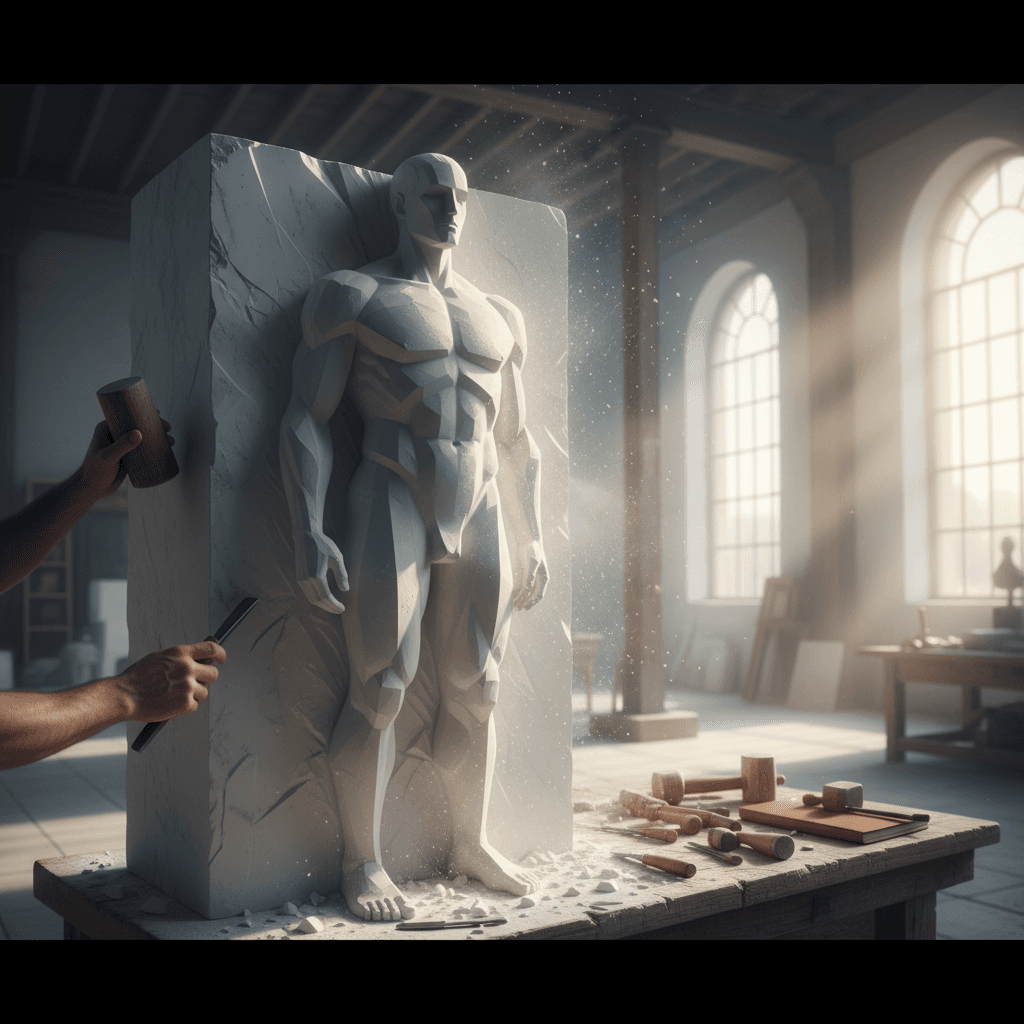
Chisel away the needless to reveal the bold figure of what you are meant to be. — Michelangelo
—What lingers after this line?
The Self as a Hidden Sculpture
Michelangelo’s line frames identity as something already present, waiting beneath excess. Instead of “building” a self from scratch, he suggests we uncover a truer form by removing what obscures it—habits, fears, and borrowed expectations. In that sense, the bold figure is not a fantasy but a latent reality, like a statue within marble. This metaphor echoes Michelangelo’s own artistic legend: he reportedly spoke of freeing a figure trapped in stone, an idea consistent with how Renaissance artists treated craft as both technical labor and spiritual revelation. From the outset, the quote shifts self-improvement away from piling on achievements and toward subtracting what doesn’t belong.
Subtraction as a Discipline, Not a Loss
From there, the quote redefines “needless” as anything that dilutes purpose, not merely what is unpleasant. Subtraction can look like refusing distractions, ending performative relationships, or abandoning goals that were adopted to impress others. Although this can feel like losing parts of oneself, Michelangelo implies it is actually a recovery of form. This is why the chisel matters: it represents deliberate, sometimes uncomfortable choice. A sculptor doesn’t remove marble once and call it done; similarly, becoming who you are meant to be involves repeated, conscious edits—less noise, fewer false obligations, and a clearer outline of what remains.
The Courage to Face Unfinished Stone
Yet removing the needless exposes roughness, and that exposure demands courage. When external padding falls away—constant busyness, social approval, defensive cynicism—what’s left can initially look incomplete. Michelangelo’s image reassures us that awkward in-between stages are not failure; they are the honest middle of transformation. This is also why the figure is described as “bold.” Boldness is not an add-on accessory but an emergent property of clarity: once the clutter is gone, decisions sharpen, values become visible, and the self stands out with stronger lines. The process may feel stark, but starkness can be the gateway to authenticity.
Crafting Character Through Daily Cuts
Next, the metaphor becomes practical: chiseling happens through small, repeatable actions rather than grand declarations. One person might chisel by limiting compulsive scrolling; another by practicing a difficult conversation instead of avoiding it. Over time, these tiny cuts accumulate into recognizable shape, much as patient toolmarks gradually reveal a face. Importantly, the quote implies active participation in one’s own making. Fate may provide the marble—background, temperament, circumstance—but agency guides the chisel. As Aristotle argues in the Nicomachean Ethics (4th century BC), character is built through habituated action; Michelangelo’s twist is that building often looks like removing what blocks virtuous habit.
Letting Go of Borrowed Identities
Furthermore, “needless” can include identities we wear because they once protected us. The perpetual achiever, the peacemaker, the cynic, the caretaker—each can be adaptive, yet become restrictive when it is no longer chosen freely. Chiseling away, then, may involve asking where a role ends and a person begins. A common modern anecdote fits: someone changes careers after realizing they pursued a prestigious path to satisfy family expectations, only to find their energy return when they align work with intrinsic interest. In Michelangelo’s terms, the prestigious identity was extra stone; removing it revealed a more truthful figure underneath.
Boldness as the Final Reveal
Finally, the quote lands on a hopeful promise: what remains after honest subtraction is not smaller, but stronger. The bold figure is the self that can bear weight—commitments made without resentment, goals pursued without self-betrayal, relationships entered without masks. By ending the pursuit of endless additions, you make room for a coherent life. In this closing movement, Michelangelo’s artistry becomes a philosophy of becoming: clarity precedes greatness. When you consistently remove what is needless—one cut, one choice, one boundary at a time—you don’t merely improve; you reveal the person you were meant to be.
One-minute reflection
What does this quote ask you to notice today?
Related Quotes
6 selectedYou will never be able to experience everything. So, please, do poetical justice to your soul and simply experience yourself. — Albert Camus
Albert Camus
Camus begins from a humbling truth: no person can live every possible life, see every landscape, or test every path. Because existence is finite, the dream of total experience becomes a source of restlessness rather than...
Read full interpretation →You cannot express something you have not first discovered. — Carl Jung
Carl Jung
At its core, Jung’s remark suggests that authentic expression begins not with performance but with discovery. A person cannot meaningfully speak, create, or reveal what has never been encountered within the self.
Read full interpretation →Sometimes losing everything is how you find yourself. — J.K. Rowling
J.K. Rowling
At first glance, J.K. Rowling’s line frames devastation not simply as an ending, but as a brutal kind of beginning.
Read full interpretation →Quietly, I am becoming the woman I was always meant to be. — Mitsuye Yamada
Mitsuye Yamada
Mitsuye Yamada’s line begins not with spectacle, but with stillness. The word “quietly” suggests that the deepest changes in a life often happen away from applause, in private acts of courage, reflection, and endurance.
Read full interpretation →Art and love are the same thing: it's the process of seeing yourself in things that are not you. — Chuck Klosterman
Chuck Klosterman
At first glance, Chuck Klosterman’s line collapses two vast experiences into one elegant idea: both art and love involve recognizing ourselves in something outside us. In this sense, a painting, a song, or another person...
Read full interpretation →You were born a child of light's wonderful secret—you return to the beauty you have always been. — Aberjhani
Aberjhani
At its heart, Aberjhani’s line begins with a reassuring claim about human identity: we are born not in spiritual emptiness, but as “a child of light’s wonderful secret.” In other words, the self is rooted in something ra...
Read full interpretation →More From Author
More from Michelangelo →If people knew how hard I had to work to gain my mastery, it would not seem so wonderful at all. — Michelangelo
At first glance, Michelangelo’s remark strips genius of its mystique. Rather than presenting mastery as a gift bestowed at birth, he insists that extraordinary achievement is rooted in sustained and often invisible effor...
Read full interpretation →I am still learning. — Michelangelo
Michelangelo’s brief statement, “I am still learning,” carries unusual force because it comes from a master whose achievements might have justified certainty. Instead, he presents knowledge as unfinished and the self as...
Read full interpretation →The true work of art is but a shadow of the divine perfection. — Michelangelo
Michelangelo’s statement immediately frames art as an act of humility rather than conquest. Instead of claiming that human creativity rivals ultimate truth, he suggests that even the finest painting or sculpture merely r...
Read full interpretation →Chisel away at your fears until only the sculpture of your purpose remains. — Michelangelo
Michelangelo’s metaphor invites us to imagine fear not as an enemy to be destroyed, but as surplus marble hiding who we really are. Just as a block of stone contains a statue within it, our lives often contain a clear pu...
Read full interpretation →