
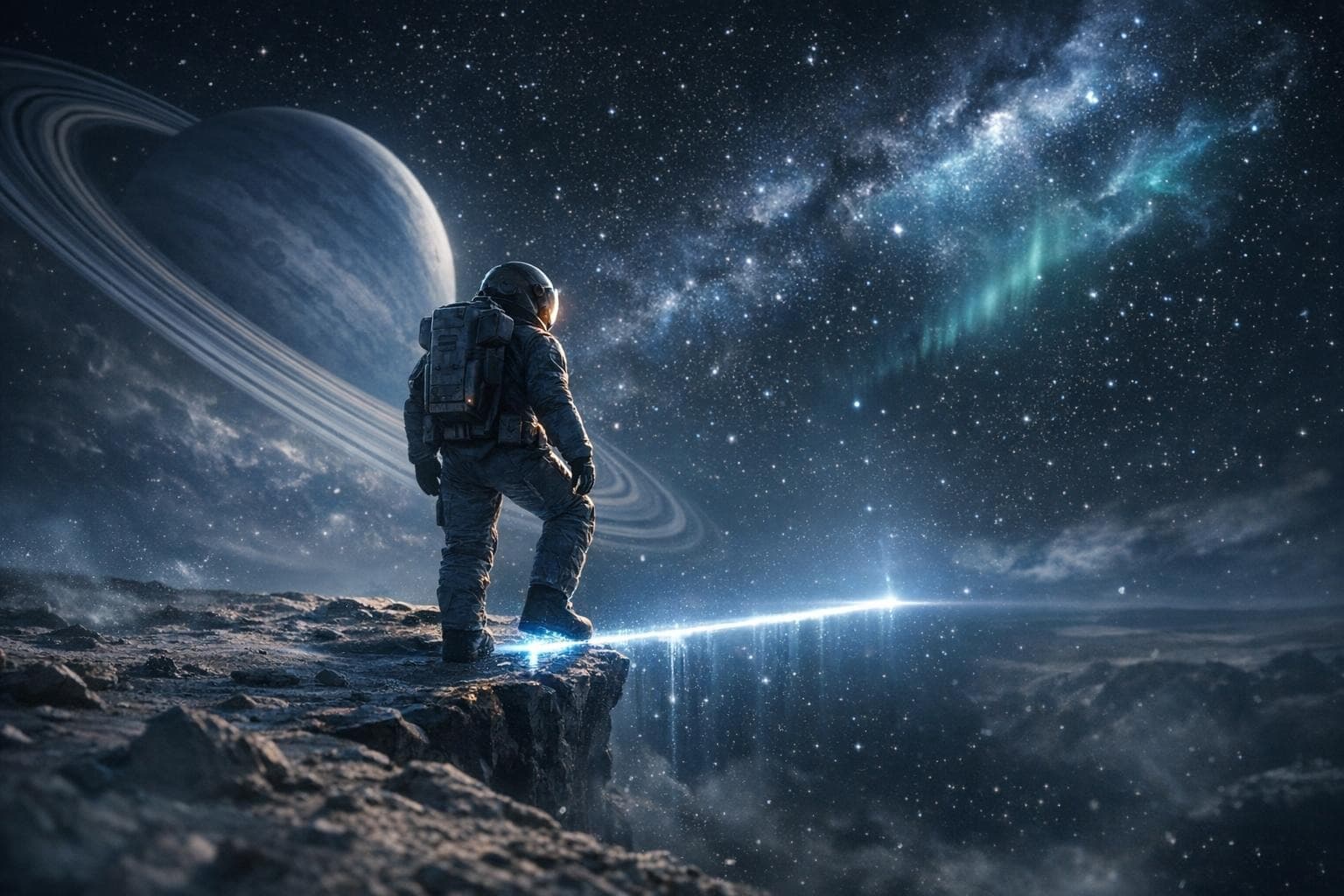
The only way of discovering the limits of the possible is to venture a little way past them into the impossible. - Arthur C. Clarke
—What lingers after this line?
A Provocation Disguised as Advice
Arthur C. Clarke’s line reads like a dare, but it is really a method: you cannot map the shoreline of what can be done while standing safely inland. The “limits of the possible” are not fixed signposts; they are provisional judgments built from current tools, knowledge, and courage. By insisting we step “a little way past” them, Clarke suggests that only experimentation—sometimes reckless-seeming in hindsight—reveals where the boundary actually lies. This opening claim also reframes failure. If testing the “impossible” is how we learn the true contours of the possible, then missteps are not embarrassing detours so much as measurements taken in the field. From that perspective, discovery becomes less about being certain and more about being willing.
Why the Impossible Often Isn’t
Moving from rhetoric to reality, Clarke is pointing at a common historical pattern: yesterday’s impossibility is frequently today’s routine. The label “impossible” often means “we don’t yet know how,” or “the cost is too high,” or “the risk feels unacceptable.” When someone pushes slightly beyond what is considered feasible, they sometimes find that the constraint was social or conceptual rather than physical. Consider powered flight. Before the Wright brothers’ 1903 flight at Kitty Hawk, many respected voices treated controlled human flight as fanciful. What changed wasn’t the laws of nature but the willingness to test designs, accept crashes, and iterate. The “impossible” shrank as practical knowledge expanded.
Science Fiction as a Laboratory of Possibility
Clarke’s perspective gains extra force because he worked in the borderland between imagination and engineering. In “Extra-Terrestrial Relays” (1945), he described geostationary communication satellites decades before they were deployed, treating an audacious idea as an engineering problem rather than a fantasy. That habit—turning the unbuilt into a set of constraints to explore—mirrors his quote’s core logic. In that sense, speculative thought is not escapism but rehearsal. By narrating futures that feel “impossible,” science fiction can weaken the mental taboo against them and encourage the first experiments that make them ordinary.
Risk, Calibration, and “A Little Way Past”
Still, Clarke’s wording is carefully calibrated: venture “a little way past” the boundary, not leap blindly into catastrophe. The insight here is that progress often comes from controlled overreach—prototypes, pilot programs, and limited trials that probe constraints without wagering everything. This is how aviation tests new airframes, how medicine runs phased clinical trials, and how software teams ship in increments. The phrase also hints at humility. You don’t know where the true limit is, so you approach it experimentally, with instruments, feedback, and a plan to retreat if necessary. The impossible becomes a testing ground rather than a permanent residence.
The Psychology of Pushing Boundaries
As the idea moves from laboratories to everyday life, it becomes clear that “impossible” is frequently an emotional verdict. People protect identity and status by avoiding attempts that might fail publicly, and groups enforce consensus by ridiculing outliers. Clarke’s quote challenges that social gravity: if you never risk being wrong, you never gather the evidence that revises what everyone believes. A small anecdote captures this. An early-career researcher might hesitate to propose an unconventional experiment, fearing it will be dismissed. Yet the attempt—documented carefully—can reveal a new method or a negative result that still teaches the field something real. Boundary-pushing begins as a psychological decision before it becomes a technical one.
A Practical Ethic for Innovation
Finally, Clarke’s statement offers an ethic: treat limits as hypotheses. If you want to know what can be done—personally, scientifically, or culturally—you design respectful tests of the “impossible” and learn from the outcome. This ethic doesn’t glorify recklessness; it dignifies curiosity and disciplined courage. When adopted widely, the approach compounds. One person’s small venture past the accepted boundary becomes another’s new baseline, and what was once unthinkable becomes teachable. In that way, discovering the limits of the possible is less a one-time revelation than a continuous practice of advancing, measuring, and revising.
One-minute reflection
Where does this idea show up in your life right now?
Related Quotes
6 selectedThe only way to discover the limits of the possible is to go beyond them into the impossible. — Arthur C. Clarke, United Kingdom.
Arthur C. Clarke, United Kingdom.
This quote implies that in order to truly understand what can be achieved, one must push past existing boundaries and venture into areas that seem unattainable.
Read full interpretation →Only those who will risk going too far can possibly find out how far one can go. — T.S. Eliot, United Kingdom.
T.S. Eliot, United Kingdom.
This quote highlights the importance of taking risks in order to discover one's true potential. It suggests that staying within comfort zones does not lead to growth or understanding of one's capabilities.
Read full interpretation →Channels of possibility are found only in the courage to explore. — J. Patrick Lewis
J. Patrick Lewis
This quote emphasizes that new opportunities and possibilities can only be uncovered by those who are willing to take risks and venture into the unknown.
Read full interpretation →You can be cautious or you can be creative, but there's no such thing as a cautious creative. — George Lois
George Lois
George Lois draws a sharp line between two mindsets: caution protects what already exists, while creativity risks making something new. At first glance, the statement sounds absolute, yet that severity is exactly its poi...
Read full interpretation →If you are not willing to look stupid, nothing great is ever going to happen to you. — Julia Cameron
Julia Cameron
Julia Cameron’s remark begins with a hard truth: many people do not fail because they lack talent, but because they fear embarrassment. In that sense, ‘looking stupid’ becomes shorthand for being seen trying, stumbling,...
Read full interpretation →Art is the act of navigating without a map. — Seth Godin
Seth Godin
At its core, Seth Godin’s line defines art not as technical polish but as a willingness to move forward without guaranteed direction. To create without a map is to accept uncertainty as part of the process, trusting intu...
Read full interpretation →More From Author
More from Arthur C. Clarke →Any sufficiently advanced technology is indistinguishable from magic. - Arthur C. Clarke
Arthur C. Clarke’s line points less to technology’s objective power than to our subjective limits: when we don’t understand how something works, we experience it as wonder.
Read full interpretation →The journey is the destination. — Arthur C. Clarke
This quote emphasizes that the experiences, growth, and lessons gained along the way are more valuable than the final result. The journey itself is what truly matters.
Read full interpretation →