
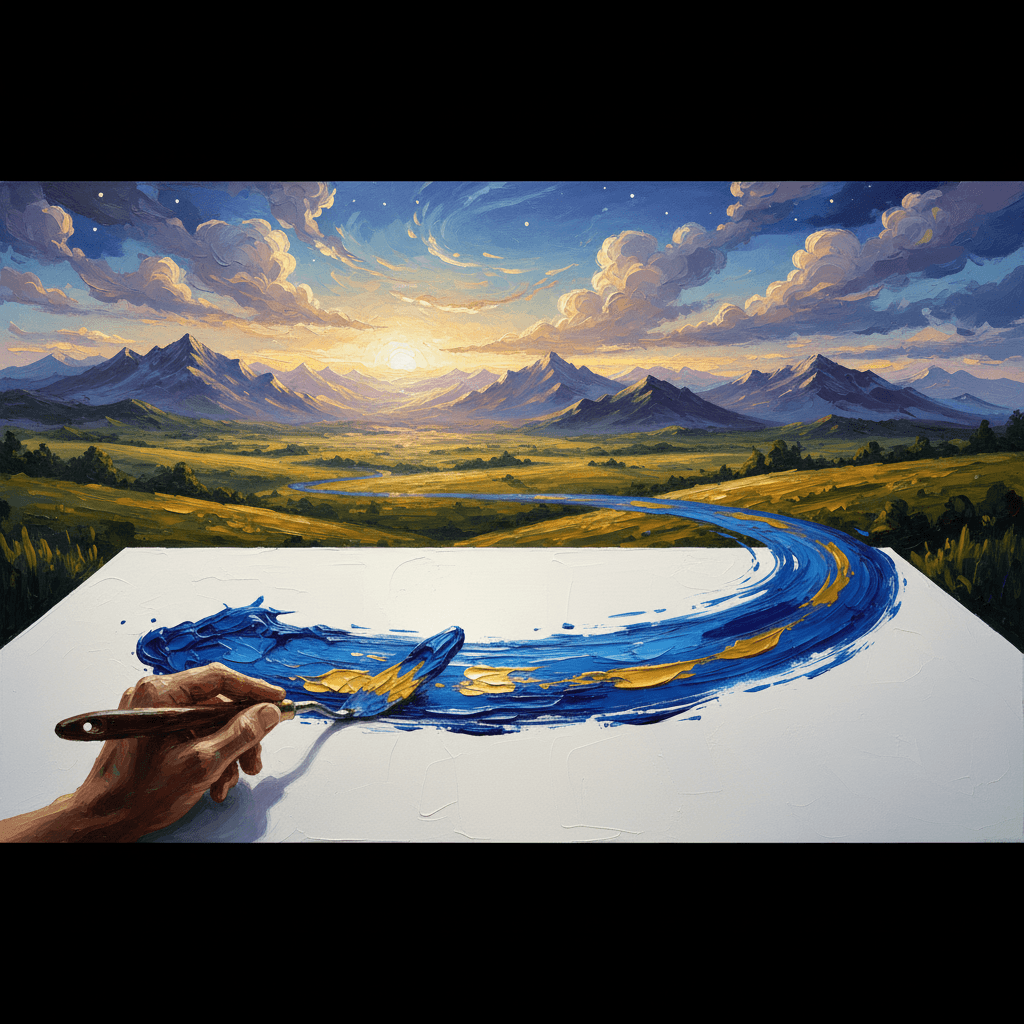
Work with wild curiosity; a single brushstroke can begin a new horizon. — Vincent van Gogh
—What lingers after this line?
Curiosity as a Creative Fuel
Van Gogh’s line opens by treating curiosity not as a casual interest, but as a way of moving through the world—“wild” enough to break routine perception. Rather than waiting for certainty, the artist begins by wondering, probing, and risking the unfamiliar. In this sense, curiosity becomes the engine that drives creation, because it continually asks what else might be possible. From there, the quote hints that the most important artistic resource is not mastery alone but an active, almost restless attention. When curiosity stays alive, even ordinary subjects can become newly charged, inviting the maker to test fresh colors, angles, and meanings.
The Power of Beginning Small
After establishing curiosity as the mindset, van Gogh turns to the smallest actionable unit: a single brushstroke. This is a quiet argument against perfectionism—progress starts with an imperfect mark rather than a flawless plan. One stroke is manageable, immediate, and concrete; it is also irreversible enough to commit the artist to the next decision. In practice, many creators recognize this threshold moment: a blank canvas or empty page feels immense until the first mark breaks the spell. Once something exists, however minor, the work becomes a dialogue rather than a void.
A Brushstroke as a Horizon-Maker
The image of a brushstroke “beginning a new horizon” shifts the quote from technique to transformation. A horizon implies distance and direction—something to move toward—so the first mark doesn’t just start a picture; it starts a journey. With each stroke, the artist discovers what the work wants to become, often in ways that could not be predicted beforehand. This idea aligns with the broader logic of experimentation: outcomes emerge through doing. What begins as a tentative line can reorganize the entire composition, just as a single decision in life can reveal new paths that were previously invisible.
Learning Through Motion, Not Certainty
Building on that sense of journey, van Gogh’s phrase implies that insight arrives mid-process. Curiosity acts like a compass, but the terrain is learned by walking it—by painting, revising, and responding. The horizon changes as the maker changes, so the goal is less about executing a pre-known image and more about discovering one. This approach resembles iterative practice found across disciplines: drafts, prototypes, and studies are not detours but the method itself. In other words, the brushstroke is both expression and investigation.
Courage to Risk the Unfinished
Because a brushstroke can redirect everything, the quote also carries a quiet demand for courage. To start is to accept the possibility of failure, awkwardness, or mess—yet van Gogh frames that risk as the gateway to a “new horizon.” The willingness to make a mark without guarantees is what allows the work to expand beyond what is already known. Consequently, the quote reads as encouragement for anyone stalled by self-judgment: bold curiosity does not eliminate uncertainty; it uses uncertainty as a creative material. The horizon appears not before the stroke, but because of it.
Applying the Idea Beyond Painting
Finally, van Gogh’s insight translates easily into everyday making: a paragraph, a conversation, a sketch, a first attempt at a skill. The “single brushstroke” becomes a metaphor for any small start that creates momentum and reveals options. Once action replaces rumination, the world offers feedback—new questions, new constraints, and new openings. Seen this way, the quote is less romantic than practical: cultivate curiosity, then begin in the smallest possible way. The horizon of possibility is not something you wait to see; it’s something you help bring into view.
One-minute reflection
What does this quote ask you to notice today?
Related Quotes
6 selectedEvery creation begins with a single thought; let your imagination be the spark that ignites a world of possibilities. — Unknown, Global.
Unknown, Global.
This quote highlights the concept that all creations, whether artistic, technological, or literary, stem from a single initial thought. It emphasizes the importance of that first idea as the seed from which everything el...
Read full interpretation →Don't be intimidated by what you don't know. That can be your greatest strength. — Sara Blakely
Sara Blakely
At first glance, Sara Blakely’s quote sounds like a simple encouragement, yet it points to a deeper truth: ignorance is not always a weakness. When people are not trapped by assumptions about how things are “supposed” to...
Read full interpretation →Be a loner. That gives you time to wonder, to search for the truth. Have holy curiosity. Make your life worth living. — Albert Einstein
Albert Einstein
At first glance, Einstein’s advice to “be a loner” may sound like a rejection of society, yet his deeper point is about protecting the inner space where thought can mature. Solitude gives a person room to hear their own...
Read full interpretation →Sometimes, you have to find new angles on life to keep you interested. — John Travolta
John Travolta
John Travolta’s remark begins with a simple but revealing truth: interest in life is not always automatic; sometimes it must be actively rekindled. By suggesting that we ‘find new angles,’ he implies that boredom often c...
Read full interpretation →Perhaps the secret of living well is not in having all the answers but in pursuing unanswerable questions in good company. — Rachel Naomi Remen
Rachel Naomi Remen
Rachel Naomi Remen shifts the idea of a good life away from mastery and certainty. Instead of treating wisdom as the possession of final answers, she suggests that living well may depend on how we travel through mystery.
Read full interpretation →The most important thing is insight, that is... curiosity to wonder, to mull, and to muse why it is that man does what he does. — William Faulkner
William Faulkner
Faulkner places insight above mere information, and in doing so he defines it not as quick understanding but as sustained curiosity. To wonder, to mull, and to muse are slower, deeper acts than simply noticing facts; the...
Read full interpretation →More From Author
More from Vincent van Gogh →Learning technique is a way to make your soul grow. So do it. — Vincent van Gogh
Van Gogh’s brief statement turns learning into more than a practical task; it becomes an ethical and spiritual imperative. By saying that learning technique helps the soul grow, he suggests that disciplined study does no...
Read full interpretation →A great fire burns within me, but no one stops to warm themselves at it, and passers-by only see a wisp of smoke. — Vincent van Gogh
Van Gogh’s image begins with a painful contrast: immense inner warmth exists, yet it goes unreceived. The “great fire” suggests passion, generosity, and creative force, while the absence of anyone who “stops to warm them...
Read full interpretation →I cannot rest, I must draw, however poor the result, and when I have a bad time come over me it is a stronger desire than ever. — Vincent van Gogh
Van Gogh’s words present drawing not as a hobby or even a disciplined profession, but as an inner command he cannot silence. The phrase “I must draw” carries the force of survival, suggesting that artistic creation answe...
Read full interpretation →As we advance in life it becomes more and more difficult, but in fighting the difficulties the inmost strength of the heart is developed. — Vincent van Gogh
Van Gogh’s sentence begins with a sober observation: life does not necessarily become simpler as we grow older. Instead, responsibilities deepen, losses accumulate, and choices carry heavier consequences.
Read full interpretation →