
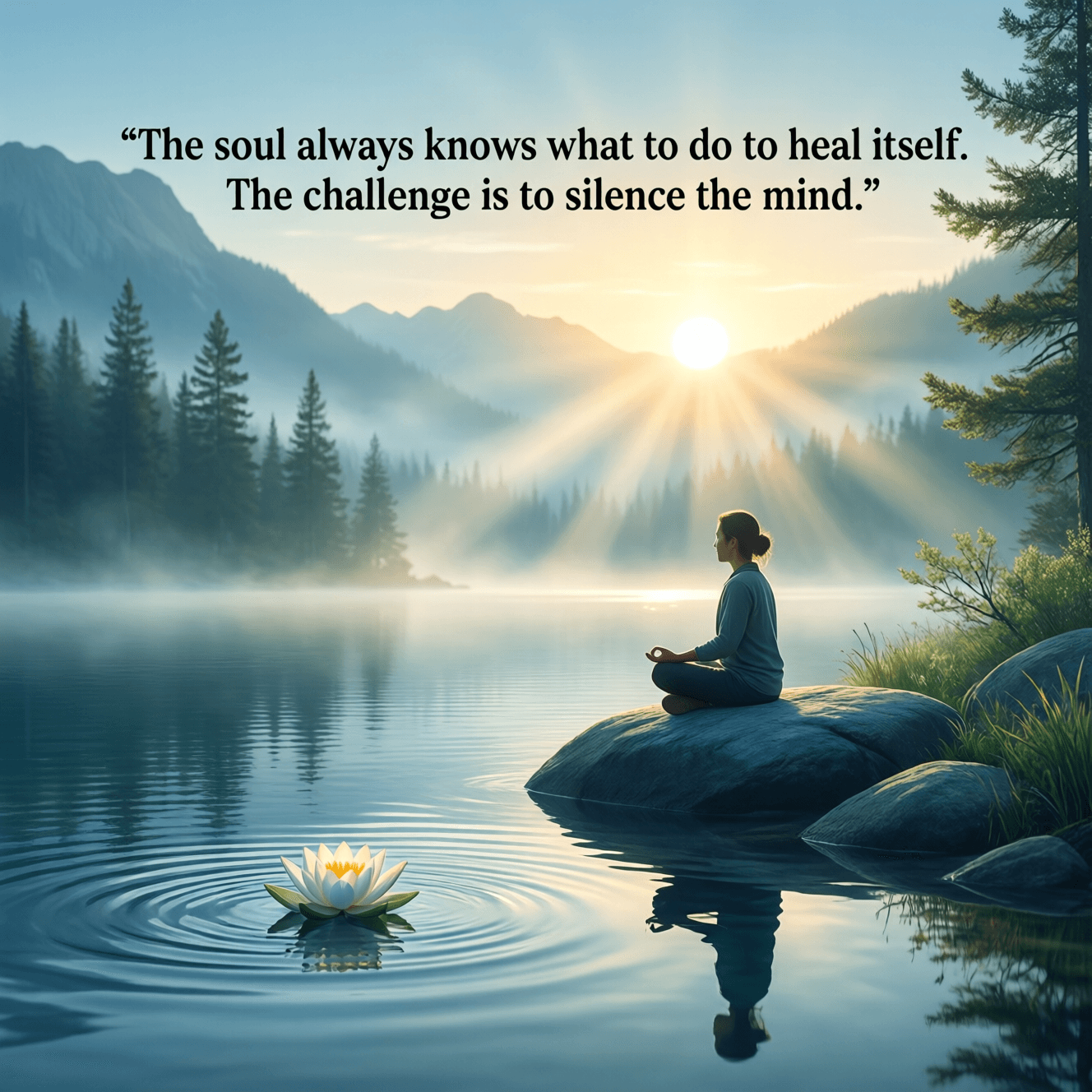
The soul always knows what to do to heal itself. The challenge is to silence the mind. — Caroline Myss
—What lingers after this line?
The Inner Intelligence of Healing
Caroline Myss’s line rests on a provocative premise: beneath our plans and narratives, something deeper already knows the way back to wholeness. By calling it “the soul,” she points to an inner intelligence that can register what we need—rest, truth, forgiveness, change—before we can justify it logically. From this view, healing is less a puzzle to solve and more a process to allow. The body’s reflex to mend a cut, or our sudden clarity after sleep, becomes a metaphor for a broader self-repair system: when the conditions are right, restoration emerges naturally.
Why the Mind Becomes the Challenge
Yet Myss immediately names the obstacle: the mind’s noise. Thoughts can be useful, but they also spiral into worry, rumination, and the relentless search for certainty, especially when we feel vulnerable. In that state, the mind tries to manage pain by controlling outcomes, which can drown out subtler signals. This is where the quote turns practical. If healing requires listening inwardly, then constant mental commentary—replaying conversations, forecasting worst cases, comparing ourselves to others—functions like static on a radio, making the soul’s guidance harder to hear.
Silence as a Skill, Not an Escape
Silencing the mind doesn’t have to mean suppressing thought or avoiding reality; it can mean changing our relationship to thought. Practices like mindfulness meditation emphasize noticing thoughts without automatically following them, an approach popularized in modern clinical settings through Mindfulness-Based Stress Reduction (Jon Kabat-Zinn, 1979). Over time, this creates space between sensation and interpretation. Instead of “I feel tightness, so something is terribly wrong,” we might arrive at “I feel tightness; I’m anxious; I can breathe and be kind to myself.” In that gap, the body and deeper self often communicate more clearly.
How the Soul “Speaks” in Everyday Life
Once the mental volume lowers, guidance often appears in ordinary forms: a persistent feeling of fatigue that signals burnout, a recurring sense of dread about a situation that violates our values, or an unexpected calm when we choose the harder but truer path. These cues are rarely loud or dramatic; they are more like gentle repetition. People commonly recognize this in hindsight through small anecdotes: someone keeps feeling relieved when imagining leaving a job, despite fear about money, or they notice their body relax whenever they set a boundary with a family member. The “knowing” is not always comfortable, but it tends to be clarifying.
Emotion as Information, Not a Verdict
Another bridge between soul and mind is emotion. When the mind labels feelings as problems to eliminate, it can intensify them; when feelings are treated as information, they can guide healing. Grief may point to love and loss that need acknowledgment, anger may signal a crossed boundary, and anxiety may indicate uncertainty that requires support rather than self-criticism. Psychological approaches like Acceptance and Commitment Therapy (Steven C. Hayes, 1980s) similarly encourage making room for internal experiences while choosing actions aligned with values. In this way, emotional honesty becomes a channel through which deeper wisdom can direct next steps.
Creating Conditions for Self-Healing
Finally, Myss’s insight implies that healing is facilitated by conditions we can cultivate: quiet, rest, truthful reflection, and compassionate routines. Journaling, time in nature, prayer, breathwork, or simply sitting without input for ten minutes can be less about “fixing” and more about letting the inner system recalibrate. The mind still has a role—planning appointments, seeking help, making changes—but it works best as a servant rather than the driver. When the mind settles enough to listen, the soul’s orientation toward wholeness can become not a mystical idea, but a lived experience of steadier, wiser choices.
One-minute reflection
Why might this line matter today, not tomorrow?
Related Quotes
6 selectedThe soul always knows what to do to heal itself. — Caroline Myss
Caroline Myss
The quote highlights the idea that every person possesses an inner wisdom capable of guiding their own healing process.
Read full interpretation →Quiet the mind, and the soul will speak. — Ma Jaya Sati Bhagavati
Ma Jaya Sati Bhagavati
Ma Jaya Sati Bhagavati’s line reads like a gentle command: reduce the noise of thought, and something truer can finally be heard. The quote assumes that the mind—busy, analytic, reactive—often talks over the subtler sign...
Read full interpretation →The teacher who is indeed wise does not bid you to enter the house of his wisdom but rather leads you to the threshold of your mind. — Khalil Gibran
Khalil Gibran
Gibran’s line begins by redefining what a truly wise teacher does. Rather than inviting students to dwell inside the teacher’s own conclusions, such a guide escorts them to the edge of their own understanding.
Read full interpretation →As soon as you trust yourself, you will know how to live. — Johann Wolfgang von Goethe
Johann Wolfgang von Goethe
Goethe’s line suggests that the real beginning of a meaningful life is not an external event but an internal turning point: the moment you trust yourself. Until then, choices often feel borrowed—from parents, peers, or c...
Read full interpretation →In the center of your being, you have the answer; you know who you are and you know what you want. - Laozi
Lao Tzu
This quote emphasizes the importance of looking inward for answers. It suggests that self-awareness and introspection are key to understanding one's true identity and desires.
Read full interpretation →Trust yourself. You know more than you think you do. — Benjamin Spock
Benjamin Spock
This quote encourages individuals to have confidence in their own abilities and knowledge. It suggests that people often underestimate what they are capable of understanding and achieving.
Read full interpretation →More From Author
More from Caroline Myss →What drains your spirit drains your body. What fuels your spirit fuels your body. — Caroline Myss
Caroline Myss frames the human being as an inseparable whole, where inner life and physical life constantly influence one another. At first glance, the quote sounds simple, yet it carries a profound claim: emotional exha...
Read full interpretation →When you do not seek or need approval, you are at your most powerful. — Caroline Myss
Caroline Myss’s statement points to a simple but radical shift: real power begins when a person no longer organizes life around being liked, praised, or validated. In that moment, the center of gravity moves inward.
Read full interpretation →We are meant to outgrow ourselves; we can no more avoid this development than we can stop the aging process. The question is how gracefully we handle the transition. — Caroline Myss
Caroline Myss frames personal development as something woven into the fabric of being alive: we are “meant” to outgrow our current selves. By pairing inner growth with the unarguable reality of aging, she removes the ill...
Read full interpretation →What we need to do is look at how we can bring about change in our own lives. — Caroline Myss
This quote emphasizes the importance of taking responsibility for our own growth. Change begins within us, rather than relying on external circumstances or other people.
Read full interpretation →