
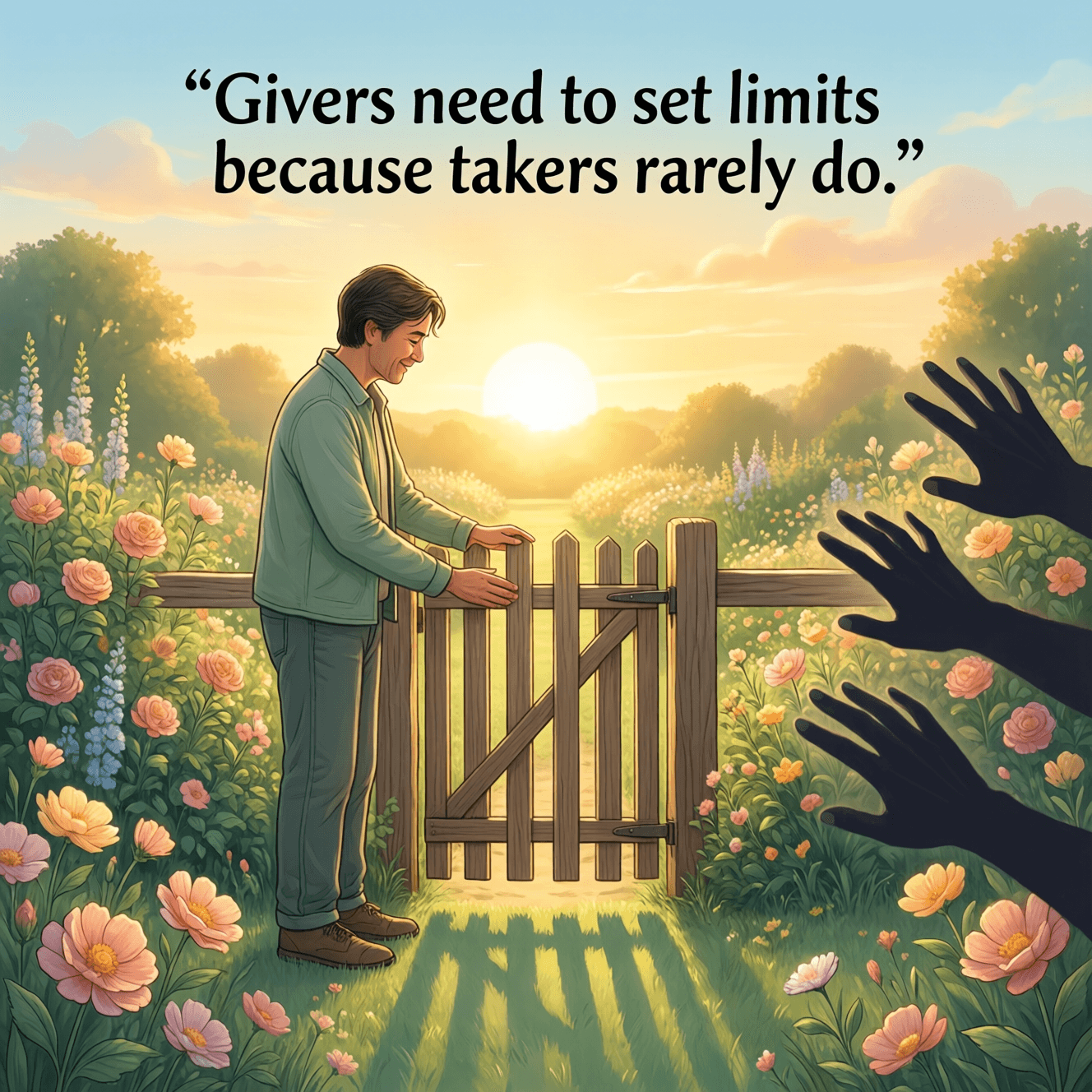
Givers need to set limits because takers rarely do. — Rachel Wolchin
—What lingers after this line?
A Simple Warning About Imbalance
Rachel Wolchin’s line distills a recurring social imbalance: people who naturally give—time, care, attention, money—often assume others will self-regulate their demands. However, “takers” operate differently, pursuing what they can get rather than what is fair, which means the relationship’s equilibrium doesn’t correct itself. As a result, the giver’s generosity can quietly become the very mechanism that enables overreach. From there, the quote shifts responsibility to the person most likely to be depleted: the giver. It’s not an accusation against giving; it’s an argument that generosity without limits invites a one-sided dynamic that grows more entrenched over time.
Why Takers Rarely Self-Regulate
The phrase “takers rarely do” points to a practical reality: if someone benefits from a pattern, they have little incentive to change it. Even when takers aren’t malicious, they may normalize the giver’s availability—interpreting kindness as capacity, silence as consent, and past help as a standing offer. Because the costs are carried elsewhere, the taker’s internal “stop” signal stays quiet. Consequently, the giver can end up functioning like an informal safety net. What begins as occasional help becomes an expectation, and expectations harden into entitlement unless something interrupts the pattern.
The Hidden Costs of Being the Constant Helper
If the giver doesn’t set limits, the costs accumulate in ways that are easy to dismiss day-to-day: missed rest, delayed personal goals, resentment, or a constant low-level stress that comes from being “on call.” Over time, this can erode the giver’s sense of agency, because their schedule and emotional bandwidth are increasingly organized around other people’s needs. At that point, generosity stops feeling voluntary and starts feeling compulsory. The quote’s urgency comes from recognizing that depletion isn’t just unpleasant—it can change how a giver relates to others, turning warmth into avoidance or bitterness.
Boundaries as Clarity, Not Cruelty
Wolchin’s emphasis on limits reframes boundaries as a form of honesty. A clear “I can’t do that” or “I can help this much” gives the relationship structure—something the taker is unlikely to provide. Importantly, boundaries don’t negate care; they define the terms under which care is sustainable, preventing generosity from becoming self-erasure. This is why limits often improve relationships rather than harm them. They replace guesswork with clarity, and they make room for reciprocity—either from the same person or by freeing the giver to invest in more balanced connections.
How Patterns Become Self-Reinforcing
Once a giver repeatedly says yes, a pattern forms that both parties begin to treat as “normal.” The taker asks more readily because it has worked before, while the giver complies more automatically to avoid guilt, conflict, or disappointing someone. In this way, past generosity becomes a precedent, and precedent becomes pressure. Breaking the cycle can feel abrupt, but it’s often the first truly accurate communication in the relationship. Limits reveal whether the bond is based on mutual respect or on access to the giver’s resources.
Sustainable Giving and Mutual Respect
Ultimately, the quote argues for a version of giving that can last. Limits protect the giver’s health and dignity while also testing the relational environment: respectful people adapt; chronic takers protest. In that sense, boundaries are not merely defensive—they’re diagnostic, clarifying who values the giver as a person rather than as a utility. When givers set limits, they don’t stop being generous; they become intentional. And with intention, giving can return to what it’s meant to be: a choice rooted in compassion, not an obligation maintained by someone else’s refusal to stop.
One-minute reflection
Where does this idea show up in your life right now?
Related Quotes
6 selectedGivers have to set limits because takers rarely do. — Irma Kurtz
Irma Kurtz
Irma Kurtz’s line hinges on an imbalance: people inclined to give often default to accommodating others, while people inclined to take may default to asking for more. In practice, that means the “natural stopping point”...
Read full interpretation →No is a complete sentence. — Shonda Rhimes
Shonda Rhimes
At its core, Shonda Rhimes’s line insists that refusal does not require decoration. “No” stands on its own because personal boundaries are valid even when they disappoint others.
Read full interpretation →You don't have to be a billionaire to believe you can make a difference. Give your time, give your love, or simply give a smile. — Steve Goodier
Steve Goodier
At its core, Steve Goodier’s quote challenges the idea that influence belongs only to the wealthy or powerful. By placing time, love, and even a smile alongside money, he broadens generosity into something almost anyone...
Read full interpretation →Takers must have no limits, because givers never do. — Iyanla Vanzant
Iyanla Vanzant
At first glance, Iyanla Vanzant’s line sounds almost humorous, yet its irony cuts deeply. If givers continue offering time, energy, money, or emotional labor without pause, then takers are effectively trained to expect a...
Read full interpretation →In the ordinary life, we hardly realize that we receive a great deal more than we give, and that it is only with gratitude that life becomes rich. — Dietrich Bonhoeffer
Dietrich Bonhoeffer
Bonhoeffer begins with a quiet but unsettling observation: most of us move through ordinary life without noticing how much we constantly receive. From language and education to food, care, and companionship, our days are...
Read full interpretation →The love we give away is the only love we keep. — Elbert Hubbard
Elbert Hubbard
At first glance, Elbert Hubbard’s line seems to contradict common sense: how can love that is given away be the only love we keep? Yet the paradox is precisely the point.
Read full interpretation →More From Author
More from Rachel Wolchin →