
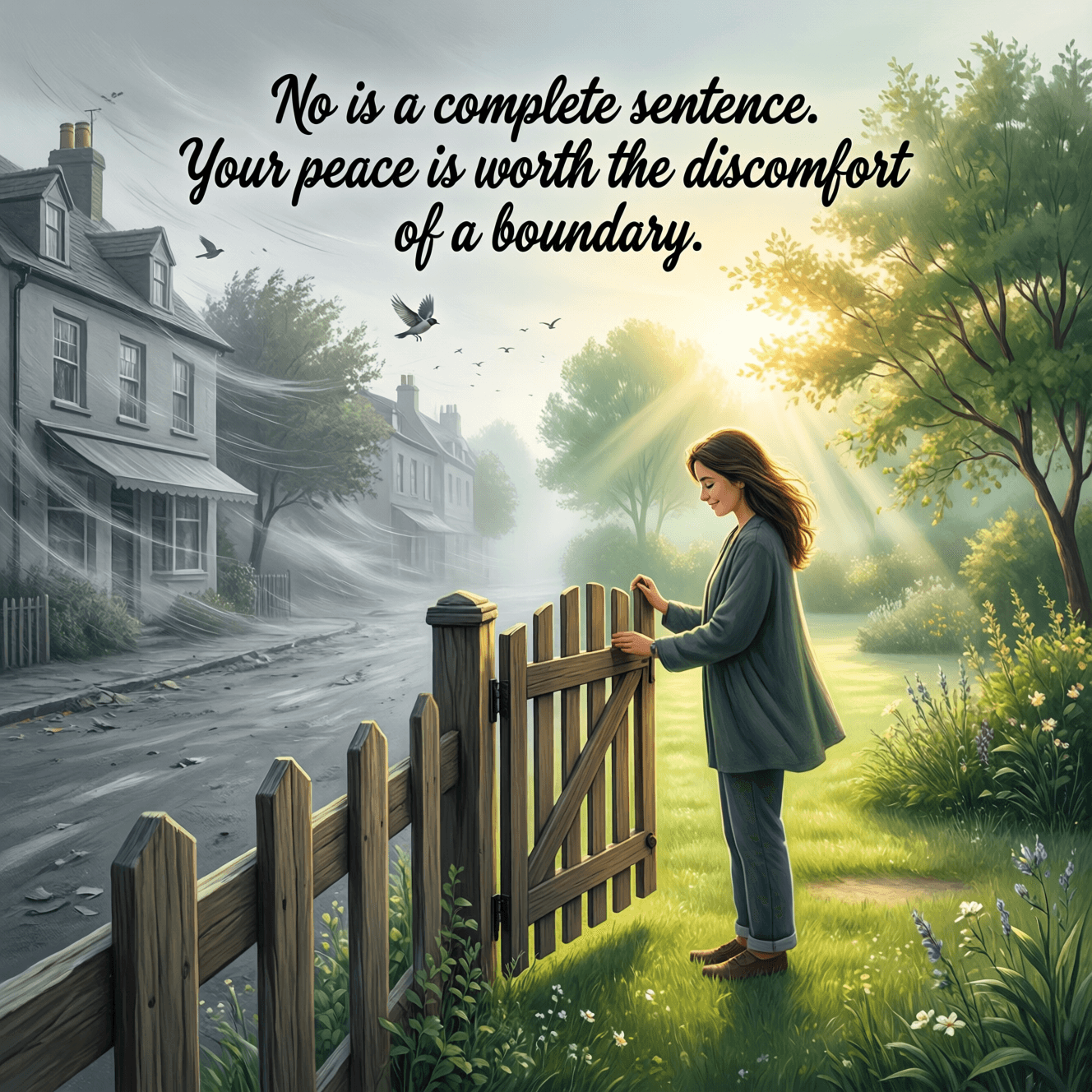
No is a complete sentence. Your peace is worth the discomfort of a boundary. — Unknown
—What lingers after this line?
Why “No” Stands on Its Own
The line “No is a complete sentence” insists that refusal doesn’t require decoration—no explanations, no negotiations, no apology. In everyday life, many people are trained to soften their limits with qualifiers (“I’m sorry, but…”) as if consent must be earned through persuasive storytelling. Yet a plain “no” treats personal agency as self-evident. From there, the quote quietly reframes communication: clarity is not cruelty. A direct boundary can feel abrupt, but it prevents the confusion that often follows when we dilute our real answer to protect someone else’s feelings.
Peace as a Legitimate Priority
Moving beyond the grammar of “no,” the quote anchors the message in a deeper goal: peace. Peace here isn’t laziness or avoidance; it’s the internal steadiness that comes from living in alignment with one’s limits. When peace is treated as valuable, boundaries stop looking like walls and start looking like maintenance—like locking your door at night. This perspective challenges the assumption that being “good” means being endlessly available. Instead, it suggests that emotional well-being is a legitimate priority, not a prize you earn after everyone else is satisfied.
The Discomfort Boundary-Setting Creates
The second sentence acknowledges a hard truth: boundaries often create discomfort. That discomfort may be yours—guilt, anxiety, fear of being misunderstood—or it may be someone else’s, especially if they benefited from your lack of limits. In either case, the quote normalizes the tension as a cost of change rather than a sign you did something wrong. Consequently, it invites a practical mindset: if the choice is between temporary discomfort and long-term resentment, choosing the boundary can be the more compassionate option for everyone involved.
Guilt, People-Pleasing, and Learned Permission
Underneath the need to justify “no” often sits people-pleasing: the belief that harmony is maintained by self-erasure. Many learn early that saying yes keeps relationships calm, while refusal triggers conflict, withdrawal, or criticism. Over time, “permission” becomes the default—waiting for others to approve of your limits before you act on them. Seen this way, the quote functions like a corrective. It suggests that guilt is not always a moral compass; sometimes it’s just a symptom of breaking an old pattern. The boundary may feel unfamiliar precisely because it’s healthier.
Boundaries as Care, Not Punishment
Next, the quote helps separate boundaries from ultimatums. A boundary is about what you will do to protect your well-being, not about controlling someone else. “I’m not available for that conversation when I’m being insulted” is fundamentally different from “You’re not allowed to be angry.” The first clarifies a condition for connection; the second polices emotion. With that distinction, boundaries become a form of care: they define how closeness can remain safe and respectful. In that sense, the discomfort is not a weapon—it’s the friction of adjusting to honesty.
Living the Quote in Real Situations
Finally, the quote is most powerful when applied in small, concrete moments: declining an extra shift, refusing a last-minute favor, ending a draining phone call, or saying, “No, I can’t discuss this right now.” These are ordinary scenes where many people over-explain, hoping to be found “reasonable.” Over time, practicing concise refusals teaches others what to expect and teaches you what you can survive—namely, the awkward pause, the disappointed reaction, the urge to backpedal. The message closes with a simple calculus: your peace is worth that moment of discomfort, because it prevents a much deeper unrest later.
Recommended Reading
As an Amazon Associate, we earn from qualifying purchases.
One-minute reflection
Where does this idea show up in your life right now?
Related Quotes
6 selectedSetting boundaries isn't about being mean; it's about being clear. If someone is offended by your 'no,' they were definitely planning on exploiting your 'yes.' — Unknown
Unknown
The quote begins by challenging a common fear: that saying “no” automatically makes a person unkind. Instead, it reframes boundaries as clarity—an act of truthful communication about what you can and cannot offer.
Read full interpretation →Mastery is not about what you add to your day, but what you have the courage to remove. A 'not-to-do' list is as vital as your ambitions. — Unknown
Unknown
The quote reframes mastery as an act of selection rather than accumulation. Instead of measuring progress by how much you pack into a day, it argues that excellence comes from choosing what deserves your limited attentio...
Read full interpretation →No is a complete sentence. It does not require a preamble or an apology. — Anne Lamott
Anne Lamott
Anne Lamott’s line condenses a powerful truth into everyday language: “No” stands on its own. At its core, the quote rejects the idea that refusal must be softened, justified, or wrapped in politeness to be valid.
Read full interpretation →Your 'yes' has no value until you learn to say 'no'. — Paulo Coelho
Paulo Coelho
Paulo Coelho’s line hinges on a simple contrast: a “yes” only carries weight when an alternative is genuinely available. If you can’t—or won’t—say “no,” agreement becomes automatic rather than chosen, and it starts to re...
Read full interpretation →Your boundary is not for them; it is for you. It is a statement of what you will and will not tolerate. — Nedra Glover Tawwab
Nedra Glover Tawwab
Nedra Glover Tawwab’s quote shifts the definition of a boundary away from controlling others and toward clarifying the self. Instead of functioning like a rulebook for someone else’s behavior, a boundary is presented as...
Read full interpretation →If someone is upset by your boundaries, it's a sign that they benefited from you not having any. — Nedra Glover Tawwab
Nedra Glover Tawwab
Nedra Glover Tawwab’s line points to a common turning point in relationships: the moment you begin naming what you will and won’t accept, the atmosphere shifts. Boundaries—whether about time, emotional labor, money, or a...
Read full interpretation →More From Author
More from Unknown →The language is the substrate. The architecture is the contract.
The line sets up a deliberate pairing: language lies beneath everything, while architecture governs everything above it. In other words, what you can express determines what you can build, and what you commit to structur...
Read full interpretation →A scroll is not a break; it is a trap disguised as rest. — Unknown
The quote begins by challenging a familiar story we tell ourselves: that a brief scroll is a harmless pause between tasks. On the surface, it looks like recovery—no effort, no decision, no commitment.
Read full interpretation →Don't let your ice cream melt while you're counting someone else's sprinkles. — Unknown
The quote uses ice cream as a simple stand-in for life’s fleeting pleasures: what you have is delicious, but it won’t last forever if you ignore it. Meanwhile, “counting someone else’s sprinkles” captures the habit of mo...
Read full interpretation →If your absence doesn't affect them, your presence never mattered. — Unknown
The quote frames absence as a revealing experiment: remove yourself, and the reaction—concern, curiosity, indifference—becomes a kind of data. If nothing changes when you’re gone, it suggests your role was never integrat...
Read full interpretation →