
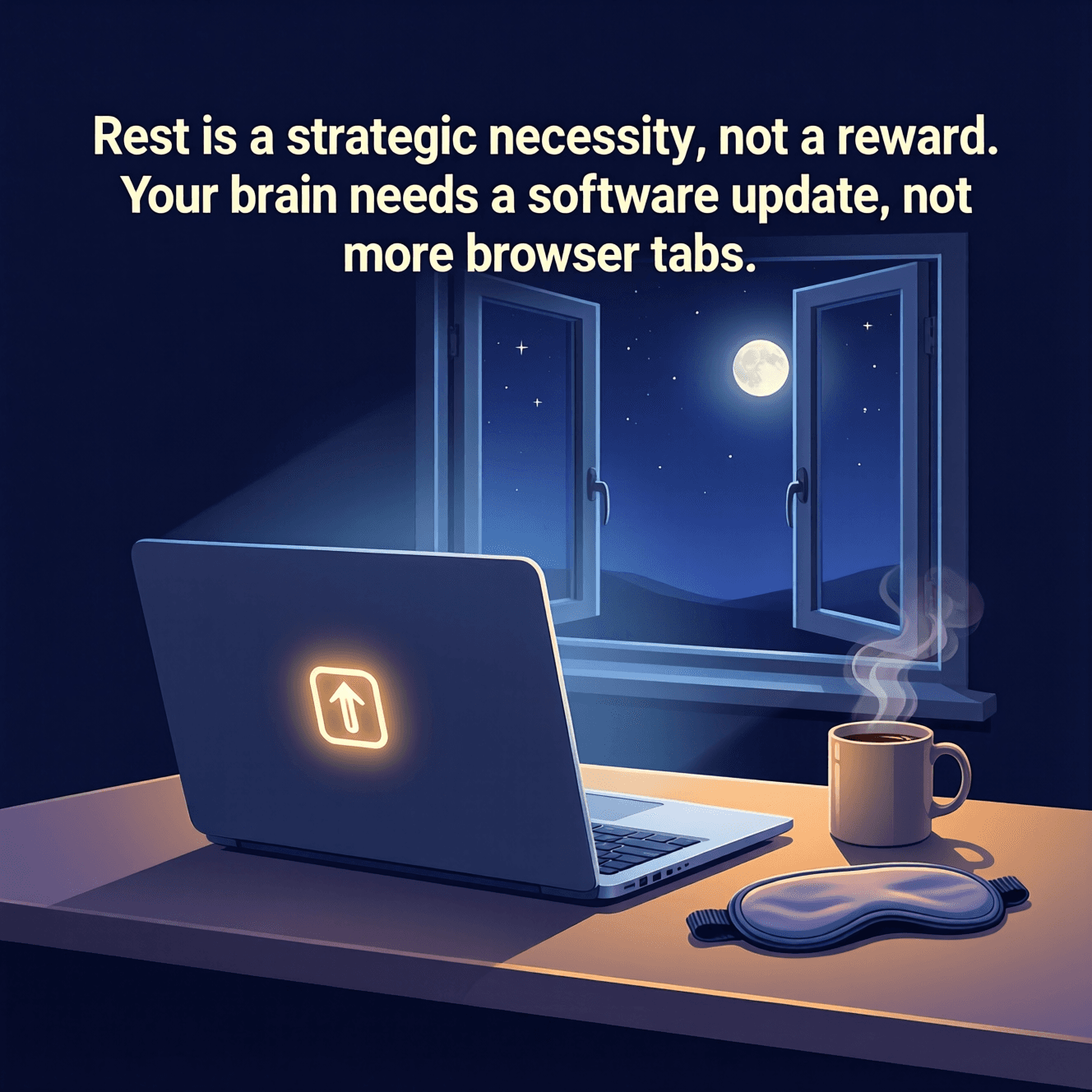
Rest is a strategic necessity, not a reward. Your brain needs a software update, not more browser tabs. — Unknown
—What lingers after this line?
Reframing Rest as Essential Work
The quote challenges a common habit: treating rest as something you “earn” only after you’ve proved your worth through nonstop output. Instead, it frames rest as a strategic necessity—closer to maintenance than indulgence—because the ability to think, decide, and create depends on recovery. From there, the message implies that exhaustion isn’t a badge of commitment but a predictable constraint on performance. Much like athletes schedule recovery to avoid injury, knowledge workers need deliberate downtime to avoid cognitive wear that quietly undermines accuracy, judgment, and emotional balance.
The Brain’s “Software Update” Metaphor
Building on that reframing, the metaphor of a “software update” suggests that rest doesn’t merely pause activity; it actively restores and reorganizes mental resources. Sleep and true breaks help consolidate learning and integrate experiences, which is why problems that feel impossible at night can look solvable in the morning. This idea aligns with how modern neuroscience describes sleep’s role in memory consolidation and emotional processing, and it echoes earlier intuitions about incubation in creativity—where stepping away allows the mind to reorganize ideas below the surface rather than forcing immediate results through sheer effort.
Why More “Browser Tabs” Backfires
The second sentence shifts from recovery to overload, warning that piling on more inputs—more tasks, notifications, and open loops—doesn’t fix the underlying issue. Extra “tabs” simulate productivity, but they often fragment attention and increase cognitive switching costs, leaving you feeling busy while becoming less effective. Consequently, what feels like catching up can actually be a form of avoidance: adding information instead of making decisions, consuming instead of synthesizing. The quote implies the bottleneck isn’t a lack of effort or data, but a depleted system that can’t process what it already has.
Strategic Rest as a Performance Tool
Once overload is recognized, rest becomes a tool you deploy to improve outcomes, not a retreat from responsibility. Short breaks can reset attention, longer periods of sleep restore baseline functioning, and true time off can reestablish perspective—each serving a different “maintenance cycle” for the mind. In practice, this means planning rest with the same seriousness as planning work: scheduling pauses before cognitive decline sets in. The strategy is preventative, not reactive, because the goal is to stay capable of clear thought rather than to recover from total burnout.
From Self-Worth to Systems Thinking
Underneath the quote is a quiet critique of moralizing productivity—where resting feels like failing. By describing rest in technical terms (necessity, updates, tabs), it shifts the conversation from self-worth to systems thinking: if the system is overloaded, you don’t shame it; you optimize it. This transition matters because it removes guilt from recovery and replaces it with realism. When rest is treated as operational hygiene, it becomes easier to choose it early, before errors, irritability, and diminishing returns accumulate and start costing more than a break ever would.
A Practical Philosophy of Enough
Finally, the quote points toward a philosophy of “enough”: enough tabs, enough stimulation, enough pushing. It suggests that clarity and effectiveness often come not from adding one more thing, but from subtracting—closing loops, sleeping, taking a walk, or simply letting your mind settle. Over time, this approach can change how you measure a good day. Instead of equating success with constant activity, you judge it by the quality of attention and decisions you can sustain—proof that strategic rest isn’t the opposite of ambition, but one of its core supports.
One-minute reflection
Why might this line matter today, not tomorrow?
Related Quotes
6 selectedRest is a strategy, not a luxury; recovery is the foundation of every great performance. — Unknown
Unknown
The quote overturns a common assumption: that rest is what remains after “real work” is done. Instead, it frames rest as an intentional choice—something planned with the same seriousness as training, studying, or buildin...
Read full interpretation →Rest is the new flex. If your only status symbol is a packed calendar, you're not successful; you're just a sentient to-do list in need of a nap. — Unknown
Unknown
The quote flips a familiar social script: instead of admiring exhaustion as proof of importance, it suggests that rest has become the real marker of a well-lived life. In that sense, “rest is the new flex” isn’t about la...
Read full interpretation →Rest is a form of resistance; don't let the 'hustle' convince you that your worth is tied to a to-do list. — Unknown
Unknown
The quote opens by flipping a familiar assumption: rest is not a passive lapse in effort but a deliberate stance against pressures that demand constant output. By calling rest “resistance,” it treats downtime as an actio...
Read full interpretation →Rest is not a reward; it is a prerequisite for a meaningful life.
Unknown
The quote overturns a common moral storyline: work earns rest, and rest is a prize for those who have “done enough.” Instead, it argues that rest comes first—not as indulgence, but as the basic condition that makes a lif...
Read full interpretation →Rest is not a luxury; it is a necessity for high performance. Protect your sleep, your boundaries, and your peace, for a well-rested nervous system is the foundation of all true resilience. — Doral Health & Wellness
Doral Health & Wellness
At its core, this quote overturns a common modern belief: that rest is a reward earned only after relentless effort. Instead, Doral Health & Wellness argues that rest is a basic requirement for doing meaningful work well...
Read full interpretation →Rest is a sacred act of defiance against a world that demands your exhaustion. — Unknown
Unknown
The quote begins by naming an atmosphere many people recognize: a culture that quietly equates worth with output and treats fatigue as proof of commitment. In workplaces, schools, and even social media feeds, being busy...
Read full interpretation →More From Author
More from Unknown →The language is the substrate. The architecture is the contract.
The line sets up a deliberate pairing: language lies beneath everything, while architecture governs everything above it. In other words, what you can express determines what you can build, and what you commit to structur...
Read full interpretation →A scroll is not a break; it is a trap disguised as rest. — Unknown
The quote begins by challenging a familiar story we tell ourselves: that a brief scroll is a harmless pause between tasks. On the surface, it looks like recovery—no effort, no decision, no commitment.
Read full interpretation →Don't let your ice cream melt while you're counting someone else's sprinkles. — Unknown
The quote uses ice cream as a simple stand-in for life’s fleeting pleasures: what you have is delicious, but it won’t last forever if you ignore it. Meanwhile, “counting someone else’s sprinkles” captures the habit of mo...
Read full interpretation →If your absence doesn't affect them, your presence never mattered. — Unknown
The quote frames absence as a revealing experiment: remove yourself, and the reaction—concern, curiosity, indifference—becomes a kind of data. If nothing changes when you’re gone, it suggests your role was never integrat...
Read full interpretation →