
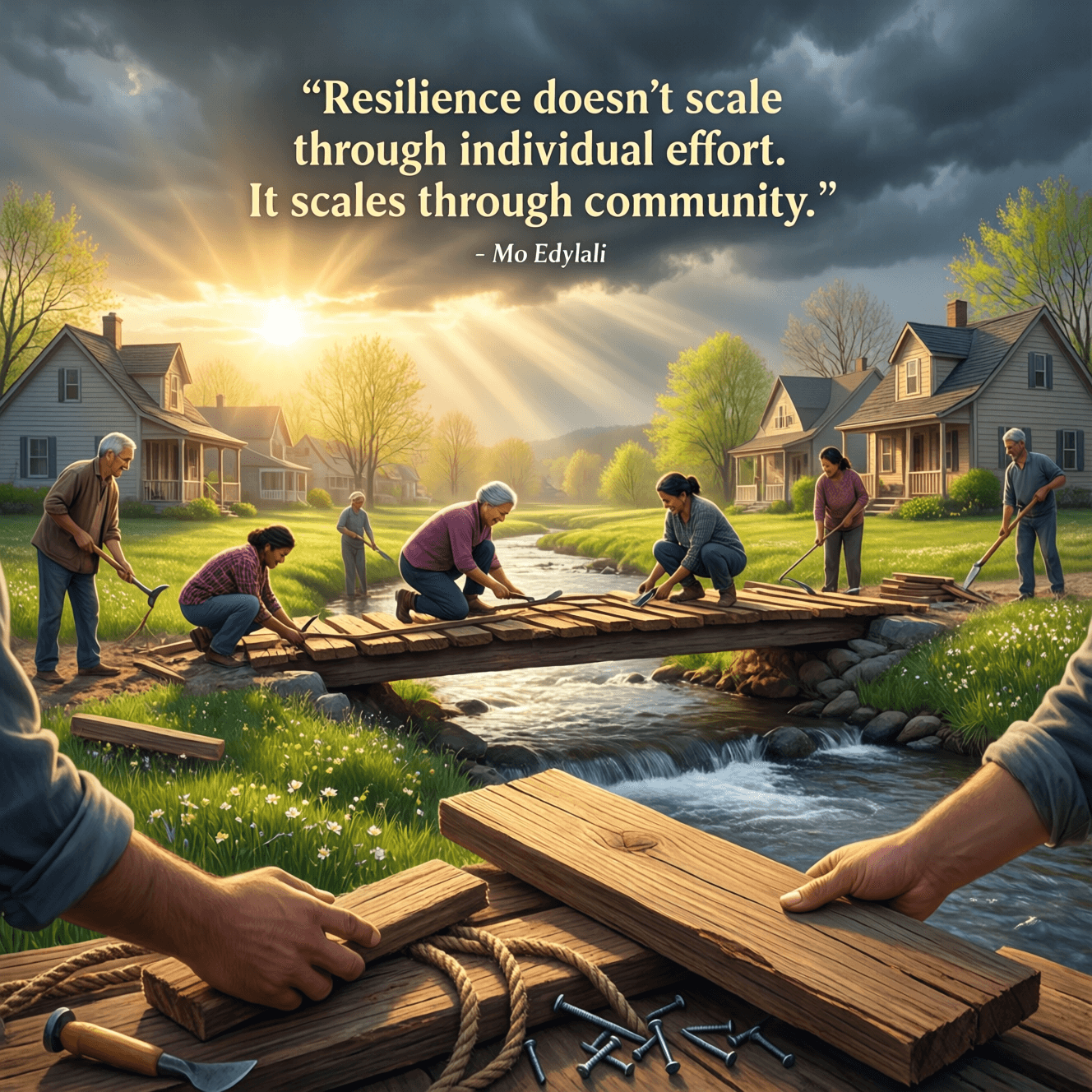
Resilience doesn't scale through individual effort. It scales through community. — Mo Edjlali
—What lingers after this line?
The Limits of Going It Alone
Mo Edjlali’s line draws a sharp boundary between admirable personal grit and the kind of resilience that can endure repeated shocks. Individual effort can help someone push through a hard week or survive a single setback, but it often depends on finite resources—time, money, energy, and mental bandwidth. Eventually, even the most disciplined person meets pressures that no solo strategy can absorb. From that starting point, the quote reframes resilience not as a private virtue but as a shared capacity. The question shifts from “How tough am I?” to “How well can we hold each other up when conditions worsen?”
What It Means for Resilience to “Scale”
The word “scale” matters: it implies growth in reach and reliability, not just intensity. Personal resilience can intensify—someone can become tougher—but it rarely expands to cover a whole neighborhood, workforce, or city. Community resilience, by contrast, can multiply because it spreads risk, distributes skills, and creates redundancy. As this idea unfolds, resilience starts to look like infrastructure: systems that keep functioning under strain. When one person is sick, another can cook; when one income disappears, a network can bridge the gap. Scaling, in other words, happens when support becomes organized, repeatable, and shared.
Mutual Aid as a Practical Engine
One concrete way community turns into scalable resilience is mutual aid—people directly meeting one another’s needs without waiting for formal institutions to catch up. Historically, mutual aid societies offered pooled resources for funerals, illness, or unemployment, creating a buffer that no single member could have maintained alone. Moving from principle to everyday life, mutual aid can be as small as a childcare swap among parents or as coordinated as a neighborhood food distribution after a storm. These arrangements don’t just help one person survive; they create a template others can adopt, strengthening the entire group over time.
Psychological Safety and Shared Burden
Community doesn’t only provide material support; it reduces the psychological load of crisis. Knowing you can ask for help without shame changes how stress is processed and how quickly people recover. In that sense, resilience scales because emotional regulation becomes collective—someone else can hold hope, perspective, or calm when you can’t. This is why supportive groups often outperform isolated individuals during prolonged hardship: they normalize struggle, interrupt spirals of self-blame, and encourage practical problem-solving. Over time, the shared burden becomes a shared narrative—“we handle things together”—which itself is a renewable resource.
Institutions, Trust, and the Strength of Networks
Yet community resilience depends on trust, and trust is built through repeated, reliable exchanges. Sociologist Robert Putnam’s *Bowling Alone* (2000) argues that social capital—networks, norms, and reciprocity—shapes the health of civic life. Where connections are dense and dependable, people coordinate faster, share information more accurately, and recover more effectively. Extending this further, strong networks can interface with institutions—schools, clinics, local governments—to turn informal support into lasting capacity. When communities are organized, they can advocate for resources, design local solutions, and prevent crises from becoming catastrophes.
From Personal Grit to Collective Design
Edjlali’s claim doesn’t dismiss individual effort; it places it inside a larger design. Personal resilience still matters, but it functions best as a contribution to a system—someone’s skills, steadiness, or generosity becomes more powerful when connected to others. The most durable communities make it easy to give and easy to receive. In the end, the quote is a blueprint: build relationships before emergencies, practice reciprocity in small ways, and create structures that don’t rely on heroic individuals. That’s how resilience stops being a lonely achievement and becomes a scalable, shared strength.
One-minute reflection
What's one small action this suggests?
Related Quotes
6 selectedRarely, if ever, are any of us healed in isolation. — bell hooks
bell hooks
bell hooks’ line reframes healing as something that unfolds between people rather than inside a sealed, private self. Instead of imagining recovery as a solitary climb—one person conquering pain through willpower—she poi...
Read full interpretation →When the storm passes and the paths calm down, and we are survivors of a collective shipwreck, with tearful hearts and a blessed destiny, we will feel fortunate just to be alive. - Alexis Valdés
Alexis Valdés
The quote speaks to the resilience and endurance required to withstand crises. It highlights that surviving a collective calamity, like a storm or any other challenging event, can bring a profound sense of gratitude for...
Read full interpretation →Encourage one another and build each other up. — 1 Thessalonians 5:11
1 Thessalonians 5:11
This verse emphasizes the importance of fostering a supportive community. By encouraging one another, individuals can create a positive environment that empowers everyone to thrive.
Read full interpretation →Look for the helpers. You will always find people who are helping. — Fred Rogers
Fred Rogers
At the heart of the quote stands a childhood memory Fred Rogers retold: "When I was a boy and I would see scary things in the news, my mother would say, 'Look for the helpers.'" He later collected this reflection in The...
Read full interpretation →When I was a boy and I would see scary things in the news, my mother would say to me, 'Look for the helpers.' — Fred Rogers
Fred Rogers
At the outset, Fred Rogers recalls his mother’s counsel as a way to steady a child’s mind in the face of frightening headlines: when fear spikes, redirect attention toward those who are helping. This simple reframe does...
Read full interpretation →Resilience is not an exercise in quiet endurance; it is the courage to seek the visibility and support you deserve. — Unknown
Unknown
The quote challenges a familiar stereotype: that resilience is proven by staying silent, stoic, and self-contained. Instead, it reframes resilience as an active stance—choosing what helps you recover and move forward rat...
Read full interpretation →More From Author
More from Mo Edjlali →