
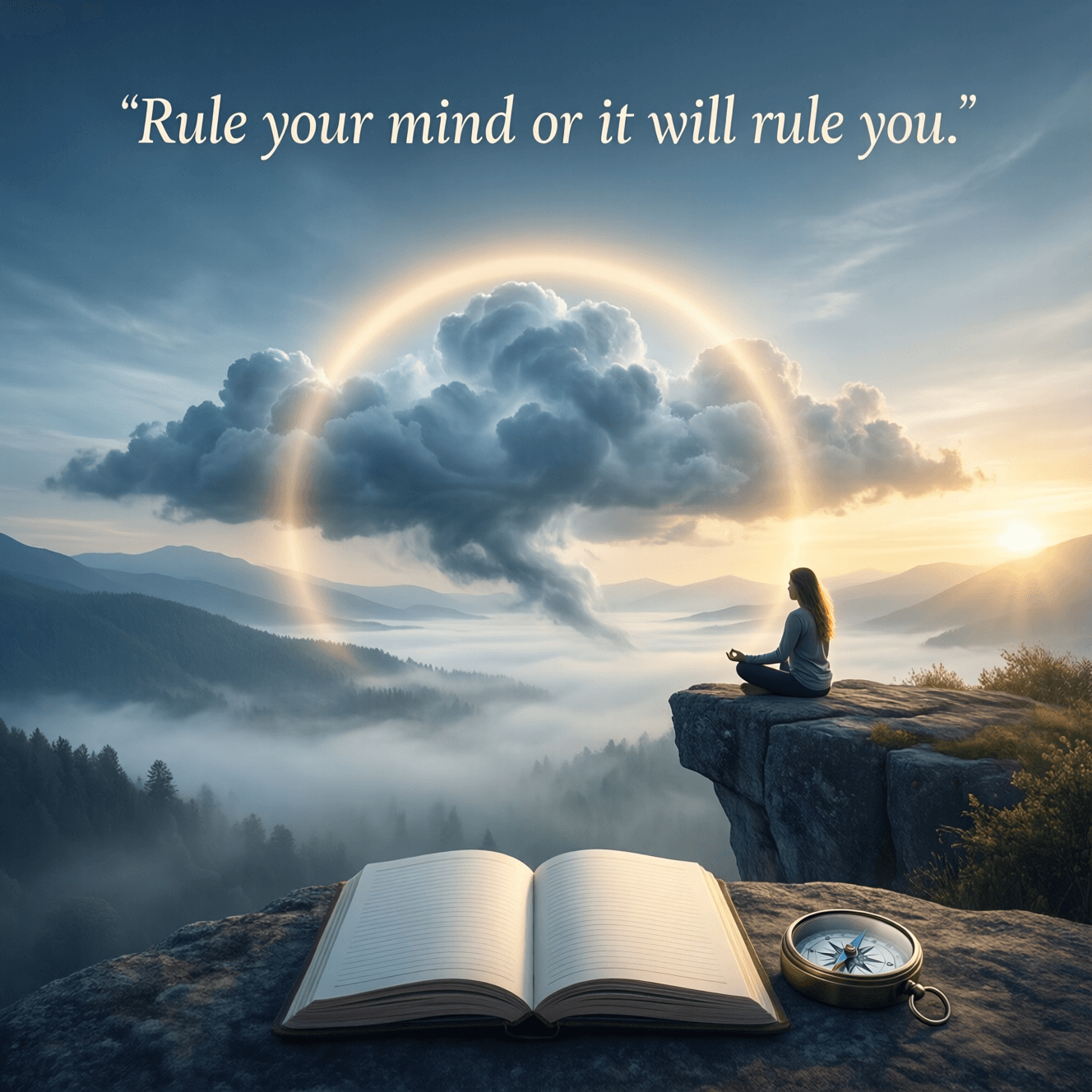
Rule your mind or it will rule you. — Horace
—What lingers after this line?
Horace’s Warning About Inner Governance
Horace’s line distills a political truth into a personal mandate: either you govern your inner life, or it becomes the regime that governs you. By framing the mind as something that can “rule,” he implies it has momentum—habits, impulses, fears, and cravings that will organize your behavior if left unchallenged. From there, the quote invites a shift in identity. You are not merely the stream of thoughts passing through; you are also the one capable of steering them. That distinction—between having a mind and being mastered by it—sets the stage for the disciplines that ancient moralists considered essential to freedom.
Self-Mastery as the Basis of Freedom
To Horace, mastery is not repression for its own sake but a route to liberty. If anger, envy, or appetite dictate your choices, you may appear autonomous while living in quiet servitude to whatever stimulus is strongest at the moment. In that sense, “rule your mind” becomes an argument that freedom is an internal achievement before it is a social condition. This connects naturally to broader Greco-Roman ethics, where character was treated like a craft. Just as a city needs laws to avoid chaos, a person needs guiding principles—otherwise moods and urges write the constitution day by day, often with contradictory and costly decrees.
Stoic Parallels: Directing Assent, Not Events
Moving from Horace’s poetic brevity to Stoic precision, Epictetus’ *Enchiridion* (c. 125 AD) insists that what lies within our control is not the world but our judgments about it. This reframes “ruling the mind” as governing assent: the moment you decide whether a thought is true, useful, or worthy of action. Consequently, the Stoic approach does not demand that you never feel fear or desire; it asks that you examine the story attached to those feelings. When the mind says, “This insult ruins me,” self-rule replies, “It hurts, but it does not define me,” and behavior follows that calmer verdict.
When the Mind Rules: Rumination and Reactivity
In practical terms, the mind “ruling you” often looks less dramatic than madness and more like relentless rumination. A minor embarrassment replays for hours, a future scenario is catastrophized, or a single criticism crowds out ten affirmations. The result is reactivity: decisions made to escape discomfort rather than to pursue values. A familiar anecdote illustrates this: someone receives a short text—“We need to talk”—and their day collapses into imagined breakups and disasters. Nothing has happened yet, but the mind has seized power, issuing alarms and demanding immediate obedience. Horace’s point is that without training, this pattern becomes default governance.
Tools of Rule: Attention, Reflection, and Practice
Because mental rule is a skill, it is built through repeated, ordinary acts. Attention is the first lever: noticing a thought as a thought, not as an order. Reflection is the second: asking what triggered it, what evidence supports it, and what action aligns with long-term aims rather than short-term relief. From there, practice makes the rule durable. Marcus Aurelius’ *Meditations* (c. 180 AD) reads like daily rehearsal—brief reminders to return to perspective, to choose response over reflex. Over time, the mind becomes less like a tyrant issuing decrees and more like an adviser whose proposals you can accept or decline.
Balanced Authority: Firm Without Becoming Harsh
Finally, ruling the mind does not mean waging war on it. A good ruler listens, interprets, and sets limits; likewise, self-mastery includes compassion for the signals the mind sends—fear may indicate something to protect, anger may reveal a boundary crossed, desire may point to a genuine need. Yet compassion without authority turns into indulgence, and authority without compassion turns into brittle control. Horace’s enduring counsel is to combine both: to lead your inner life with steadiness, so that thoughts and feelings can inform you without commandeering you. In that equilibrium, the mind serves the person rather than ruling the person.
One-minute reflection
Why might this line matter today, not tomorrow?
Related Quotes
6 selectedRule your mind or it will rule you. Mastery begins when you stop reacting and start choosing your focus. — Horace
Horace
Horace’s line frames the mind as a powerful instrument that can either serve or dominate its owner. The warning is not that thoughts and emotions exist, but that—left unattended—they can steer behavior through impulse, h...
Read full interpretation →Discipline your mind to prefer effort; there you will find progress. — Marcus Aurelius
Marcus Aurelius
Marcus Aurelius urges us to train the mind to seek what is hard because difficulty is the arena where virtue takes shape. Rather than treating effort as a tax on comfort, he reframes it as the price of becoming who we in...
Read full interpretation →Master your thoughts, and you will steer your life with an unshakable hand. — Marcus Aurelius
Marcus Aurelius
Marcus Aurelius offers a mariner’s image: if thoughts are the helm, the mind is the ship’s bridge. Master the helm, and storms still rage, yet the vessel holds its course.
Read full interpretation →Discipline your thoughts, and your world will answer in action — Marcus Aurelius
Marcus Aurelius
Marcus Aurelius ties inner governance to outer consequence. In Meditations 5.16 he observes that the soul is dyed with the color of its thoughts, while 12.36 reminds us that we command the mind, not events.
Read full interpretation →You are not responsible for your first thought, but you are responsible for your second thought. — Viktor Frankl
Viktor Frankl
At its core, the quotation distinguishes between what arises automatically and what we deliberately endorse. A first thought may be reflexive, inherited, fearful, angry, or conditioned by habit; it appears before moral j...
Read full interpretation →The strongest person controls the self, not others. — Seneca
Seneca
Seneca’s statement turns the usual idea of power inside out. Instead of praising the person who dominates rivals, commands attention, or bends others to their will, he locates real strength in self-command.
Read full interpretation →More From Author
More from Horace →Rule your mind or it will rule you; most burnout is just a failure to set boundaries between your peace and your output. — Horace
At its core, the quotation argues that self-governance is not a luxury but a necessity. To ‘rule your mind’ means refusing to let impulses, anxieties, and external demands dictate the shape of one’s life.
Read full interpretation →Rule your mind or it will rule you. Mastery begins when you stop reacting and start choosing your focus. — Horace
Horace’s line frames the mind as a powerful instrument that can either serve or dominate its owner. The warning is not that thoughts and emotions exist, but that—left unattended—they can steer behavior through impulse, h...
Read full interpretation →Seize the day, put very little trust in tomorrow. — Horace
This quote embodies the 'carpe diem' philosophy, encouraging people to live in the present moment and make the most of the opportunities available today.
Read full interpretation →Seize the day, and put the least possible trust in tomorrow. — Horace
This quote emphasizes the importance of living in the moment. It encourages individuals to make the most of today rather than deferring actions and ambitions to an uncertain future.
Read full interpretation →