
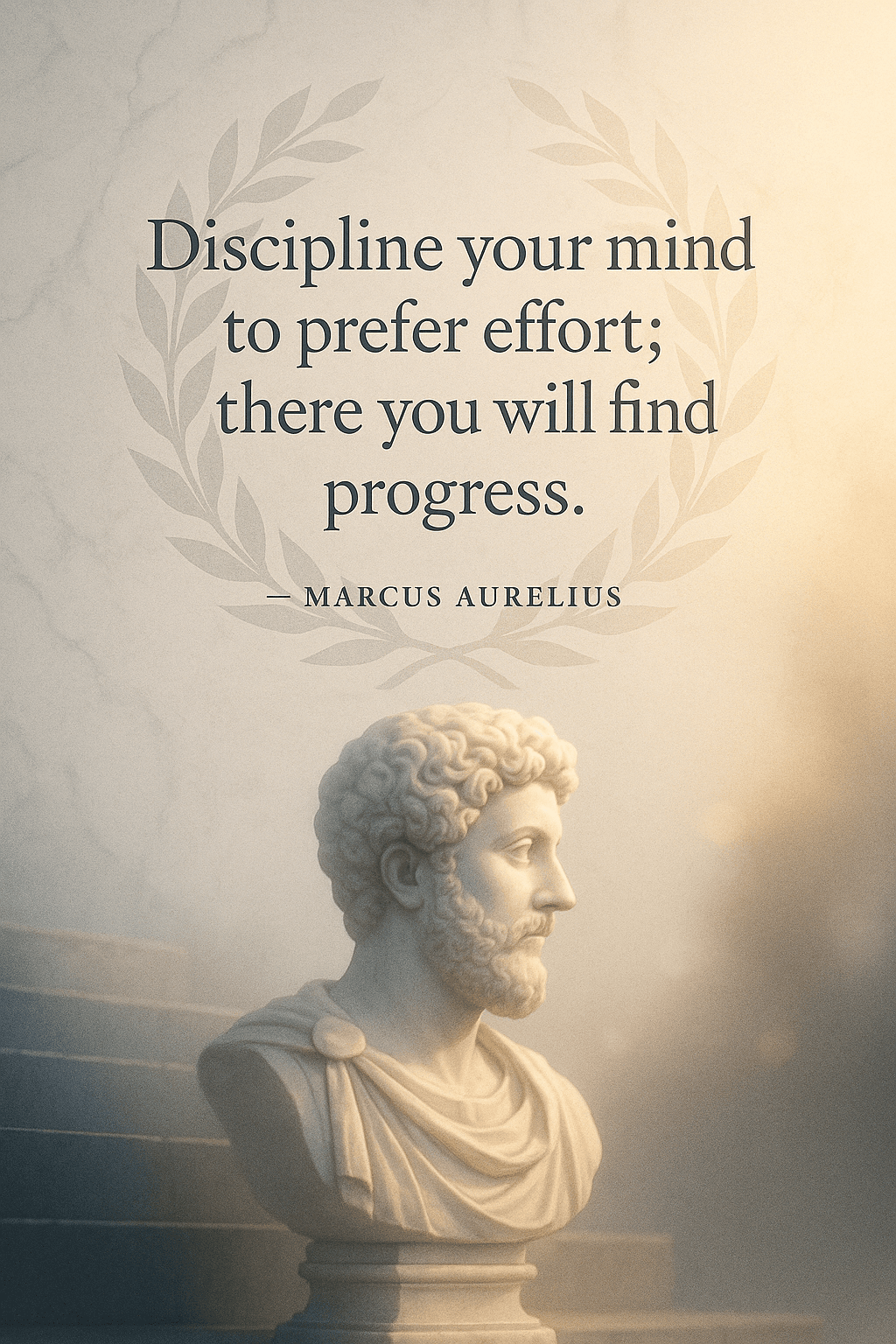
Discipline your mind to prefer effort; there you will find progress. — Marcus Aurelius
—What lingers after this line?
The Stoic Reframing of Effort
Marcus Aurelius urges us to train the mind to seek what is hard because difficulty is the arena where virtue takes shape. Rather than treating effort as a tax on comfort, he reframes it as the price of becoming who we intend to be. In Meditations 5.1, he counsels himself at daybreak to rise to “the work of a human being,” reminding us that duty precedes mood. Seen this way, progress is not an accident of inspiration but a habit of choosing the uphill path. When attention reaches for challenge instead of ease, the mind discovers its agency, and with agency comes growth.
Training Desire, Not Just Endurance
While grit matters, Stoicism goes deeper by educating desire itself. Epictetus distinguishes what is in our control from what is not (Discourses 1.1), urging us to love the strenuous choices that refine judgment, not merely survive them. Likewise, Roman Stoics praised voluntary hardship as moral exercise—choosing the harder right to make it the easier default. Therefore, the discipline Marcus recommends is not grim asceticism; it is taste formation. By repeatedly preferring effort, we teach ourselves to want practices that enlarge us, so perseverance becomes less a battle of willpower and more an alignment of values.
Why Effort Works: Deliberate Practice
Modern skill research clarifies the mechanism behind the Stoic intuition. Anders Ericsson’s work on deliberate practice shows that improvement requires targeted, effortful stretches just beyond current ability, coupled with feedback and rest (Ericsson & Pool, Peak, 2016). Comfort stabilizes performance; only calibrated difficulty upgrades it. Moreover, a growth mindset makes those stretches tolerable. Carol Dweck’s Mindset (2006) documents that believing abilities are developable redirects attention from proving talent to improving technique. Thus, preferring effort is not masochism; it is a rational bet on the only conditions under which mastery reliably emerges.
Neural and Psychological Payoffs
Effort leaves a physical trace. Draganski et al. (2004) found that adults who learned to juggle showed gray-matter increases in motion-related regions—changes that receded when practice stopped. Repeated, focused challenge reshapes the brain; avoiding challenge leaves circuits unpracticed and fragile. Psychologically, effort predicts durable achievement. Angela Duckworth et al. (2007) showed that grit—sustained effort and interest—outperforms raw aptitude in forecasting long-term success. In this light, Marcus’s counsel is pragmatic: prefer the process that rewires you for competence, not the sensation that merely gratifies you now.
Building a Daily Discipline
From philosophy to practice, make effort the default by designing for action. Use implementation intentions—if-then plans that bind cues to behaviors (Gollwitzer, 1999): “If it’s 6 a.m., then I write for 25 minutes.” Reduce choice friction by preparing tools the night before, and stack challenges from smallest to hardest to keep momentum. To sweeten the start, employ temptation bundling—pairing a desired indulgence with a demanding habit (Milkman, Minson, & Volpp, 2014). Over time, these structures shift preference: the mind learns to associate effort with clarity, progress, and even pleasure.
Progress With a Purpose
Finally, Stoic progress is not solitary self-optimization; it is service-oriented. Marcus reminds us that “what does not benefit the hive does not benefit the bee” (Meditations 6.54). Choosing effort prepares us to contribute reliably—at work, in family, and in civic life—because disciplined people can be counted on when stakes are high. Thus the arc closes: by training our minds to prefer effort, we not only improve skills, we align character with a common good. Progress becomes more than personal gain; it becomes a way of belonging to something larger.
One-minute reflection
What does this quote ask you to notice today?
Related Quotes
6 selectedThe mind freed from passions is an impenetrable fortress — a person has no more secure place of refuge for all time. — Marcus Aurelius
Marcus Aurelius
At the heart of Marcus Aurelius’s statement lies a distinctly Stoic image: the mind, once freed from destructive passions, becomes a fortress no external force can breach. In his Meditations (c.
Read full interpretation →Train your mind like a garden: remove the weeds and welcome the sun. — Marcus Aurelius
Marcus Aurelius
Marcus Aurelius frames the mind as something living—capable of growth, decay, and renewal—rather than a fixed container of thoughts. A garden isn’t improved by force of will alone; it changes through patient, repeated ca...
Read full interpretation →Discipline your thoughts, and your world will answer in action — Marcus Aurelius
Marcus Aurelius
Marcus Aurelius ties inner governance to outer consequence. In Meditations 5.16 he observes that the soul is dyed with the color of its thoughts, while 12.36 reminds us that we command the mind, not events.
Read full interpretation →Master your thoughts, and you will steer your life with an unshakable hand. — Marcus Aurelius
Marcus Aurelius
Marcus Aurelius offers a mariner’s image: if thoughts are the helm, the mind is the ship’s bridge. Master the helm, and storms still rage, yet the vessel holds its course.
Read full interpretation →Rule your mind or it will rule you. Mastery begins when you stop reacting and start choosing your focus. — Horace
Horace
Horace’s line frames the mind as a powerful instrument that can either serve or dominate its owner. The warning is not that thoughts and emotions exist, but that—left unattended—they can steer behavior through impulse, h...
Read full interpretation →Courage is less about fearlessness than training the mind to act with clarity and conviction. — Ranjay Gulati
Ranjay Gulati
Ranjay Gulati’s line begins by overturning a common myth: that courage belongs to people who simply don’t feel afraid. Instead, he frames fear as normal—and even expected—while locating courage in what happens next.
Read full interpretation →More From Author
More from Marcus Aurelius →Consistency is the sum that equals what we become. — Marcus Aurelius
Marcus Aurelius’ line frames becoming as a kind of moral mathematics: each repeated action adds to the total of a life. Rather than imagining identity as a single grand decision, the quote suggests that character is accu...
Read full interpretation →If anyone can refute me—show me I'm making a mistake or looking at things from the wrong perspective—I'll gladly change. — Marcus Aurelius
Marcus Aurelius begins from a position that appears modest but is actually deeply disciplined: he is willing to be corrected. Rather than treating disagreement as an insult, he frames it as an opportunity to see more cle...
Read full interpretation →The art of life is more like the wrestler's art than the dancer's; stand ready and firm to meet sudden and unexpected onsets. — Marcus Aurelius
Marcus Aurelius contrasts two arts to clarify what living well demands. A dancer suggests elegance, rhythm, and practiced beauty; a wrestler, by contrast, suggests balance under pressure, resistance, and constant readine...
Read full interpretation →How much time he gains who does not look to see what his neighbour says or does or thinks, but only at what he does himself, to make it just and holy. — Marcus Aurelius
Marcus Aurelius argues that a great deal of life is wasted in watching other people—what they say, what they do, and even what they might be thinking. Instead, he recommends a disciplined inward turn: focus on your own c...
Read full interpretation →