
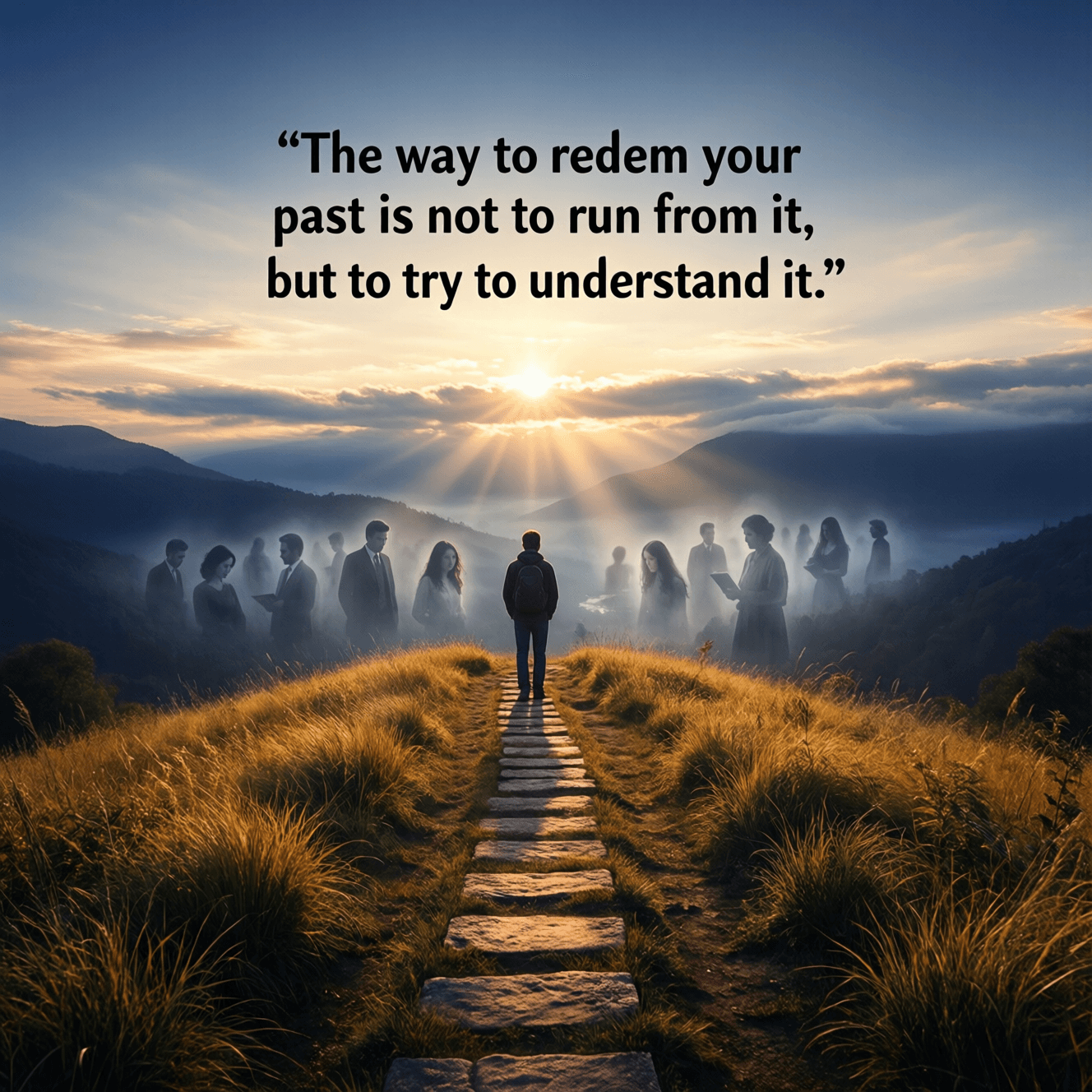
The way to redeem your past is not to run from it, but to try to understand it. — Jay-Z
—What lingers after this line?
Redemption as an Inner Task
Jay-Z’s line reframes redemption as something earned internally rather than granted externally. Instead of treating the past as a stain to hide, he suggests it can become raw material for growth once it is faced with honesty. In this view, redemption is less about erasing history and more about changing one’s relationship to it. This shift matters because running from the past often keeps it in control—unexamined memories and choices continue to shape reactions in the present. By contrast, understanding begins to loosen that grip, turning shame or regret into information. From the start, the quote positions insight as the doorway to a different future.
Why Avoidance Keeps Old Wounds Alive
Avoidance can feel like relief, but it usually functions like a short-term painkiller: the underlying issue persists. Psychology’s broad findings on experiential avoidance align with this—attempts to suppress difficult memories or emotions often intensify them or cause them to resurface indirectly, a pattern discussed in acceptance-based therapies such as Acceptance and Commitment Therapy (Steven C. Hayes et al., 1999). Building on that, Jay-Z’s warning is practical: if you sprint away from your past, you may end up organizing your life around not being reminded of it. Over time, that defensive posture can narrow relationships, opportunities, and self-understanding, making “escape” a hidden form of captivity.
Understanding Without Excusing
Importantly, “try to understand it” is not the same as “justify it.” Understanding asks questions—What was I protecting? What did I believe then? What pressures shaped my decisions?—without dissolving accountability. This distinction is crucial because people often fear that exploring causes will dilute responsibility, when it can actually sharpen it. As a result, insight becomes a tool for repair rather than self-pardon. Once you understand the pattern behind a harmful choice, you can name it, interrupt it, and make amends with clearer intent. In other words, accountability becomes more actionable when it’s paired with comprehension.
Narrative: Turning History Into Meaning
Next, the quote points toward the power of narrative—how we organize memories into a story about who we are. Many therapeutic approaches, including narrative therapy (Michael White and David Epston, 1990), emphasize that people suffer not only from events, but from the meanings they attach to them. Understanding the past can revise that meaning from “I’m doomed by what I did” to “I learned what I must change.” This is why redemption often arrives through reinterpretation rather than denial. When someone can tell the truth about their past while also recognizing their capacity to grow, the past becomes a chapter, not a life sentence.
Facing the Past Through Honest Dialogue
Understanding is rarely a purely solitary act; it often deepens through conversation—with trusted friends, mentors, therapists, or even through art and writing. A simple anecdote captures this: someone who once blamed “bad luck” for repeated conflicts might, after a few candid talks, notice a consistent trigger—pride, fear of rejection, or a learned habit from childhood. That recognition can be uncomfortable, yet it is precisely what makes change possible. From there, dialogue creates a bridge between insight and responsibility. Naming the past out loud can reduce its mystique, transforming it from a shadowy force into something specific that can be addressed, repaired, or integrated.
Practical Steps Toward Redeeming What Happened
Finally, Jay-Z’s idea becomes concrete when translated into practice: revisit key moments, identify patterns, and decide what repair looks like now. Understanding might lead to an apology, a boundary, a changed habit, or a commitment to show up differently. What matters is that the new action is informed by a clear-eyed reading of the old one. Over time, this process converts regret into wisdom. You don’t redeem the past by pretending it never occurred; you redeem it by making sure it teaches you something real—something that reshapes your choices, your relationships, and the kind of person you become.
One-minute reflection
What feeling does this quote bring up for you?
Related Quotes
6 selectedThe most fundamental aggression to ourselves is to not have the courage to look at ourselves honestly and gently. — Pema Chödrön
Pema Chödrön
Pema Chödrön reframes “aggression” in a startling way: not as something we do outwardly, but as a subtle violence we direct inward when we refuse to face our own experience. Instead of fists or harsh words, the harm come...
Read full interpretation →All of humanity's problems stem from man's inability to sit quietly in a room alone. — Blaise Pascal
Blaise Pascal
Pascal’s line compresses an entire moral psychology into a single image: one person, one room, and the unnerving demand to be alone with oneself. Rather than blaming politics, fate, or scarcity first, he points to an inn...
Read full interpretation →Maybe you are searching among the branches, for what only appears in the roots. — Rumi
Rumi
Rumi’s line opens with a quiet diagnosis: we often look for solutions where they are most visible—among the “branches,” the outward symptoms of a life—rather than where causes actually begin. In practice, this can mean c...
Read full interpretation →Being entirely honest with oneself is a good exercise. — Sigmund Freud
Sigmund Freud
Freud’s remark that “being entirely honest with oneself is a good exercise” sounds deceptively simple, yet it points to one of the hardest forms of psychological work. Rather than referring to ordinary truth-telling, he...
Read full interpretation →Not until we are lost do we begin to understand ourselves. - Henry David Thoreau
Henry David Thoreau
This quote suggests that it is only when we face significant challenges or confusion that we truly start to understand our own capabilities, values, and identities.
Read full interpretation →Not until we are lost do we begin to understand ourselves. - Henry David Thoreau
Henry David Thoreau
This quote suggests that it is often through experiencing loss or confusion that we come to truly understand our own identity and inner strengths. Adversity serves as a catalyst for self-discovery.
Read full interpretation →More From Author
More from Z →It is about knowing who you are, and just doing what is comfortable for you, and not letting people pull you in a thousand different directions. — Jay-Z
At its core, Jay-Z’s statement argues that self-knowledge is the foundation of a stable life. To know who you are is to possess an inner anchor that holds even when outside expectations become noisy or contradictory.
Read full interpretation →I'm not a businessman; I'm a business, man. — Jay-Z
Jay-Z’s line hinges on a comma-sized twist: he’s not merely someone who conducts business; he has become the business. That reframing moves the conversation from occupation to identity, implying that his value isn’t limi...
Read full interpretation →Nobody is built like you; you design yourself. — Jay-Z
Jay-Z’s line pivots away from the comforting notion that identity is simply inherited—by genes, neighborhood, or circumstance—and toward the harder claim that it is chosen. “Nobody is built like you” acknowledges real di...
Read full interpretation →No matter how hard the battle gets or no matter how many people don't believe in your dream, you cannot give up. — Jay-Z
This quote highlights the importance of resilience when facing challenges. It emphasizes that regardless of the difficulties one encounters, perseverance is key to achieving one's goals.
Read full interpretation →