
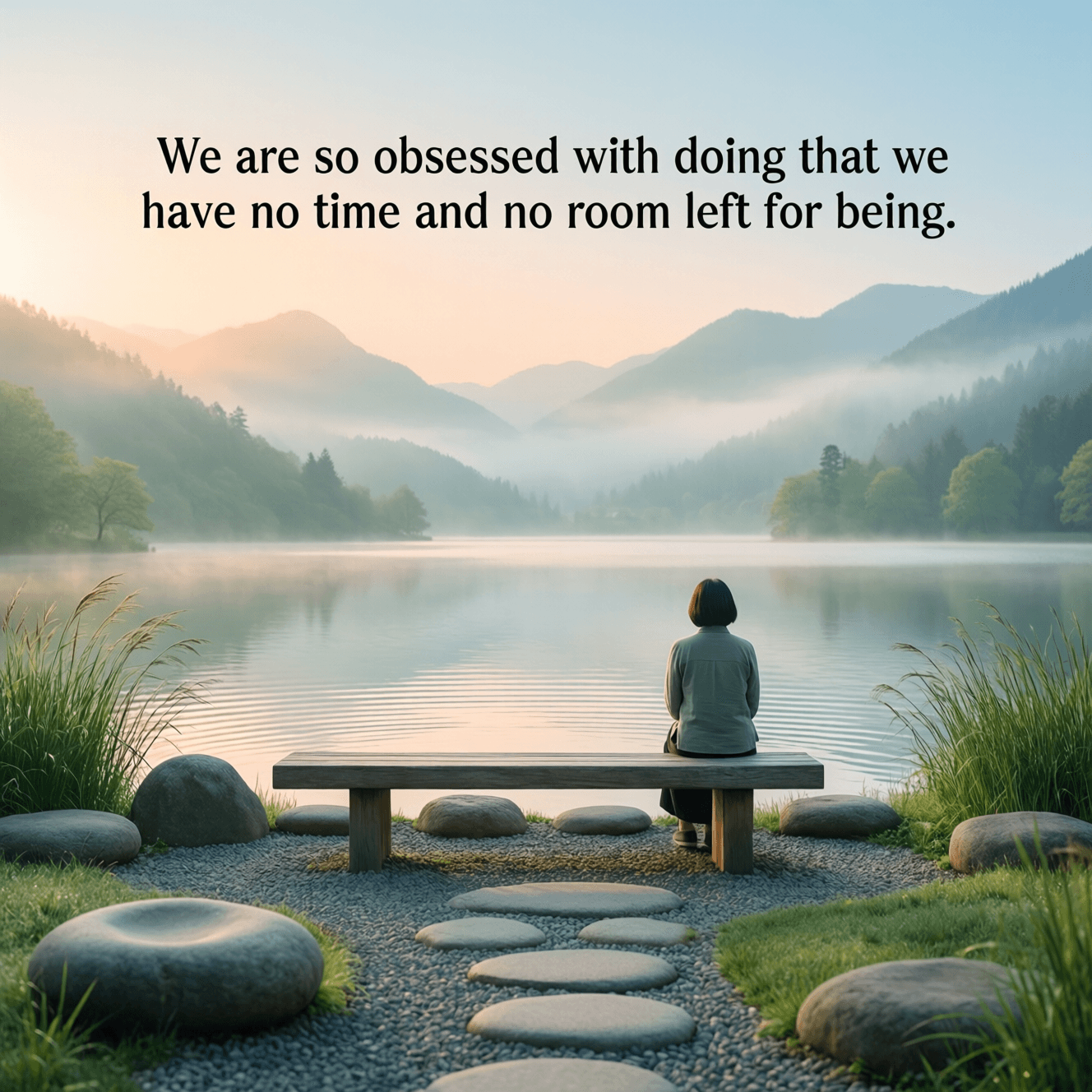
We are so obsessed with doing that we have no time and no room left for being. — Thich Nhat Hanh
—What lingers after this line?
The Hidden Cost of Constant Activity
Thich Nhat Hanh’s remark points to a modern dilemma: busyness can become so normal that it feels virtuous, even when it quietly erodes our inner life. When our days are packed with tasks, notifications, and goals, “doing” stops being a tool and turns into an identity—something we cling to for worth and security. From there, the problem deepens because obsession leaves “no time and no room” not only for rest, but for the basic experience of being alive in the present moment. What seems like productivity can, over time, become a way of fleeing discomfort, uncertainty, or silence.
What “Being” Means in Zen Practice
In Thich Nhat Hanh’s Zen tradition, “being” is not passivity or laziness; it is intimate contact with life as it is—breath, body, emotions, and the ordinary miracle of awareness. Rather than adding another task, being asks us to stop long enough to notice the mind’s rush and return to direct experience. This matters because without that return, even meaningful work can feel hollow. As Thich Nhat Hanh often emphasized in teachings collected in *Peace Is Every Step* (1991), mindfulness is meant to be woven into walking, washing dishes, and speaking—so life is not postponed until the to-do list ends.
Doing as a Form of Escape
Once “doing” becomes compulsive, it can function like a socially approved escape hatch. People may keep moving not because everything truly needs doing, but because stillness can expose grief, loneliness, fear, or a sense of meaninglessness that activity temporarily numbs. Seen this way, the quote is less a scolding and more an invitation to honesty: what do we fear we might meet if we stop? By recognizing that restlessness can be avoidance, we begin to understand why time alone isn’t enough—we also need the courage to inhabit the space that appears when we finally pause.
Presence as a Source of Clarity and Compassion
Paradoxically, making room for being often improves doing. When attention is fragmented, effort multiplies; when attention is steady, the mind simplifies. In this sense, being becomes the ground from which wiser action arises—less reactive, less driven by anxiety, and more aligned with values. Moreover, presence changes how we relate to others. If our minds are always racing ahead, we may treat people as interruptions. But when we are grounded, listening becomes fuller and kinder. Thich Nhat Hanh’s emphasis on “interbeing” highlights that our quality of presence is not private—it shapes family life, workplaces, and communities.
Small Practices That Reopen “Room”
Creating room does not require retreating from life; it can begin with brief, repeatable pauses. A few conscious breaths before answering a message, a slow walk without a phone, or a moment of silent tea-drinking can interrupt the trance of constant production. Over time, these small thresholds teach the nervous system that it is safe to stop. They also reveal an important shift: being is not something we earn after our obligations are complete; it is a way to meet each obligation without losing ourselves inside it.
A Balanced Life: Doing Rooted in Being
Ultimately, the quote argues for balance, not withdrawal. Doing is necessary—meals must be cooked, work must be done, commitments must be honored. Yet when doing is cut off from being, activity becomes brittle and joyless, and our sense of self depends on output. By contrast, when being comes first, action becomes an expression rather than a compulsion. We still build, plan, and serve, but from a steadier place. In that way, Thich Nhat Hanh’s message is quietly radical: the most humane productivity begins with the simple decision to be here.
One-minute reflection
What's one small action this suggests?
Related Quotes
6 selectedWe have to be careful not to spend our lives anticipating the next thing. — Thich Nhat Hanh
Thich Nhat Hanh
Thich Nhat Hanh’s warning points to a quiet but pervasive habit: living in the mental future. Anticipation can feel productive—planning, improving, preparing—but it can also become a way of postponing life itself.
Read full interpretation →In the quiet of your own mind, you hold the power to reclaim your attention from the chaos of the world. — Thich Nhat Hanh
Thich Nhat Hanh
Thich Nhat Hanh’s words begin with a gentle but radical claim: the mind contains a quiet space that cannot be fully colonized by the world’s noise. Rather than portraying attention as something stolen forever by distract...
Read full interpretation →To find peace, you must stop trying to solve every problem at once. Sometimes the most productive thing you can do is simply breathe and be present. — Thich Nhat Hanh
Thich Nhat Hanh
At first glance, Thich Nhat Hanh’s insight challenges a habit many people mistake for responsibility: the need to solve every problem immediately. When the mind races from one worry to the next, it often creates more str...
Read full interpretation →The goal is not to be good at everything, but to be present for the things that matter most. — Thich Nhat Hanh
Thich Nhat Hanh
Thich Nhat Hanh’s quote gently redirects ambition. Rather than chasing excellence in every possible area, he suggests that a meaningful life depends on discernment: knowing what deserves our energy and then meeting it wi...
Read full interpretation →The feeling that any task is a nuisance will soon disappear if it is done in mindfulness. — Thich Nhat Hanh
Thich Nhat Hanh
Thich Nhat Hanh begins with an everyday truth: much of our irritation comes not from the task itself, but from the label we attach to it. When we decide something is a nuisance—washing dishes, replying to emails, standin...
Read full interpretation →The present moment is the only time over which we have dominion. — Thich Nhat Hanh
Thich Nhat Hanh
Thich Nhat Hanh’s line begins with a practical insight: our influence is real only where our experience is real. The past survives as memory and interpretation, while the future exists as prediction and fear, but the pre...
Read full interpretation →More From Author
More from Thich Nhat Hanh →You must love in such a way that the person you love feels free. — Thich Nhat Hanh
At its core, Thich Nhat Hanh’s statement redefines love as an act of care that does not confine. To love someone so that they feel free means offering affection without turning it into control, guilt, or dependence.
Read full interpretation →We are not islands; we are threads in a tapestry. To pull away from the weave is to lose the very texture that makes life hold together. — Thich Nhat Hanh
At its core, Thich Nhat Hanh’s image of threads in a tapestry rejects the fantasy of total self-sufficiency. A single thread may exist on its own, yet it gains meaning, strength, and beauty only through its relation to o...
Read full interpretation →When you learn how to suffer, you suffer far less. Resilience is not about avoiding the fire; it is about becoming fireproof. — Thich Nhat Hanh
At first glance, Thich Nhat Hanh’s quote appears paradoxical: how could learning to suffer make suffering lighter? Yet his point is that pain intensifies when we resist it, fear it, or treat it as a personal failure.
Read full interpretation →Slow down, and you will find that the rhythm of your own heart becomes the master of your work. — Thich Nhat Hanh
At first glance, Thich Nhat Hanh’s words seem to offer simple advice about working more slowly, yet they point to something deeper: a different relationship with time itself. To slow down is not merely to reduce speed, b...
Read full interpretation →