
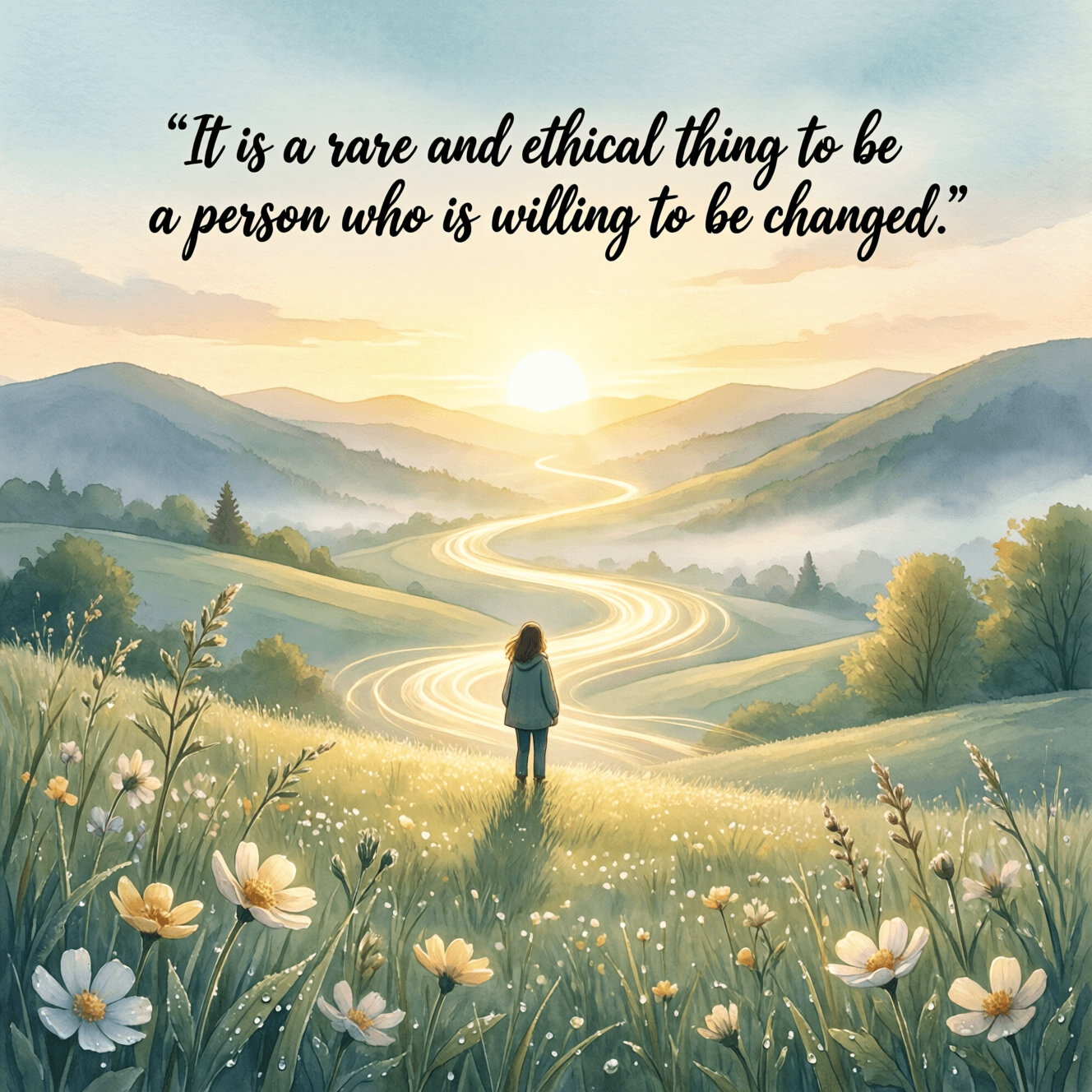
It is a rare and ethical thing to be a person who is willing to be changed. — Ocean Vuong
—What lingers after this line?
Change as a Moral Posture
Ocean Vuong frames openness to transformation as both uncommon and ethically charged, suggesting that character is not merely what we defend but what we are willing to revise. In this view, the “rare” person is not the one who never errs, but the one who treats new information, pain, or criticism as an invitation to grow rather than a threat to identity. From there, the word “ethical” signals that change is not just self-improvement for personal gain; it is a responsibility toward others. If our actions affect people, then refusing to change can become a form of harm—an insistence that others must bear the costs of our rigidity.
Why Willingness Is So Uncommon
That rarity becomes clearer when we consider how much modern life rewards certainty. Social belonging often depends on signaling fixed positions, and admitting we’ve shifted can look like weakness or betrayal. As a result, many people learn to protect their self-image at all costs, even when their experience quietly proves their old assumptions incomplete. Yet Vuong points to a different kind of strength: the courage to let the self be porous. In practice, being “willing to be changed” can mean listening long enough for another person’s reality to complicate ours—an act that demands patience, humility, and the tolerance of internal discomfort.
Ethics Beyond Intent: Becoming Accountable
Moving from rarity to ethics, the quote implies that good intentions are not enough; what matters is how we respond when we discover our impact. A person can mean well and still cause harm, and the ethical response is not defensiveness but adaptation—changing language, behavior, or assumptions to reduce harm going forward. This aligns with long-standing moral thought that treats virtue as practice rather than proclamation. Aristotle’s Nicomachean Ethics (4th century BC) describes moral character as habituated through repeated action; similarly, Vuong’s line suggests that ethical life requires ongoing revision, not a one-time declaration of being “a good person.”
The Vulnerability of Letting Go
Still, willingness to change is costly because it often requires grieving an older self. When someone outgrows a belief or admits wrongdoing, they may feel they are losing status, certainty, or belonging. Vuong’s phrasing acknowledges that this vulnerability is part of the moral beauty: to be changed is to accept that the ego is not the highest priority. Here, transformation resembles a kind of surrender—less about becoming perfect than becoming responsive. Instead of clinging to a coherent story about oneself, the person allows life and relationships to re-write that story, even when the revisions are painful.
Relationships as Agents of Transformation
From this angle, change is rarely solitary. Close relationships—love, friendship, family, community—create the conditions where we are confronted by needs and perspectives beyond our own. Vuong’s quote hints that ethical living is relational: we become better not only by introspection but by being affected, corrected, and softened by others. Consider the everyday example of someone who learns, over time, to apologize differently: not with explanations, but with accountability and repair. That shift is small yet profound, because it shows a willingness to be shaped by another person’s pain rather than insisting on one’s own innocence.
Choosing Change Without Losing Yourself
Finally, being willing to be changed does not mean being endlessly malleable or surrendering all boundaries. Ethical change is discerning: it asks what new understanding is true, what behavior is more just, and what values are worth keeping. In that sense, transformation is not self-erasure; it is self-clarification. Vuong’s line leaves us with a hopeful standard: the rare person is not flawless, but teachable. By treating change as an ethical act—an offering of humility and responsiveness—we make room for a life that is not only personally evolving but also kinder and more responsible to the people we share it with.
One-minute reflection
Why might this line matter today, not tomorrow?
Related Quotes
6 selectedUnfortunately, we've rewarded a sort of cowardice by calling it 'kindness', and this has made us utterly spineless when truth finally hits. — Criss Jami
Criss Jami
At its core, Criss Jami’s statement argues that not every gentle gesture is morally brave. Sometimes what society praises as kindness is really avoidance: a refusal to speak hard truths, set boundaries, or confront harmf...
Read full interpretation →Integrity is choosing courage over comfort; choosing what is right over what is fun. — Brené Brown
Brené Brown
Brené Brown frames integrity not as a fixed trait but as a sequence of decisions made in real time. Rather than asking whether someone “has” integrity, her line invites a more practical question: what do you choose when...
Read full interpretation →Keep a quiet hope alive and let it guide the brave choices you make. — Anne Frank
Anne Frank
Anne Frank’s line begins with a surprising premise: hope can be quiet. Instead of the loud optimism that denies fear or hardship, she points to a steadier inner posture—something you keep alive privately, even when circu...
Read full interpretation →A single act of truth can topple the tallest doubt. — Leo Tolstoy
Leo Tolstoy
Tolstoy’s line treats truth not as a static possession but as an event—“a single act”—that moves through the world with consequence. Doubt, in contrast, is depicted like a towering structure: impressive, persistent, and...
Read full interpretation →Stand where truth is thin and refill it with courage. — James Baldwin
James Baldwin
Baldwin’s image of “truth” being “thin” begins with a frank admission: in many moments—public, private, historical—what passes for truth can feel fragile, diluted, or evasive. Thin truth is not necessarily an outright li...
Read full interpretation →Let action be the truth that silence cannot speak. — Fyodor Dostoevsky
Fyodor Dostoevsky
Dostoevsky’s line begins with a tension most people recognize: there are moments when inner conviction cannot be adequately voiced. Silence may come from fear, humility, trauma, or uncertainty, yet it can also become a r...
Read full interpretation →More From Author
More from Ocean Vuong →The most beautiful part of your body is where it's headed. & remember, the mind, too, is a destination. — Ocean Vuong
Ocean Vuong shifts beauty away from a fixed appraisal of the body and toward the body in transit—“where it’s headed.” Instead of treating attractiveness as a snapshot, the line suggests that beauty unfolds through intent...
Read full interpretation →Don't we bloom for ourselves? — Ocean Vuong
Ocean Vuong’s line arrives as a question rather than a declaration, which makes it feel intimate and unsettled at once. By asking “Don’t we bloom for ourselves?”, he nudges the reader to examine an assumption many people...
Read full interpretation →Underneath the grid is a field—it was always there—where to be lost is never to be wrong, but simply more. — Ocean Vuong
Vuong opens with a quiet contrast: a “grid” suggests order, measurement, and right angles—an imposed way of seeing life as legible and correct. Underneath it, however, is a “field,” something organic and unruled, where g...
Read full interpretation →