
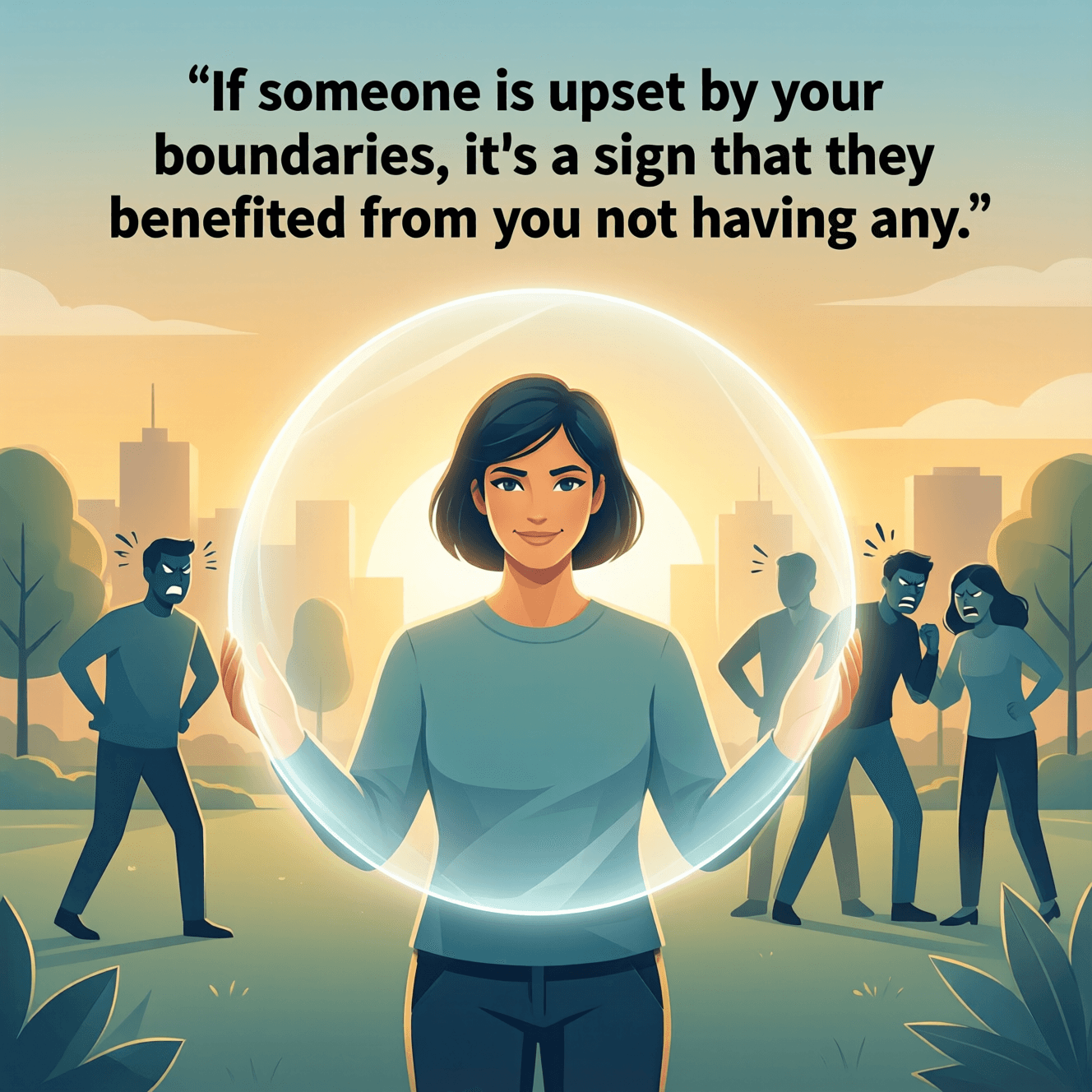
If someone is upset by your boundaries, it's a sign that they benefited from you not having any. — Nedra Glover Tawwab
—What lingers after this line?
Why Boundaries Change the Emotional Weather
Nedra Glover Tawwab’s line points to a common turning point in relationships: the moment you begin naming what you will and won’t accept, the atmosphere shifts. Boundaries—whether about time, emotional labor, money, or access—introduce structure where there may have been unspoken expectations. As a result, people who were comfortable with the old arrangement can feel suddenly inconvenienced or challenged. From there, it becomes clear that boundary-setting isn’t just a personal wellness tool; it’s also a relational test. By changing the rules from implicit to explicit, you expose who can adapt with respect and who reacts as if something is being taken away.
Upset as a Clue, Not a Verdict
Importantly, someone’s upset doesn’t automatically mean they’re manipulative or malicious. Change is hard, and even well-intentioned people can feel startled when familiar patterns are interrupted. However, Tawwab invites us to look at what the upset is about: is it disappointment they can voice and negotiate, or outrage that you dared to say no? That distinction matters because it shifts the question from “Did I do something wrong?” to “What expectation did my boundary interrupt?” When the reaction is disproportionate—anger, guilt-tripping, or punishment—it often signals that your flexibility previously served them more than it served you.
The Hidden Benefits of Your Lack of Boundaries
The quote highlights a subtle dynamic: when you don’t have boundaries, others may receive ongoing benefits they never had to request outright. They might get unlimited access to your attention, quick compliance, extra work, or emotional caretaking. Over time, those perks can start to feel like entitlements, even if no one ever said so. Consequently, when you introduce a boundary—“I can’t talk after 10,” “I’m not available this weekend,” “I won’t lend money”—it doesn’t just limit a behavior; it removes a benefit. The discomfort you witness can be the friction of a system being rebalanced.
Why “You’ve Changed” Can Be a Warning Sign
Often, the pushback arrives as a character accusation: “You’re selfish,” “You’re cold,” or the classic “You’ve changed.” In reality, you have changed—toward self-protection and clarity. What those statements sometimes mean is: “The version of you I preferred was easier to access.” This is why boundary backlash can feel confusing: you’re doing something healthy, yet you’re treated as if you’ve committed a moral offense. Tawwab’s framing helps interpret that moment: the reaction may be grief over lost convenience, not evidence that your boundary is wrong.
Boundaries as a Relationship Filter
Once boundaries are expressed, relationships tend to sort themselves. Some people adjust, ask questions, and collaborate—showing they value connection more than control. Others escalate, withdraw affection, or repeatedly test limits, revealing that the relationship depended on your over-giving. In this way, boundaries don’t merely protect your time and energy; they clarify compatibility. The new pattern answers a practical question: can this person stay connected to you when you are no longer endlessly accommodating?
Holding the Line Without Hostility
The final implication of Tawwab’s quote is empowering: you don’t need to convince everyone to like your boundaries. You need to communicate them clearly and enforce them consistently. A calm repetition—“I understand you’re upset; I’m still not available for that”—keeps the focus on behavior rather than debate. Over time, respectful people adapt and the relationship stabilizes around healthier expectations. Meanwhile, chronic boundary resentment becomes useful information, showing where a relationship may have been built on access to you rather than mutual regard for you.
One-minute reflection
Why might this line matter today, not tomorrow?
Related Quotes
6 selectedYour boundary is not for them; it is for you. It is a statement of what you will and will not tolerate. — Nedra Glover Tawwab
Nedra Glover Tawwab
Nedra Glover Tawwab’s quote shifts the definition of a boundary away from controlling others and toward clarifying the self. Instead of functioning like a rulebook for someone else’s behavior, a boundary is presented as...
Read full interpretation →A boundary is a cue to you of what you need to do, not a requirement of what the other person must do. — Nedra Glover Tawwab
Nedra Glover Tawwab
Nedra Glover Tawwab’s quote pivots the common definition of a boundary away from other people’s compliance and toward your own clarity. Instead of being a rule you impose—“You must stop doing this”—a boundary becomes a p...
Read full interpretation →It is not anyone else's job to respect your boundary until you enforce it. — Nedra Glover Tawwab
Nedra Glover Tawwab
Nedra Glover Tawwab’s line reframes boundaries as an active practice rather than a wish. It argues that while it would be ideal for others to intuit or honor our limits automatically, that expectation often leaves us stu...
Read full interpretation →No is a complete sentence. — Shonda Rhimes
Shonda Rhimes
At its core, Shonda Rhimes’s line insists that refusal does not require decoration. “No” stands on its own because personal boundaries are valid even when they disappoint others.
Read full interpretation →Burnout is too much emotional responsibility. — K. Arbidane
K. Arbidane
K. Arbidane’s line narrows burnout to something more intimate than long hours: the slow overload of carrying other people’s feelings, outcomes, and needs.
Read full interpretation →Boundaries are not what you say to other people. Boundaries are what you say to yourself. — Mel Robbins
Mel Robbins, United States.
Mel Robbins’ line pivots the usual definition of boundaries away from speeches and toward self-governance. Instead of treating boundaries as rules you announce—“Don’t talk to me like that” or “Stop asking”—she frames the...
Read full interpretation →More From Author
More from Nedra Glover Tawwab →It is not a sign that you are doing something wrong to need a break; it is a sign that you are human. — Nedra Glover Tawwab
At its core, Nedra Glover Tawwab’s quote rejects the harsh belief that constant productivity is the measure of worth. Instead, it reframes the need for a break as evidence of our basic humanity: bodies tire, minds overlo...
Read full interpretation →The most powerful relationship you will ever have is the relationship with yourself. — Nedra Glover Tawwab
Nedra Glover Tawwab’s quote places self-relationship at the center of human life, suggesting that every other bond is filtered through the one we have with ourselves. In other words, the way we speak to ourselves, interp...
Read full interpretation →Boundaries are not walls to keep others out, but gates to protect your own nervous system. — Nedra Glover Tawwab
At first glance, boundaries are often mistaken for rejection, distance, or emotional coldness. Yet Nedra Glover Tawwab’s image of gates rather than walls shifts the entire meaning: boundaries are not built to punish othe...
Read full interpretation →You do not have to fix everything today, this week, or alone. You can rebuild—gently, slowly, and sustainably. — Nedra Glover Tawwab
Nedra Glover Tawwab’s words begin by challenging a familiar pressure: the belief that healing must happen immediately and completely. By saying, “You do not have to fix everything today, this week, or alone,” she interru...
Read full interpretation →