
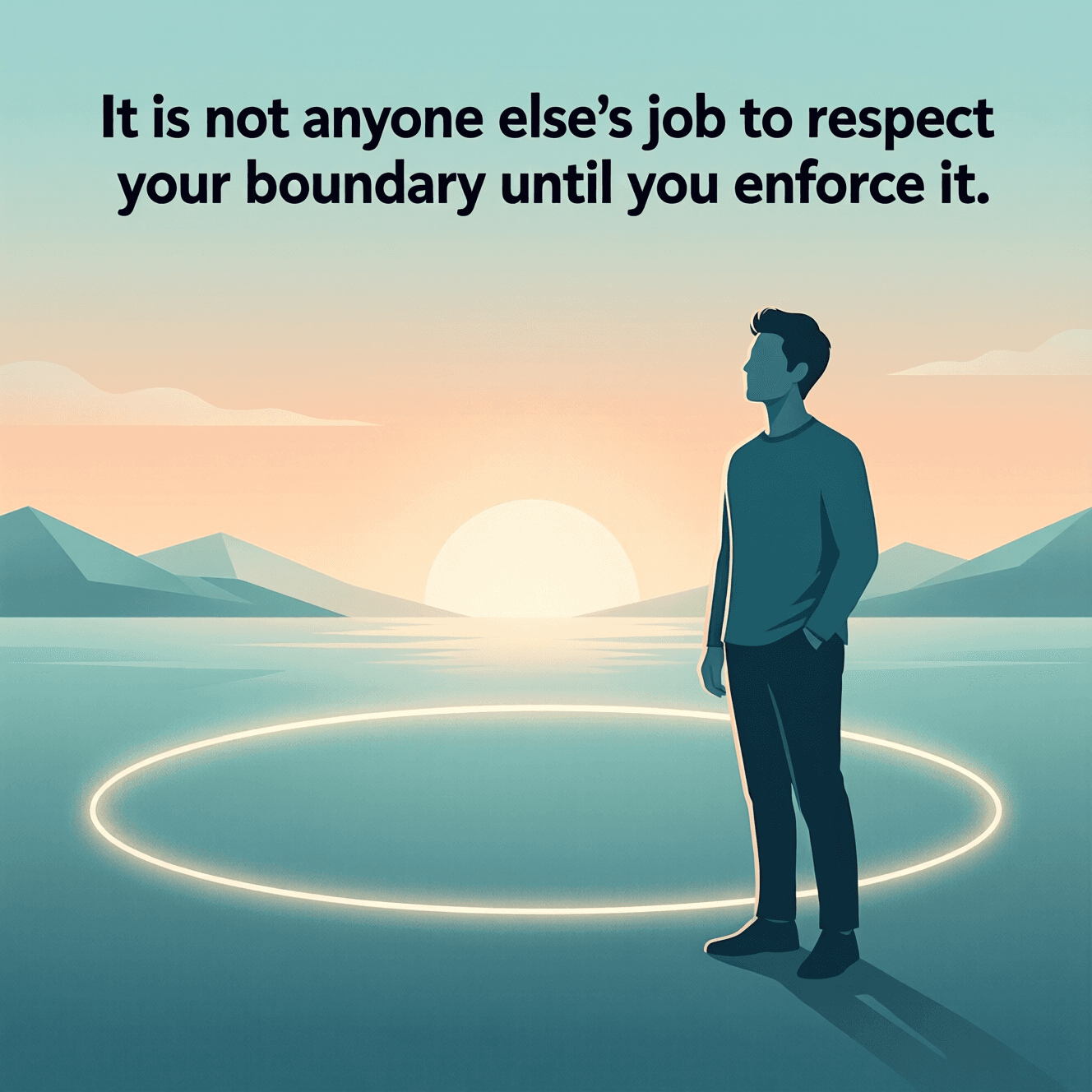
It is not anyone else's job to respect your boundary until you enforce it. — Nedra Glover Tawwab
—What lingers after this line?
The Core Claim: Responsibility Starts With You
Nedra Glover Tawwab’s line reframes boundaries as an active practice rather than a wish. It argues that while it would be ideal for others to intuit or honor our limits automatically, that expectation often leaves us stuck in resentment and disappointment. In other words, a boundary that lives only in your head is not yet a boundary in the world. From there, the quote places responsibility where it is most effective: with the person who needs the limit. This isn’t about blaming the boundary-setter for another person’s behavior; instead, it highlights the only part you can reliably control—your own actions, access, and follow-through.
Why People Don’t Automatically Respect Unenforced Limits
Even well-meaning people tend to follow the patterns that have worked before. If you’ve historically answered late-night calls, accepted last-minute requests, or tolerated intrusive questions, others may assume that access is normal. Habits form quickly in relationships, and unspoken expectations become invisible rules. Consequently, hoping someone will “just know” can set both parties up for conflict. Tawwab’s point is pragmatic: without a clear signal—stated plainly and reinforced consistently—others may interpret your discomfort as temporary mood rather than a genuine limit that changes what they can expect from you.
Enforcement: The Difference Between a Preference and a Boundary
A boundary is not merely a statement of what you like; it includes what you will do if the line is crossed. That action is the enforcement, and it’s what transforms a request into a reliable rule. For example, “Please don’t speak to me that way” is clearer when paired with, “If it continues, I’m ending the conversation and we can try again later.” This is where the quote becomes empowering. By defining the consequence as your own behavior—leaving, pausing, declining, limiting access—you avoid trying to control someone else. Enforcement makes the boundary tangible, and tangibility is what invites respect.
The Emotional Hurdles: Guilt, Fear, and Old Roles
If enforcing boundaries were easy, the quote wouldn’t land so sharply. Many people hesitate because they fear being labeled difficult, selfish, or unkind, especially if they were raised to prioritize harmony over honesty. Family roles can intensify this: the “peacemaker” may feel disloyal when they finally say no, while the “helper” may equate limits with abandonment. Yet this is precisely why Tawwab’s framing matters. Enforcement is often less about learning new scripts and more about tolerating the discomfort of change. When you endure the initial guilt without retreating, you teach both yourself and others that your limits are real and durable.
How Enforcement Builds Respect and Clarity Over Time
Once a boundary is consistently enforced, relationships gain predictability. Others learn what access looks like, what topics are off-limits, and what behavior ends an interaction. While some people may test the change at first, consistency usually reduces repeated violations because the outcome stops being negotiable. Over time, this clarity can improve intimacy rather than reduce it. When resentment decreases, communication becomes more direct, and trust grows because you are not silently absorbing harm. Respect, in this sense, is not begged for; it is cultivated through patterns of clear limits and steady follow-through.
A Practical Template for Enforcing Boundaries
A useful way to operationalize the quote is to move in three steps: name the boundary, name the consequence, then follow through. You might say, “I’m not available for work messages after 7 p.m. If you send them, I’ll respond the next day.” Or, “If you insult me, I’ll leave the room and we can talk when it’s respectful.” Finally, notice the deeper implication: enforcement is an ongoing commitment to self-respect. When you consistently protect your time, body, and emotional well-being, you communicate—without drama—that your needs matter. That message is often the first condition for others to take your boundary seriously.
One-minute reflection
What's one small action this suggests?
Related Quotes
6 selectedA boundary is a cue to others on how to love and respect you. — Nedra Glover Tawwab
Nedra Glover Tawwab
Nedra Glover Tawwab’s line reframes a boundary as something generous: a clear signal that helps other people understand what care looks like for you. Rather than being a wall that shuts others out, a boundary acts like a...
Read full interpretation →Boundaries are the path to self-respect and serenity. — Nedra Glover Tawwab
Nedra Glover Tawwab
Nedra Glover Tawwab’s line reframes boundaries as a pathway rather than a barricade. Instead of shutting people out, boundaries clarify what you can offer, what you cannot, and what you need to stay well.
Read full interpretation →Your boundary is not for them; it is for you. It is a statement of what you will and will not tolerate. — Nedra Glover Tawwab
Nedra Glover Tawwab
Nedra Glover Tawwab’s quote shifts the definition of a boundary away from controlling others and toward clarifying the self. Instead of functioning like a rulebook for someone else’s behavior, a boundary is presented as...
Read full interpretation →If someone is upset by your boundaries, it's a sign that they benefited from you not having any. — Nedra Glover Tawwab
Nedra Glover Tawwab
Nedra Glover Tawwab’s line points to a common turning point in relationships: the moment you begin naming what you will and won’t accept, the atmosphere shifts. Boundaries—whether about time, emotional labor, money, or a...
Read full interpretation →A boundary is a cue to you of what you need to do, not a requirement of what the other person must do. — Nedra Glover Tawwab
Nedra Glover Tawwab
Nedra Glover Tawwab’s quote pivots the common definition of a boundary away from other people’s compliance and toward your own clarity. Instead of being a rule you impose—“You must stop doing this”—a boundary becomes a p...
Read full interpretation →Honoring your own boundaries is the clearest message to others to honor them, too. — Gina Greenlee
Gina Greenlee
Gina Greenlee’s line treats boundaries less as private wishes and more as public communication. When you consistently honor your own limits—saying no without apology, pausing before overcommitting, or stepping away from...
Read full interpretation →More From Author
More from Nedra Glover Tawwab →Stop shrinking yourself to make others comfortable. Your peace is worth more than their approval. — Nedra Glover Tawwab
Nedra Glover Tawwab’s words begin with a quiet but powerful warning: when we constantly make ourselves smaller to keep others comfortable, we often pay with our confidence, honesty, and emotional well-being. This kind of...
Read full interpretation →It is not a sign that you are doing something wrong to need a break; it is a sign that you are human. — Nedra Glover Tawwab
At its core, Nedra Glover Tawwab’s quote rejects the harsh belief that constant productivity is the measure of worth. Instead, it reframes the need for a break as evidence of our basic humanity: bodies tire, minds overlo...
Read full interpretation →The most powerful relationship you will ever have is the relationship with yourself. — Nedra Glover Tawwab
Nedra Glover Tawwab’s quote places self-relationship at the center of human life, suggesting that every other bond is filtered through the one we have with ourselves. In other words, the way we speak to ourselves, interp...
Read full interpretation →Boundaries are not walls to keep others out, but gates to protect your own nervous system. — Nedra Glover Tawwab
At first glance, boundaries are often mistaken for rejection, distance, or emotional coldness. Yet Nedra Glover Tawwab’s image of gates rather than walls shifts the entire meaning: boundaries are not built to punish othe...
Read full interpretation →