
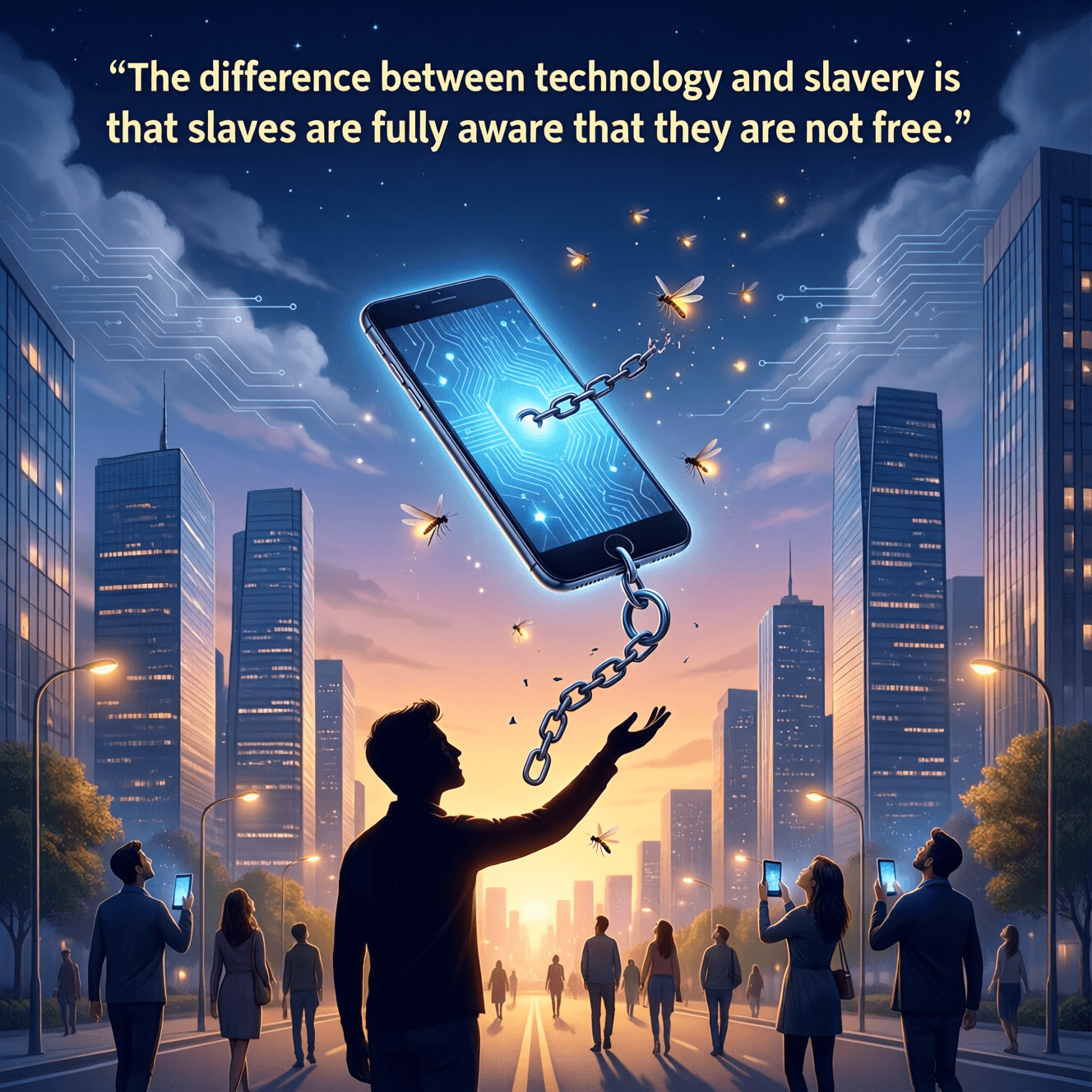
The difference between technology and slavery is that slaves are fully aware that they are not free. — Nassim Nicholas Taleb
—What lingers after this line?
A Provocation About Unseen Dependence
Taleb’s line works as a moral jolt: if slavery is defined by the loss of freedom, then the crucial difference he highlights is awareness. Enslaved people know their constraint is imposed; the modern technology user may feel autonomous while quietly adapting life around devices, platforms, and systems they do not control. This contrast is not meant to equate historical slavery with ordinary gadget use, but rather to expose a psychological vulnerability—dependence is easier to deepen when it is normalized and even celebrated as progress. From there, the quote invites a harder question: if a constraint is voluntarily adopted but later becomes unavoidable, at what point does convenience become captivity? The danger Taleb points to begins precisely when we stop noticing the trade being made.
Convenience as a Tool of Compliance
Once dependence is framed as comfort, technology’s constraints can feel like choices rather than obligations. Navigation apps reduce getting lost, messaging collapses distance, and digital payment eliminates friction; in exchange, users may surrender self-reliance, patience, and privacy without experiencing the surrender as a loss. The relationship is subtle because each step is small, and each benefit is immediate. This is why the comparison hinges on awareness: overt coercion triggers resistance, while incremental convenience invites consent. Over time, what started as “optional” can become socially mandatory—try attending modern work, school, or healthcare without certain apps or accounts—and the boundary between opting in and being locked in grows harder to see.
The Architecture of Lock-In
Following the trail from convenience to dependency leads to the concept of lock-in: systems that become costly—financially, socially, or professionally—to leave. Network effects mean the value of a service grows as everyone else uses it, so departure can feel like self-exile. Subscription models and proprietary ecosystems add another layer, shifting users from ownership toward continual rent. In that light, “freedom” becomes less about whether you can technically quit and more about what quitting would do to your relationships, income, and daily functioning. Taleb’s warning lands here: you may still feel free because no one is holding a chain, yet the practical consequences of leaving can function like one.
Attention, Habit, and the Quiet Erosion of Agency
A further step is internal rather than external: technology doesn’t only structure choices; it trains impulses. Persuasive design and algorithmic feeds can reward quick reactions, fragment attention, and make boredom intolerable, so that reaching for the device becomes automatic. In this sense, constraint is experienced as desire—people repeatedly choose what they later describe as draining. This aligns with the broader insight of behavioral psychology that habits can feel like preferences even when they bypass deliberation. Taleb’s contrast about awareness matters because the less conscious the habit, the less likely a person is to interpret it as a freedom problem at all; it simply becomes “how life is.”
Surveillance and the Price of Participation
As dependence deepens, the question shifts from what technology lets us do to what it enables others to know and influence. Data collection turns participation into a form of constant disclosure, often justified by personalization or safety. Yet when daily life—communication, transport, shopping, identity verification—routes through tracked channels, privacy becomes less a right than a luxury. Here the analogy’s bite sharpens: if someone is not fully aware of what is being extracted, they may interpret the arrangement as a fair exchange. The lack of transparency makes it difficult to consent meaningfully, and the normalization of monitoring makes the loss of freedom feel abstract until it becomes personally costly.
Fragility: When the System Fails, So Do We
Taleb frequently emphasizes fragility, and technology dependence can be fragile in precisely his sense: efficiency often removes redundancy. When GPS fails, people discover they no longer remember routes; when cloud services go down, work halts; when authentication systems lock accounts, identity and access vanish. The more tightly daily function is coupled to complex infrastructure, the more disabling a small failure can become. This fragility reinforces the illusion he critiques. In normal times, dependence feels like empowerment; only during disruption does the extent of non-freedom appear. Awareness, then, is not merely philosophical—it is practical preparedness for breakdowns that reveal how much autonomy has been outsourced.
Reclaiming Freedom Through Optionality and Limits
The natural transition from diagnosis is strategy: if the risk is unseen dependence, the remedy is to rebuild awareness and optionality. That can mean maintaining non-digital alternatives, limiting platforms that demand total integration, and favoring tools that are interoperable and user-controlled. It also means periodically testing your ability to abstain—brief “no-app” days, cash backups, offline maps—not as asceticism but as an audit of freedom. Taleb’s provocation ultimately pushes toward a simple principle: the freest relationship to technology is one where you can walk away without your life collapsing. When the exit remains real, the benefits of technology can be enjoyed without turning convenience into a cage.
One-minute reflection
What feeling does this quote bring up for you?
Related Quotes
6 selectedSelf-discipline is a form of freedom. Freedom from the slavery of your own moods. — Nassim Nicholas Taleb
Nassim Nicholas Taleb
Taleb’s line begins by flipping a common assumption: freedom is often imagined as fewer rules, fewer obligations, and maximum spontaneity. Yet he suggests that the more decisive liberty is internal—being able to act acco...
Read full interpretation →Difficulty is what wakes up the genius. — Nassim Nicholas Taleb
Nassim Nicholas Taleb
Taleb’s line suggests that genius is not a constant trait humming quietly in the background; instead, it is often dormant in comfort. When life is predictable, our minds can afford to run on routine, repeating what alrea...
Read full interpretation →To be free of a certain kind of ambition is a necessary condition for being a free man. — Nassim Nicholas Taleb
Nassim Nicholas Taleb
Taleb’s line begins with a provocation: some ambitions don’t elevate you—they tether you. The “certain kind” matters, because not all striving is corrosive; rather, it’s the ambition that makes your choices hostage to ex...
Read full interpretation →The wind extinguishes a candle and energizes a fire. You want to be the fire and wish for the wind. — Nassim Nicholas Taleb
Nassim Nicholas Taleb
Taleb compresses a whole philosophy into one physical contrast: the same wind that snuffs out a candle can make a fire roar. At first glance it reads like a motivational line, but it quickly becomes a diagnostic tool—whe...
Read full interpretation →If you need others to know that you are doing well, you're not doing well. — Nassim Nicholas Taleb
Nassim Nicholas Taleb
Taleb’s line frames a deceptively simple diagnostic: genuine stability tends to be quiet, while insecurity often needs an audience. If “doing well” requires constant broadcasting—through status updates, humblebrags, or r...
Read full interpretation →The three most harmful addictions are heroin, carbohydrates, and a monthly salary. — Nassim Nicholas Taleb
Nassim Nicholas Taleb
Nassim Nicholas Taleb’s line is built like a punch: heroin, carbohydrates, and a monthly salary. By placing an illegal opioid beside everyday food and ordinary employment, he forces the reader to pause and ask what “addi...
Read full interpretation →More From Author
More from Nassim Nicholas Taleb →Self-discipline is a form of freedom. Freedom from the slavery of your own moods. — Nassim Nicholas Taleb
Taleb’s line begins by flipping a common assumption: freedom is often imagined as fewer rules, fewer obligations, and maximum spontaneity. Yet he suggests that the more decisive liberty is internal—being able to act acco...
Read full interpretation →Difficulty is what wakes up the genius. — Nassim Nicholas Taleb
Taleb’s line suggests that genius is not a constant trait humming quietly in the background; instead, it is often dormant in comfort. When life is predictable, our minds can afford to run on routine, repeating what alrea...
Read full interpretation →To be free of a certain kind of ambition is a necessary condition for being a free man. — Nassim Nicholas Taleb
Taleb’s line begins with a provocation: some ambitions don’t elevate you—they tether you. The “certain kind” matters, because not all striving is corrosive; rather, it’s the ambition that makes your choices hostage to ex...
Read full interpretation →The wind extinguishes a candle and energizes a fire. You want to be the fire and wish for the wind. — Nassim Nicholas Taleb
Taleb compresses a whole philosophy into one physical contrast: the same wind that snuffs out a candle can make a fire roar. At first glance it reads like a motivational line, but it quickly becomes a diagnostic tool—whe...
Read full interpretation →