
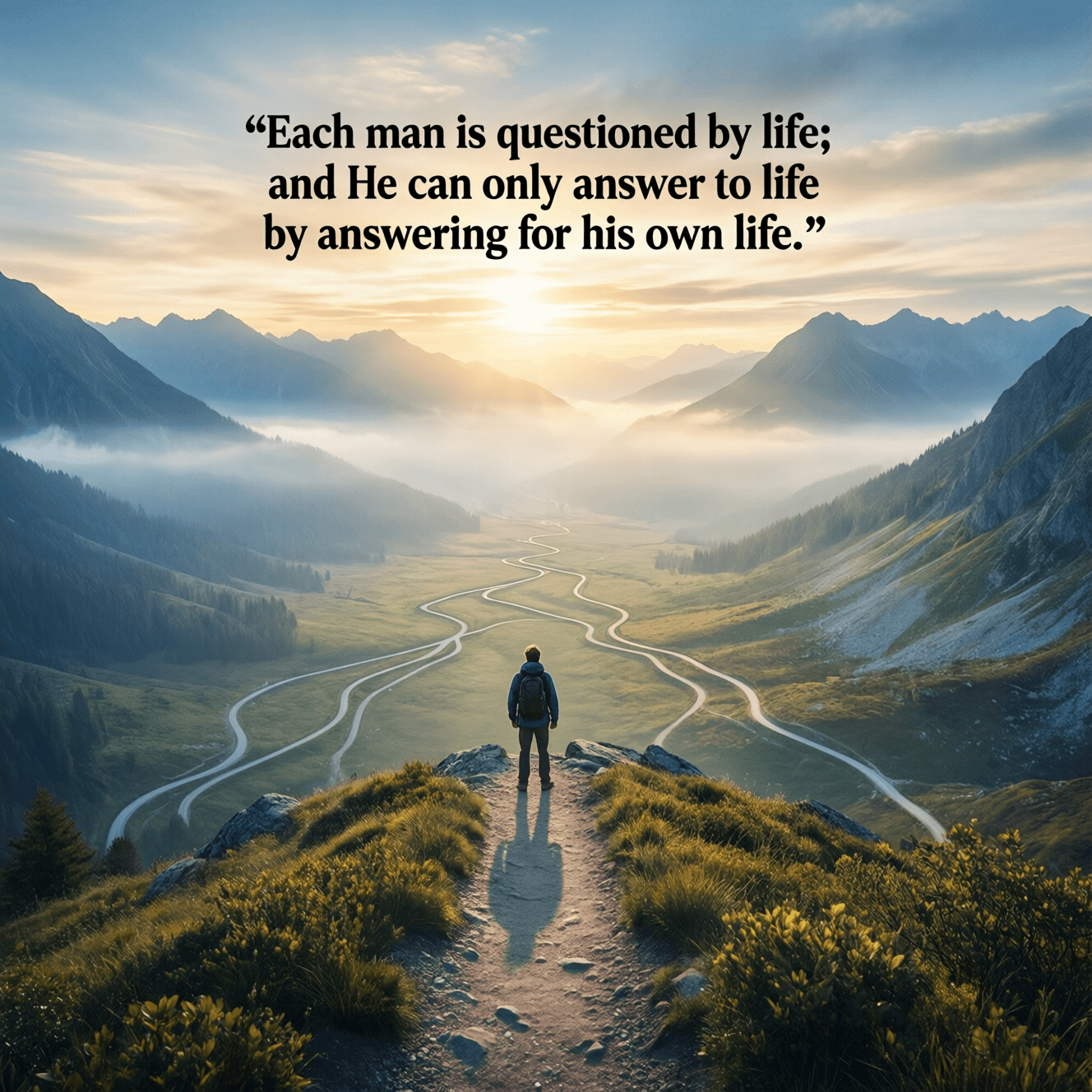
Each man is questioned by life; and he can only answer to life by answering for his own life. — Viktor Frankl
—What lingers after this line?
Life as the Questioner, Not the Answered
Frankl reverses a common assumption: instead of treating life like a puzzle we interrogate for meaning, he frames life as the one doing the asking. In this view, daily events—work demands, relationship conflicts, illness, chance encounters—arrive less like neutral facts and more like prompts directed at us. From that starting point, meaning becomes less a theory to discover and more a stance to take. The “question” is not abstract (“What is the meaning of life?”) but concrete (“What will you do with this day, this limitation, this opportunity?”), shifting attention from speculation to response.
The Only Adequate Reply: Your Own Life
When Frankl says we can only answer by “answering for” our own life, he emphasizes that the response is inseparable from action and character. Words, beliefs, or intentions may matter, but they become an answer only when embodied in choices that shape the life we actually live. Consequently, the arena of meaning is personal responsibility: not in the sense of blame, but in the sense of authorship. Even when circumstances are imposed, the reply remains ours—visible in how we treat others, how we work, what we refuse to do, and what we endure without surrendering our values.
Frankl’s Logotherapy: Meaning Through Responsibility
This line echoes the central thrust of Frankl’s logotherapy, developed after his experiences described in *Man’s Search for Meaning* (1946). He argued that the primary human drive is not pleasure or power, but meaning—and that meaning is discovered through responsibility to something beyond oneself, whether a task, a person, or a moral ideal. Seen this way, “life’s questions” are invitations to fulfill specific meanings unique to each situation. Rather than asking what we expect from life, Frankl urges the more demanding reversal: what does life—this moment, with its constraints—expect from us?
Freedom of Attitude Within Unchosen Circumstances
A crucial transition in Frankl’s thought is that responsibility does not require perfect freedom of circumstance. Many conditions cannot be changed quickly—or ever—yet a person still retains a limited but real freedom: the freedom to choose an attitude and the next right action within the given boundary. That is why the quote can apply as much to small frustrations as to major tragedies. The “answer” might be patience instead of bitterness, honesty instead of convenience, or perseverance instead of drift. In each case, life’s question is answered not by control but by deliberate orientation.
The Ethics of Self-Accountability Without Self-Condemnation
Because responsibility can sound harsh, Frankl’s formulation also helps clarify what it is not. Answering for one’s life is different from relentless self-condemnation; it is closer to a mature accounting that distinguishes between what was controllable and what was not, and then focuses energy on what remains possible. This is where the quote becomes ethically potent: it resists both victimhood and moral arrogance. We cannot outsource our reply to parents, politics, or fate, yet we also need not pretend omnipotence. The dignity lies in taking ownership of the next choice available.
Practicing the Quote: Turning Prompts Into Commitments
In practical terms, Frankl’s idea can be lived by treating recurring situations as repeated questions. A difficult colleague may be life asking about patience and boundaries; a creative opportunity may be life asking about courage; a season of grief may be life asking about fidelity to love even when it hurts. Over time, the accumulation of these answers becomes a life-story with moral texture. Meaning is not merely found once; it is composed—decision by decision—until one can look back and see not only what happened, but how one answered.
One-minute reflection
What does this quote ask you to notice today?
Related Quotes
6 selectedCharacter—the willingness to accept responsibility for one's own life—is the source from which self-respect springs. — Joan Didion
Joan Didion
Joan Didion frames character not as charm, talent, or reputation, but as a willingness to accept responsibility for one’s own life. The word “willingness” matters: it suggests an ongoing choice rather than a fixed trait,...
Read full interpretation →Let your suffering teach you the architecture of resilience. — Viktor Frankl
Viktor Frankl
Frankl’s injunction treats suffering not as a dead end but as a draftsman’s table. Pain, he implies, sketches load-bearing truths about who we are, where we fracture, and how we might be reinforced.
Read full interpretation →Life is a series of choices. It’s up to you to make them count. — David A. O. Smith
David A. O. Smith
This quote emphasizes the power individuals hold over their lives through the choices they make. It suggests that one’s agency is crucial in shaping their destiny.
Read full interpretation →Life is a question and how we live it is our answer. — Gary Keller
Gary Keller
This quote presents life as an overarching question that invites introspection. It suggests that our actions and choices serve as responses to the fundamental questions of existence and purpose.
Read full interpretation →We are not victims of our impulses or emotions; we have the power to control them. It is time to relinquish the excuses. — Allie Brosh
Allie Brosh
At its core, Allie Brosh’s quote rejects the comforting idea that emotions and impulses are irresistible forces. Instead, it insists that human beings possess agency: the ability to pause, choose, and act deliberately ev...
Read full interpretation →My will shall shape my future. Whether I fail or succeed shall be no man's doing but my own. — Elaine Maxwell
Elaine Maxwell
At its core, Elaine Maxwell’s statement is a declaration of personal agency. By saying that her will shall shape her future, she rejects the idea that destiny is merely handed down by circumstance, luck, or the judgments...
Read full interpretation →More From Author
More from Viktor Frankl →You are not responsible for your first thought, but you are responsible for your second thought. — Viktor Frankl
At its core, the quotation distinguishes between what arises automatically and what we deliberately endorse. A first thought may be reflexive, inherited, fearful, angry, or conditioned by habit; it appears before moral j...
Read full interpretation →The meaning of life differs from man to man, from day to day and from hour to hour. — Viktor Frankl
Frankl’s sentence immediately resists the idea that life has one universal, static answer. Instead, he frames meaning as something that changes with the individual and even with the passing of time—so what matters most t...
Read full interpretation →Meaning is not something you find; it is something you build. Stop waiting for a sign and start laying the bricks of your own purpose. — Viktor Frankl
Frankl’s line overturns a familiar hope—that life’s purpose is hidden somewhere, waiting to be uncovered like a buried artifact. Instead, he frames meaning as something made, assembled through choices and commitments ove...
Read full interpretation →Act with care, move with purpose, and leave behind a trail people want to follow. — Viktor Frankl
The opening directive—“Act with care”—frames life as something shaped by attention rather than impulse. Care here is not mere gentleness; it is the discipline of considering consequences, especially when other people’s d...
Read full interpretation →