
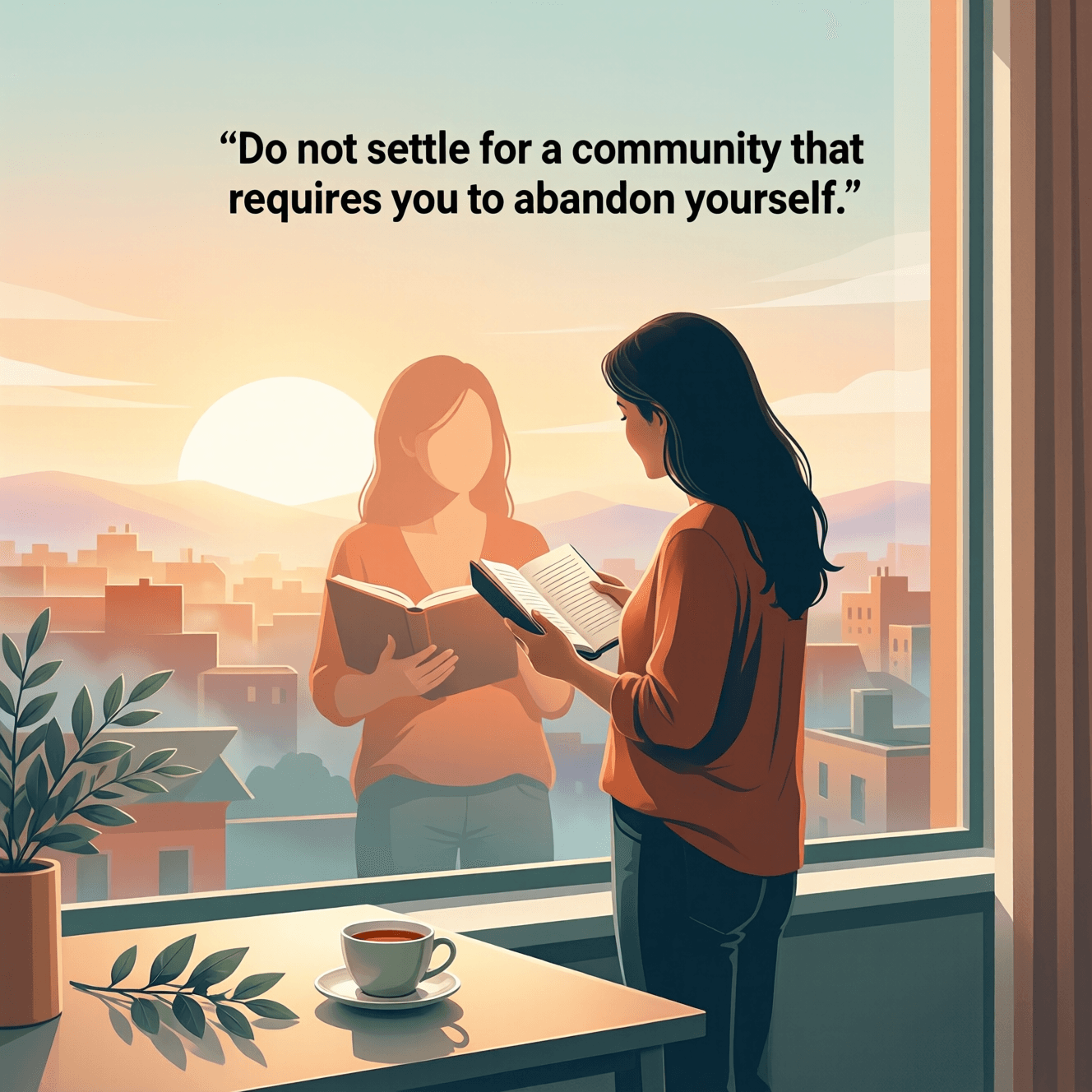
Do not settle for a community that requires you to abandon yourself. — bell hooks
—What lingers after this line?
The Cost of Conditional Acceptance
bell hooks’ warning begins with a hard truth: some forms of belonging come with a price tag hidden in the fine print. A community may offer safety, status, or companionship, yet quietly demand that you mute parts of your identity, soften your convictions, or perform a version of yourself that feels more “acceptable.” In that sense, the invitation to belong can become a negotiation over your inner life. From here, hooks pushes the question beyond whether a group feels welcoming in the moment and toward what it ultimately extracts. If acceptance depends on self-erasure, the relationship is less a home than an arrangement—stable on the surface, but spiritually expensive over time.
Belonging Versus Assimilation
To develop her point, it helps to distinguish belonging from assimilation. Belonging implies mutual recognition: you are received as you are, and you also shape the collective as a full participant. Assimilation, by contrast, offers membership only after you compress yourself to fit a dominant norm—whether that norm involves race, gender, class, sexuality, politics, or even tone and speech. Seen this way, hooks is not rejecting community; she is rejecting counterfeit community. The moment you must abandon yourself to stay, you are no longer relating as a whole person, and the group’s unity is purchased through your diminishment.
How Self-Abandonment Happens in Groups
Often, self-abandonment is not demanded explicitly; it arrives through small, repeating cues. You notice which stories are welcomed and which earn silence, which emotions are respected and which are labeled “too much,” which disagreements are treated as betrayal. Gradually, you learn to edit yourself before you even speak. As this pattern settles in, the community becomes an internalized supervisor: you anticipate the penalty for authenticity and preempt it by shrinking. hooks’ sentence captures that slippery slope—how belonging can turn into a daily practice of self-betrayal long before anyone calls it that.
Power, Love, and the Ethics of Community
hooks’ broader work repeatedly links love to justice, insisting that care without accountability can mask domination. In that frame, a community that demands self-abandonment is not simply imperfect; it is practicing a form of control. The group’s comfort becomes more important than your integrity, and harmony is maintained by silencing difference rather than engaging it. Consequently, her quote reads like an ethical boundary: if participation requires you to disappear, then the community’s “love” is conditional. Real solidarity makes room for truth-telling, even when that truth disrupts the group’s preferred self-image.
Signs of a Community Worth Staying In
Moving from critique to possibility, hooks’ line implies that better communities exist—ones that do not require your abandonment. Such spaces typically treat boundaries as normal, dissent as information, and growth as shared labor. You can make mistakes without being exiled, and you can name harm without being cast as the problem. Importantly, these communities don’t rely on a single “right” way to be human. Instead, they widen their norms through relationship, allowing members to become more themselves rather than less. Belonging, then, becomes a source of expansion rather than contraction.
Choosing Yourself Without Choosing Isolation
Finally, hooks offers a form of permission: leaving—or refusing—can be an act of self-respect, not failure. When a group requires self-erasure, walking away may be the first step toward a community grounded in mutual dignity. This is especially vital for people who have been taught that survival depends on pleasing others. At the same time, her message does not romanticize solitude; it reframes the search. The goal is not to endure alone, but to find or build relationships where you can remain intact—where community is not the opposite of selfhood, but its ally.
Recommended Reading
As an Amazon Associate, we earn from qualifying purchases.
One-minute reflection
Where does this idea show up in your life right now?
Related Quotes
6 selectedYou do not have to be understood to be heard, and you do not have to be perfect to be significant. — bell hooks
bell hooks
bell hooks challenges two common burdens at once: the pressure to be fully understood and the pressure to be flawless. At the heart of the quote is a liberating claim that human value does not depend on perfect translati...
Read full interpretation →Rarely do we find anyone who can stand to be the way they are. — bell hooks
bell hooks
bell hooks’ line points to a quiet, common struggle: many people find it hard to endure their own inner lives. Even when nothing dramatic is happening externally, the mind can become an inhospitable place—full of self-cr...
Read full interpretation →Live authentically; your truth is your power. — bell hooks
bell hooks
This quote emphasizes that being true to oneself is a source of power. When individuals embrace their true selves, they gain confidence and inner strength.
Read full interpretation →Authenticity is the rarest jewel, worn only by those daring to be real. — bell hooks
bell hooks
To begin with, bell hooks’ metaphor places authenticity among the most treasured human qualities—‘the rarest jewel’. In a culture that often rewards conformity, daring to be real requires both self-knowledge and the will...
Read full interpretation →Whatever you are willing to put up with is exactly what you will have. — Iyanla Vanzant
Iyanla Vanzant
At first glance, Iyanla Vanzant’s statement sounds blunt, yet its force comes from a simple truth: what we repeatedly allow begins to define the conditions of our lives. Tolerating disrespect, chaos, or neglect can funct...
Read full interpretation →If you want to be free, be as you are. Authenticity is the only currency that doesn't lose value. — Ai Weiwei
Ai Weiwei
Ai Weiwei’s statement opens with a striking condition: freedom is not merely granted by laws or institutions, but discovered in the courage to remain fully oneself. In this sense, “be as you are” is less a passive descri...
Read full interpretation →More From Author
More from bell hooks →A home is not a place, it's a feeling. It's the warmth you build with the people who actually hear you. — Bell Hooks
At first glance, Bell Hooks shifts home away from geography and architecture and into the realm of emotional experience. Her words suggest that home is not secured by walls, ownership, or even permanence, but by a sense...
Read full interpretation →You do not have to be understood to be heard, and you do not have to be perfect to be significant. — bell hooks
bell hooks challenges two common burdens at once: the pressure to be fully understood and the pressure to be flawless. At the heart of the quote is a liberating claim that human value does not depend on perfect translati...
Read full interpretation →The artist is a sort of emotional archaeologist. Digging through the layers of the self is not just a process; it is a necessity for clarity. — bell hooks
bell hooks frames the artist as an “emotional archaeologist,” and the image is striking because archaeology is never casual digging. It requires patience, method, and a willingness to uncover what time has buried.
Read full interpretation →The creative act is not an escape from reality, but a way to encounter it more deeply. — bell hooks
At first glance, creative work can look like withdrawal: a painter disappears into a studio, a writer vanishes into pages, a musician closes the door and listens inward. Yet bell hooks reverses that assumption.
Read full interpretation →