
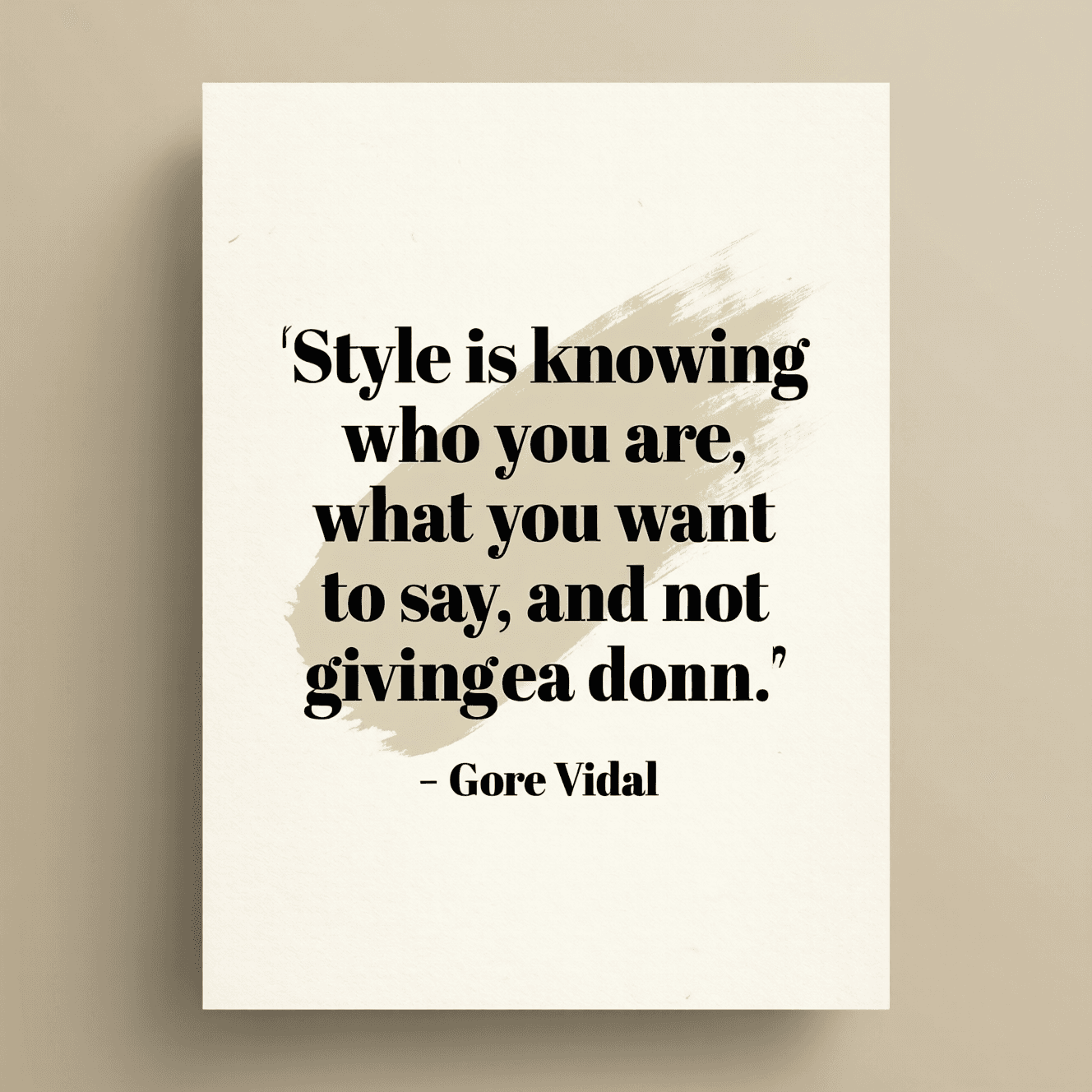
Style is knowing who you are, what you want to say, and not giving a damn — Gore Vidal
—What lingers after this line?
Style Beyond Surface Aesthetics
Gore Vidal’s line reframes “style” as something far deeper than fashion, manners, or a polished turn of phrase. Instead of treating style as decoration, he treats it as an outward sign of an inner stance: a person with style has already done the difficult work of self-definition. In that sense, style is not the frosting on the cake—it is the recipe. From the outset, Vidal also implies that style cannot be borrowed wholesale. You can imitate a silhouette, a voice, or a literary rhythm, but unless it originates in a coherent self, it reads as costume. What looks like effortless elegance is often simply the visible byproduct of clarity.
Knowing Who You Are
The first requirement—knowing who you are—places identity at the center of expression. Vidal points to a kind of internal alignment: values, taste, and temperament must come into focus before any “style” can feel authentic. This recalls the ancient demand to “know thyself,” a maxim associated with the Delphic tradition and echoed in Plato’s dialogues, where self-knowledge is portrayed as the groundwork for a well-ordered life. Once this self-knowledge exists, choices become simpler: what you wear, how you speak, and what you create start to cohere. Consequently, style appears less like a series of clever moves and more like consistency—a signature that’s hard to counterfeit because it’s rooted in lived self-understanding.
Knowing What You Want to Say
After identity comes intention: knowing what you want to say. Vidal suggests that style is inseparable from message; without a point of view, stylistic flourishes become noise. This is why some writing feels “stylish” yet empty—because it prioritizes effect over meaning—whereas other work feels sharp even when plain, because it knows exactly what it is trying to do. In practice, intention functions like a compass. Whether the medium is an essay, a painting, or a conversation, clarity about purpose shapes every decision: what to emphasize, what to omit, when to be blunt, and when to be lyrical. As a result, “style” becomes the disciplined art of saying one thing well rather than many things vaguely.
The Freedom of Not Caring
Vidal’s final clause—“not giving a damn”—introduces the social risk inherent in genuine expression. Once you know yourself and your message, the biggest threat is often external: the pull of approval, the fear of ridicule, or the temptation to soften your edges to fit the room. Vidal frames indifference to that pressure not as rudeness, but as creative and personal freedom. Importantly, this isn’t the same as being thoughtless. It is closer to refusing to let imagined spectators edit your voice. In this way, “not giving a damn” becomes the protective barrier that keeps self-knowledge and intention from being diluted into something merely acceptable.
Authenticity Versus Performance
Taken together, the quote argues that style is authenticity with nerve. Many people perform a version of themselves that is optimized for praise—an identity assembled from trends and audience expectations. Vidal’s definition cuts against that performance by insisting that style begins before the audience arrives: you decide who you are and what you mean, and only then do you present it. This distinction explains why some figures seem stylish even in plain clothes or simple prose: they are not constantly negotiating their image. Their consistency creates trust, and their lack of anxious self-correction makes their choices feel intentional rather than strategic. Thus, style becomes less about spectacle and more about integrity made visible.
Cultivating Vidal’s Kind of Style
If Vidal’s formula sounds provocative, it is also practical. Self-knowledge can be developed by paying attention to patterns—what you repeatedly admire, what you cannot tolerate, what you defend even when it costs you. From there, clarifying what you want to say often means choosing a few commitments and letting them shape your tone, habits, and craft. Finally, the “not giving a damn” portion can be practiced incrementally: saying one honest sentence you would normally withhold, wearing something because it feels like you rather than because it signals status, or writing a paragraph that prioritizes truth over likability. Over time, those small acts of defiance knit together into what Vidal calls style: a self, a message, and the courage to stand by both.
One-minute reflection
Why might this line matter today, not tomorrow?
Related Quotes
6 selectedBe who you are and say what you feel, because those who mind don't matter, and those who matter don't mind. — Bernard M. Baruch
Bernard M. Baruch
Baruch’s quote begins with a simple but demanding instruction: be yourself and speak honestly. At its core, the line argues that authenticity is not merely a personality trait but an act of courage, especially in a world...
Read full interpretation →You're born an original—don't die a copy. — John Mason
John Mason
At its core, John Mason’s line is a sharp reminder that every person begins life with a distinct combination of temperament, talent, and perspective. To be “born an original” suggests that individuality is not something...
Read full interpretation →Authenticity is a habit. It is a road we are comfortable with. — Ai Weiwei
Ai Weiwei
At first glance, Ai Weiwei’s statement shifts authenticity away from dramatic self-revelation and toward repetition. By calling it a habit, he suggests that being genuine is not an occasional act of courage but a pattern...
Read full interpretation →Quietly persist. The world is loud, but your work only needs to be true. — Anne Lamott
Anne Lamott
Anne Lamott’s line begins with a simple imperative: “Quietly persist.” At once, it rejects the idea that meaningful work must announce itself to be real. Instead, she points toward a steadier form of effort, one rooted i...
Read full interpretation →Fitting in is one of the greatest barriers to belonging. Belonging doesn't require us to change who we are; it requires us to be who we are. — Brené Brown
Brené Brown
At the heart of Brené Brown’s statement is a crucial distinction: fitting in is about adaptation, while belonging is about acceptance. When people try to fit in, they often study the room, edit themselves, and perform wh...
Read full interpretation →You don't need a formal invitation to be exactly who you are. — Brené Brown
Brené Brown
At its heart, Brené Brown’s statement rejects the quiet habit of waiting for approval before living honestly. It suggests that authenticity is not something granted by family, institutions, or social circles; rather, it...
Read full interpretation →More From Author
More from Gore Vidal →