
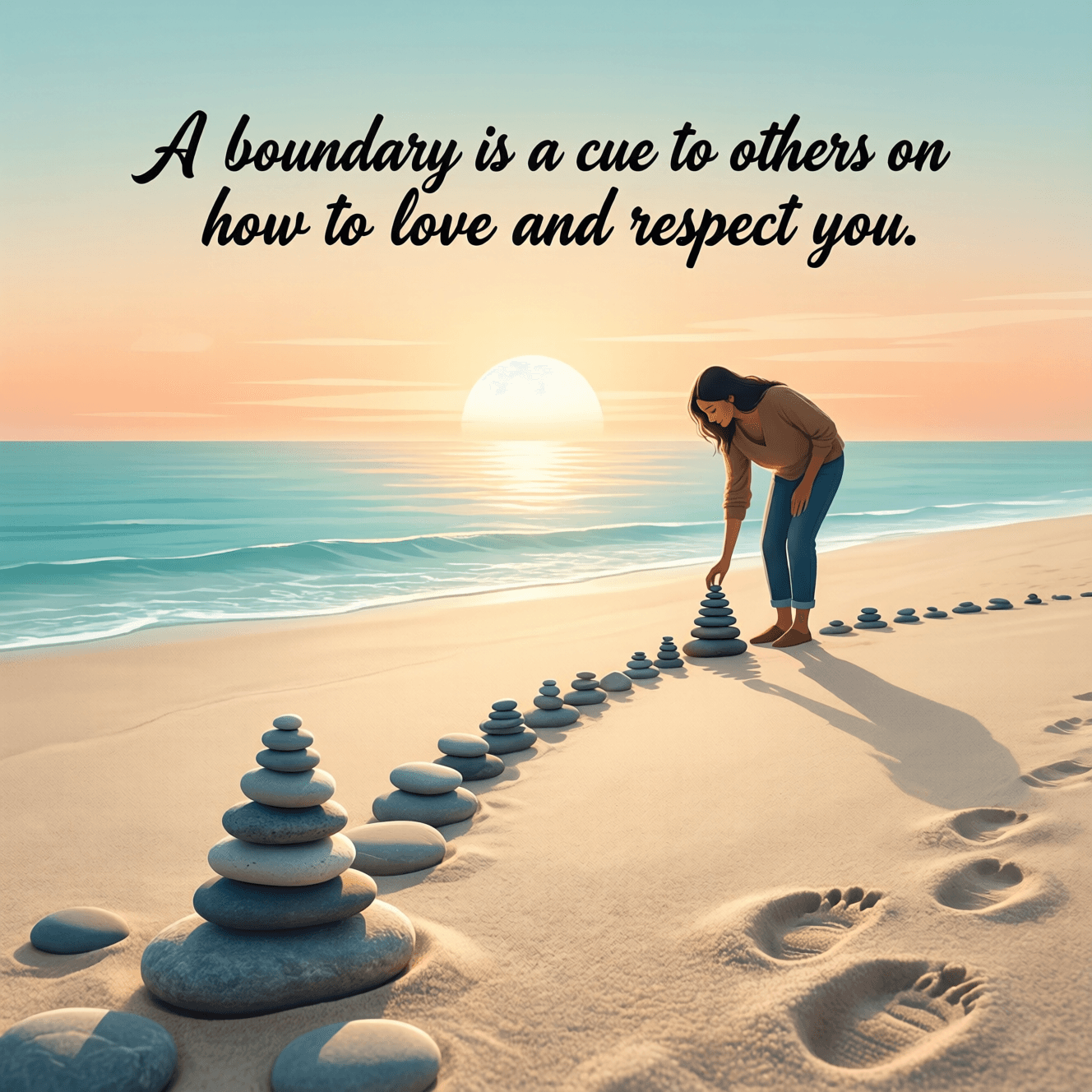
A boundary is a cue to others on how to love and respect you. — Nedra Glover Tawwab
—What lingers after this line?
Boundaries as Clarity, Not Coldness
Nedra Glover Tawwab’s line reframes a boundary as something generous: a clear signal that helps other people understand what care looks like for you. Rather than being a wall that shuts others out, a boundary acts like a set of directions—specific, observable, and easier to follow than unspoken expectations. In that sense, boundaries reduce guesswork in relationships. When people don’t know what hurts, overwhelms, or diminishes you, they often rely on their own defaults, which may not match your needs. A boundary turns vague discomfort into clear information, making respect more achievable.
The Difference Between Hints and Cues
Building on that idea, calling a boundary a “cue” highlights how often we communicate indirectly—through silence, resentment, or withdrawal—when a straightforward message would be kinder and more effective. Many conflicts aren’t rooted in malice; they arise because someone missed a signal that was never actually stated. A cue, however, is meant to be noticed. Saying, “I can talk, but not after 9 p.m.,” gives a person a concrete way to succeed with you. In contrast, hoping they’ll infer it from your mood sets both of you up for frustration and a cycle of repair that could have been prevented.
Self-Respect as the Foundation of Mutual Respect
From there, the quote points to an internal starting place: boundaries first communicate that your needs matter. When you treat your own time, body, energy, and emotions as worthy of protection, you implicitly teach others to treat them that way too. This isn’t about demanding special treatment; it’s about setting a baseline for dignity. In practice, someone who repeatedly says yes while feeling violated trains others to expect access. A boundary interrupts that pattern and replaces it with a healthier lesson: connection is welcome, but it must be reciprocal and considerate.
Healthy Love Learns and Adapts
Once boundaries are seen as cues, love becomes less about mind-reading and more about responsiveness. Caring people can adjust when they know what matters to you, and a relationship strengthens when both sides can make course corrections without shame. For example, a friend who tends to vent for an hour may not realize you’re drained afterward. When you say, “I can listen for fifteen minutes, then I need to switch topics,” you’re offering a structure that preserves the friendship rather than silently accumulating resentment. Over time, this kind of adaptation becomes a shared language of respect.
What Boundaries Are—and What They Aren’t
Still, it helps to clarify what a boundary is not. It isn’t a tool to control someone else’s choices; it’s a statement of what you will do to take care of yourself in response to those choices. That shift keeps boundaries grounded in responsibility rather than punishment. So instead of, “You can’t speak to me like that,” a boundary might be, “If you raise your voice, I will end the conversation and revisit it later.” The first tries to manage another person; the second communicates your limit and your follow-through, which is precisely what makes it a usable cue.
Consistency Turns Cues Into Trust
Finally, boundaries only function as cues when they are consistent. If the message changes depending on guilt, fear, or fatigue, others can’t reliably learn how to love you well, and you may start doubting your own limits. Consistency doesn’t require harshness; it requires follow-through with compassion. When you repeat your boundary calmly and act on it when necessary, you create predictability—and predictability is a form of safety. Over time, that safety makes relationships sturdier, because respect stops being accidental and becomes a practiced way of relating.
Recommended Reading
As an Amazon Associate, we earn from qualifying purchases.
One-minute reflection
What does this quote ask you to notice today?
Related Quotes
6 selectedBoundaries are not walls to keep others out, but gates to protect your own nervous system. — Nedra Glover Tawwab
Nedra Glover Tawwab
At first glance, boundaries are often mistaken for rejection, distance, or emotional coldness. Yet Nedra Glover Tawwab’s image of gates rather than walls shifts the entire meaning: boundaries are not built to punish othe...
Read full interpretation →Your boundary is not for them; it is for you. It is a statement of what you will and will not tolerate. — Nedra Glover Tawwab
Nedra Glover Tawwab
Nedra Glover Tawwab’s quote shifts the definition of a boundary away from controlling others and toward clarifying the self. Instead of functioning like a rulebook for someone else’s behavior, a boundary is presented as...
Read full interpretation →If you're over-explaining, you're usually over-compensating for a boundary you're not willing to keep. — Nedra Glover Tawwab
Nedra Glover Tawwab
Nedra Glover Tawwab’s line reframes over-explaining as more than a communication quirk; it becomes a clue about inner conflict. When someone keeps adding reasons, clarifications, and context, they may be trying to earn p...
Read full interpretation →A boundary is a door, not a wall. It is the distance at which I can love you and still love myself. — Nedra Glover Tawwab
Nedra Glover Tawwab
Nedra Glover Tawwab flips a common assumption: boundaries are often treated like cold barricades, but she calls them “a door.” That image matters because doors are meant to open and close with intention, letting closenes...
Read full interpretation →Self-care is more than a spa day. It is the ability to say no to people and situations that drain your energy. — Nedra Glover Tawwab
Nedra Glover Tawwab
Nedra Glover Tawwab’s quote begins by dismantling a common misconception: that self-care is primarily about treats, products, or occasional relaxation rituals. While comfort can be restorative, she argues that it’s not t...
Read full interpretation →Boundaries are the path to self-respect and serenity. — Nedra Glover Tawwab
Nedra Glover Tawwab
Nedra Glover Tawwab’s line reframes boundaries as a pathway rather than a barricade. Instead of shutting people out, boundaries clarify what you can offer, what you cannot, and what you need to stay well.
Read full interpretation →More From Author
More from Nedra Glover Tawwab →Boundaries are not walls to keep others out, but gates to protect your own nervous system. — Nedra Glover Tawwab
At first glance, boundaries are often mistaken for rejection, distance, or emotional coldness. Yet Nedra Glover Tawwab’s image of gates rather than walls shifts the entire meaning: boundaries are not built to punish othe...
Read full interpretation →You do not have to fix everything today, this week, or alone. You can rebuild—gently, slowly, and sustainably. — Nedra Glover Tawwab
Nedra Glover Tawwab’s words begin by challenging a familiar pressure: the belief that healing must happen immediately and completely. By saying, “You do not have to fix everything today, this week, or alone,” she interru...
Read full interpretation →The greatest gift you can give an anxious mind is a home that serves as a sanctuary, where you can be heard without being judged. — Nedra Glover Tawwab
At its core, Nedra Glover Tawwab’s quote redefines home as more than a physical shelter. She presents it as an emotional refuge, a place where an anxious mind can finally lower its guard.
Read full interpretation →A boundary is not about pushing people away; it's about protecting the energy you need to thrive. — Nedra Glover Tawwab
At first glance, boundaries are often mistaken for walls, as if saying no automatically signals rejection. Yet Nedra Glover Tawwab’s statement gently corrects that misunderstanding: a boundary is less about distancing ot...
Read full interpretation →