
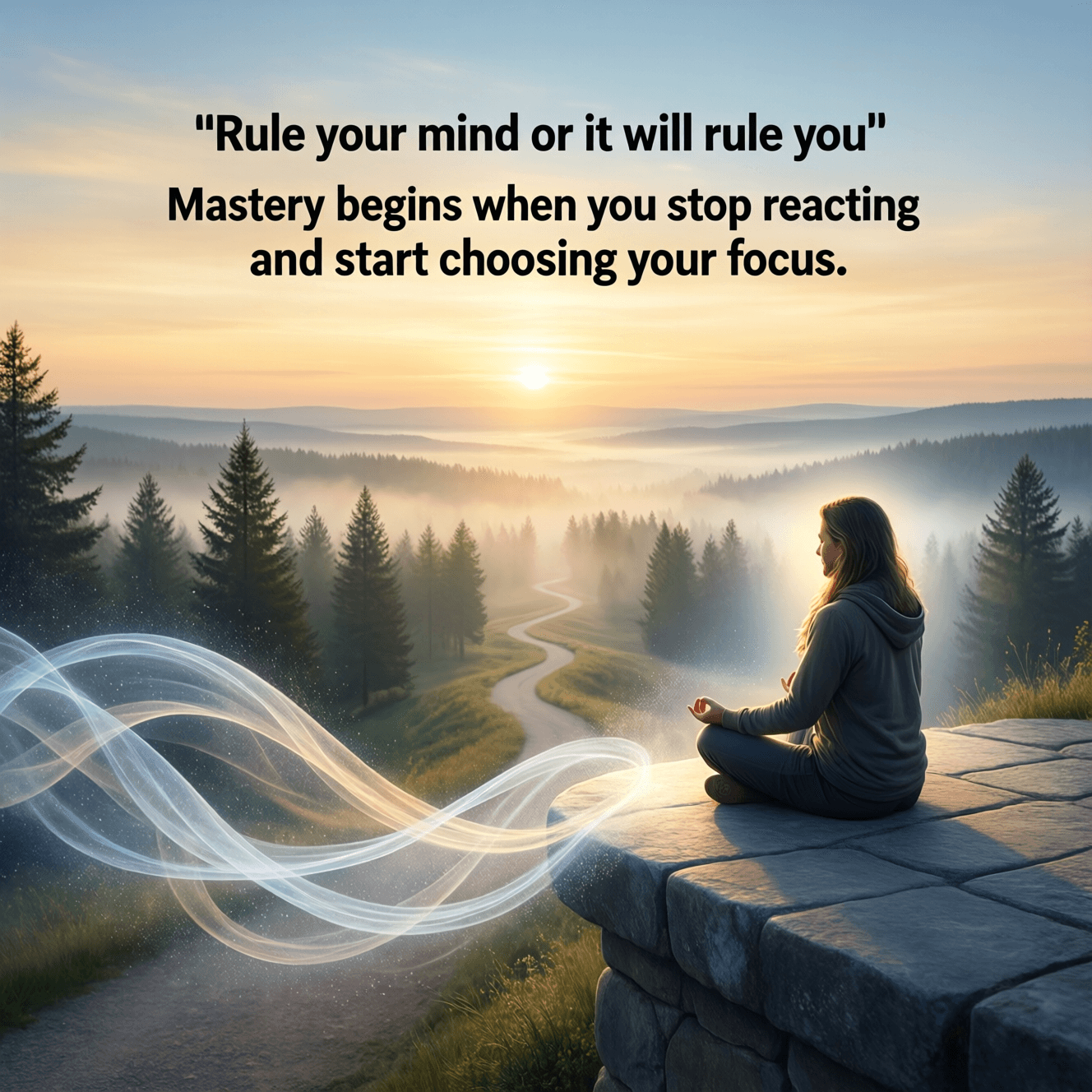
Rule your mind or it will rule you. Mastery begins when you stop reacting and start choosing your focus. — Horace
—What lingers after this line?
The Core Warning Behind the Quote
Horace’s line frames the mind as a powerful instrument that can either serve or dominate its owner. The warning is not that thoughts and emotions exist, but that—left unattended—they can steer behavior through impulse, habit, and fear, quietly becoming the “ruler” of our days. From there, the quote pivots to a practical claim: mastery starts at the moment we notice ourselves reacting automatically. That noticing creates a gap—small but decisive—where choice becomes possible, and where focus can be directed rather than stolen.
From Reflex to Choice: Where Mastery Starts
The phrase “stop reacting and start choosing” points to a shift from reflexive living to intentional living. Reaction is fast, emotionally loaded, and often borrowed from past conditioning; choice is slower, values-based, and responsive to the present. This distinction echoes later Stoic language that grew from Horace’s era: Epictetus’ *Enchiridion* (c. 125 AD) emphasizes what is “up to us” versus what is not, suggesting freedom begins when we govern our inner responses. In that sense, the first act of mastery is not control of the world, but authorship of our next move.
Attention as a Finite Resource
Once choice becomes possible, focus becomes the lever. Attention is limited, and whatever repeatedly captures it tends to shape identity—what you notice becomes what you practice, and what you practice becomes what you are good at. Modern psychology supports this in practical terms: research on attentional control and goal pursuit shows that people who can sustain attention and inhibit distractions generally perform better and report greater well-being. Seen this way, “choosing your focus” isn’t motivational fluff; it’s a daily budgeting decision about where your mental energy will go.
The Mind’s Default: Habit, Not Wisdom
Even with good intentions, the mind tends to default to what is familiar—rumination, worry, comparison, or pleasure-seeking—because habit is efficient. That efficiency can look like “the mind ruling you,” especially when a single trigger (a message, an insult, a memory) reliably pulls you into the same emotional script. Therefore, mastery requires more than willpower in the moment; it requires redesigning the defaults. By repeatedly redirecting attention—back to the task, the breath, or the value at stake—you train the mind to treat choice as the normal path, not the exception.
Practicing the Pause: A Small Gap With Big Effects
A workable method implied by the quote is the deliberate pause between stimulus and response. Viktor Frankl describes this gap in *Man’s Search for Meaning* (1946): “Between stimulus and response there is a space… in our response lies our growth and our freedom.” That “space” is exactly where reacting can become choosing. In everyday life, the pause might be as simple as naming the emotion—“anger,” “anxiety,” “envy”—before acting. The label slows the cascade, making it easier to redirect focus toward what you actually want to build rather than what you momentarily feel.
Freedom Through Focused Values
Choosing focus is easiest when it is anchored in values, because values outlast moods. If your value is craftsmanship, you return to the work; if it is kindness, you return to a measured reply; if it is health, you return to the next good choice—even after a lapse. Over time, this repeated return becomes a form of self-rule: not a rigid suppression of feelings, but a steady preference for what matters. In that final sense, Horace’s advice is less about dominating the mind and more about befriending it—training attention to align with intention until mastery becomes a lived habit.
One-minute reflection
What feeling does this quote bring up for you?
Related Quotes
6 selectedRule your mind or it will rule you. — Horace
Horace
Horace’s line distills a political truth into a personal mandate: either you govern your inner life, or it becomes the regime that governs you. By framing the mind as something that can “rule,” he implies it has momentum...
Read full interpretation →Master your attention, and you master your life — Marcus Aurelius
Marcus Aurelius
At the outset, Marcus Aurelius’s maxim distills a Stoic conviction: the quality of our attention determines the quality of our living. In Meditations, he urges, “Confine yourself to the present,” implying that attention...
Read full interpretation →Your attention is your most precious currency; spend it on what nourishes your future rather than what exhausts your present. — Cal Newport
Cal Newport
At its core, Cal Newport’s statement reframes attention as a form of currency: limited, valuable, and constantly at risk of being wasted. By calling it ‘your most precious currency,’ he implies that what we notice, dwell...
Read full interpretation →The mind freed from passions is an impenetrable fortress — a person has no more secure place of refuge for all time. — Marcus Aurelius
Marcus Aurelius
At the heart of Marcus Aurelius’s statement lies a distinctly Stoic image: the mind, once freed from destructive passions, becomes a fortress no external force can breach. In his Meditations (c.
Read full interpretation →Courage is less about fearlessness than training the mind to act with clarity and conviction. — Ranjay Gulati
Ranjay Gulati
Ranjay Gulati’s line begins by overturning a common myth: that courage belongs to people who simply don’t feel afraid. Instead, he frames fear as normal—and even expected—while locating courage in what happens next.
Read full interpretation →Train your mind like a garden: remove the weeds and welcome the sun. — Marcus Aurelius
Marcus Aurelius
Marcus Aurelius frames the mind as something living—capable of growth, decay, and renewal—rather than a fixed container of thoughts. A garden isn’t improved by force of will alone; it changes through patient, repeated ca...
Read full interpretation →More From Author
More from Horace →Rule your mind or it will rule you; most burnout is just a failure to set boundaries between your peace and your output. — Horace
At its core, the quotation argues that self-governance is not a luxury but a necessity. To ‘rule your mind’ means refusing to let impulses, anxieties, and external demands dictate the shape of one’s life.
Read full interpretation →Rule your mind or it will rule you. — Horace
Horace’s line distills a political truth into a personal mandate: either you govern your inner life, or it becomes the regime that governs you. By framing the mind as something that can “rule,” he implies it has momentum...
Read full interpretation →Seize the day, put very little trust in tomorrow. — Horace
This quote embodies the 'carpe diem' philosophy, encouraging people to live in the present moment and make the most of the opportunities available today.
Read full interpretation →Seize the day, and put the least possible trust in tomorrow. — Horace
This quote emphasizes the importance of living in the moment. It encourages individuals to make the most of today rather than deferring actions and ambitions to an uncertain future.
Read full interpretation →