
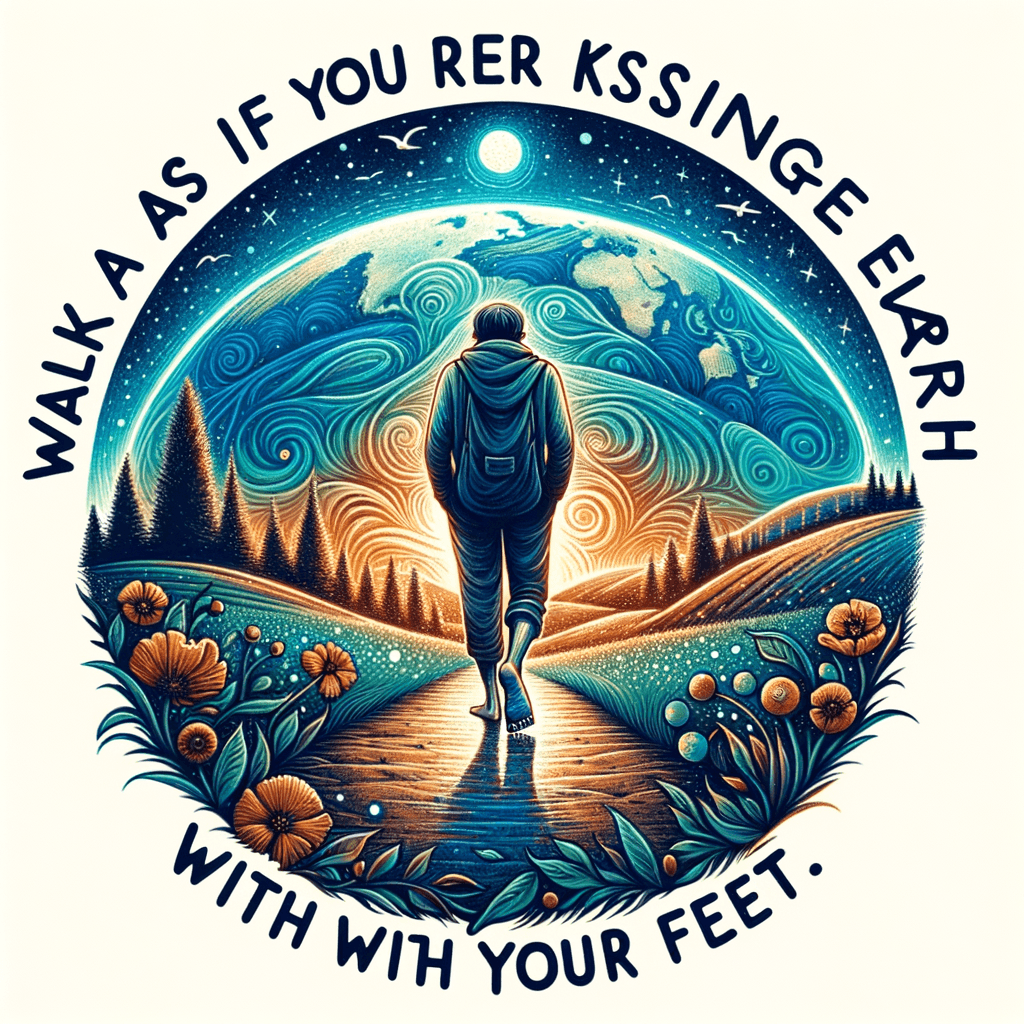
Walk as if you are kissing the Earth with your feet. — Thich Nhat Hanh
—What lingers after this line?
Mindfulness
This quote encourages us to practice mindfulness in our daily actions. Walking with awareness allows us to connect deeply with the present moment and our surroundings.
Respect for the Earth
It emphasizes a sense of reverence and respect for our planet. Walking gently and consciously on the Earth signifies taking care of it and appreciating its gifts.
Grace and Delicacy
The act of 'kissing the Earth' with our feet suggests a graceful, delicate way of moving through life. It implies that our actions should be gentle and considerate.
Spiritual Practice
Thich Nhat Hanh, a Buddhist monk, nudges us towards a spiritual practice where every step is a form of meditation. It encourages turning simple acts like walking into sacred experiences.
Interconnectedness
The quote reflects the Buddhist idea of interconnectedness, reminding us that we are intrinsically linked to the Earth and all living beings. Walking mindfully helps us recognize and honor this connection.
Historical Context
Thich Nhat Hanh, a Vietnamese Buddhist monk and peace activist, has written extensively on mindfulness and peace. His teachings often bridge Eastern spiritual practices with Western mindfulness techniques.
One-minute reflection
Why might this line matter today, not tomorrow?
Related Quotes
6 selectedThe world is moving fast, but the soul travels at the speed of a walk. — Proverb
Proverb
The proverb begins by splitting experience into two tempos: the world’s and the soul’s. Technology, schedules, and expectations accelerate our outer lives, yet our inner life—meaning, grief, joy, conviction—refuses to be...
Read full interpretation →Drink your tea slowly and reverently, as if it is the axis of the world. — Thich Nhat Hanh
Thich Nhat Hanh
Thich Nhat Hanh’s invitation to drink tea “slowly and reverently” turns an ordinary act into a meditation. By calling tea “the axis of the world,” he suggests that the present moment—however small—can become the stable c...
Read full interpretation →Your actions are your only true belongings. — Thich Nhat Hanh
Thich Nhat Hanh
This quote emphasizes the importance of personal responsibility. It suggests that our actions define us and are the truest measure of who we are.
Read full interpretation →If we are facing in the right direction, all we have to do is keep walking. — Thích Nhất Hạnh
Thich Nhat Hanh
Thích Nhất Hạnh’s words begin with a simple but profound premise: progress depends first on direction, not speed. If a person is turned toward compassion, clarity, healing, or truth, then each modest step becomes meaning...
Read full interpretation →You must love in such a way that the person you love feels free. — Thich Nhat Hanh
Thich Nhat Hanh
At its core, Thich Nhat Hanh’s statement redefines love as an act of care that does not confine. To love someone so that they feel free means offering affection without turning it into control, guilt, or dependence.
Read full interpretation →We are not islands; we are threads in a tapestry. To pull away from the weave is to lose the very texture that makes life hold together. — Thich Nhat Hanh
Thich Nhat Hanh
At its core, Thich Nhat Hanh’s image of threads in a tapestry rejects the fantasy of total self-sufficiency. A single thread may exist on its own, yet it gains meaning, strength, and beauty only through its relation to o...
Read full interpretation →More From Author
More from Thich Nhat Hanh →If we are facing in the right direction, all we have to do is keep walking. — Thích Nhất Hạnh
Thích Nhất Hạnh’s words begin with a simple but profound premise: progress depends first on direction, not speed. If a person is turned toward compassion, clarity, healing, or truth, then each modest step becomes meaning...
Read full interpretation →You must love in such a way that the person you love feels free. — Thich Nhat Hanh
At its core, Thich Nhat Hanh’s statement redefines love as an act of care that does not confine. To love someone so that they feel free means offering affection without turning it into control, guilt, or dependence.
Read full interpretation →We are not islands; we are threads in a tapestry. To pull away from the weave is to lose the very texture that makes life hold together. — Thich Nhat Hanh
At its core, Thich Nhat Hanh’s image of threads in a tapestry rejects the fantasy of total self-sufficiency. A single thread may exist on its own, yet it gains meaning, strength, and beauty only through its relation to o...
Read full interpretation →When you learn how to suffer, you suffer far less. Resilience is not about avoiding the fire; it is about becoming fireproof. — Thich Nhat Hanh
At first glance, Thich Nhat Hanh’s quote appears paradoxical: how could learning to suffer make suffering lighter? Yet his point is that pain intensifies when we resist it, fear it, or treat it as a personal failure.
Read full interpretation →