
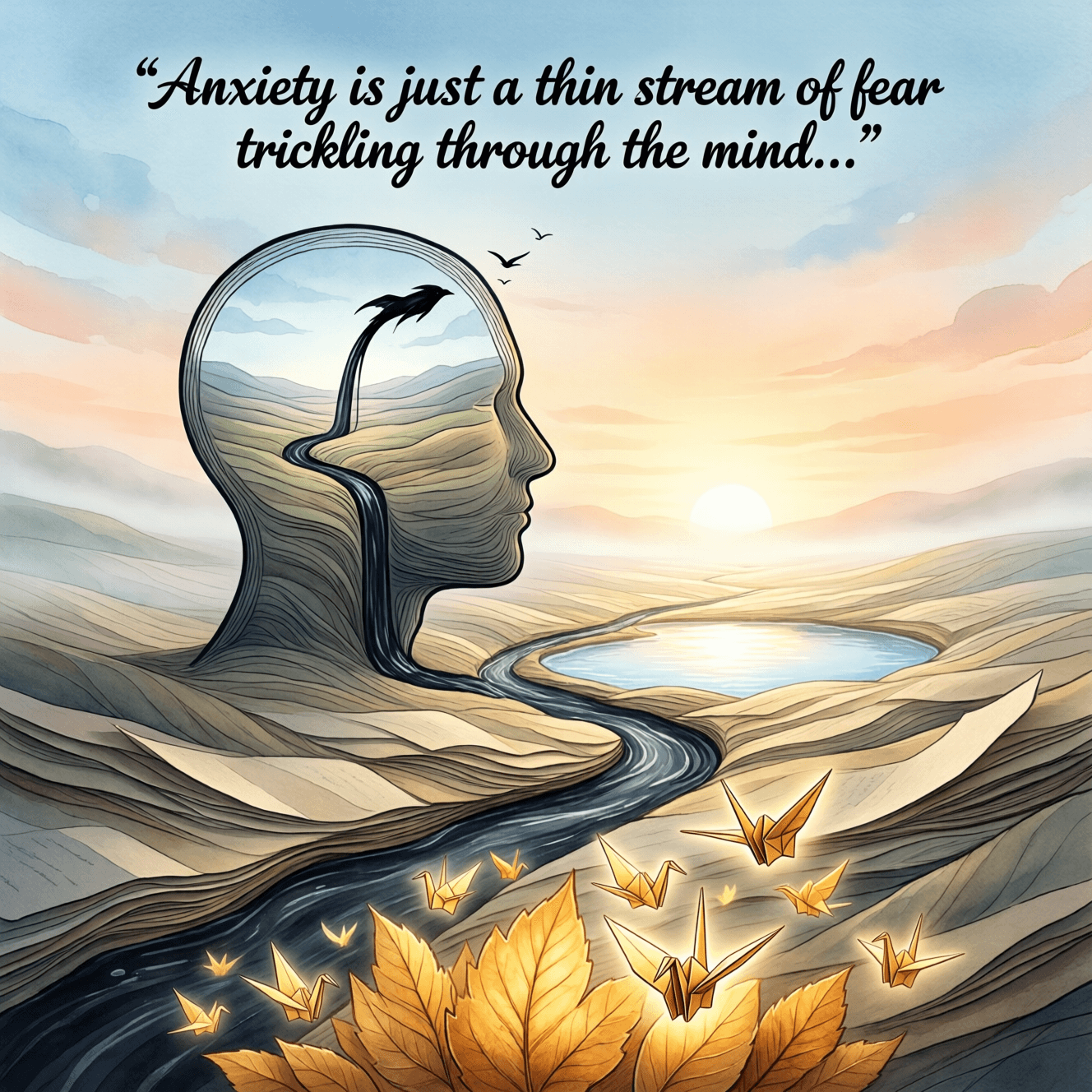
Anxiety is just a thin stream of fear trickling through the mind. If encouraged, it cuts a channel into which all other thoughts are drained. — Arthur Somers Roche
—What lingers after this line?
A Metaphor of Water and Thought
Arthur Somers Roche frames anxiety as water: not a flood at first, but a “thin stream” that quietly moves through the mind. That image matters because it suggests anxiety often begins as something subtle—an uneasy question, a faint sense of danger—rather than an obvious crisis. In this way, the quote normalizes anxiety’s early stage as small and seemingly manageable. From there, the metaphor hints at motion and direction. Thoughts, like water, tend to follow paths of least resistance, and the mind can gradually learn to flow toward worry if that pathway is repeatedly used.
The First Trickle: Fear’s Quiet Entry
Building on that image, Roche distinguishes fear from anxiety without lecturing: the “stream of fear” is the ingredient, while anxiety is the ongoing mental process that carries it forward. A single fearful thought—about health, money, rejection, or safety—can be ordinary and even protective. Yet when the mind keeps returning to it, the fear stops being a momentary signal and becomes a background current. This helps explain why anxiety can feel out of proportion to the original trigger. The initial worry may be small, but repetition gives it persistence, and persistence gives it power.
Encouragement as Reinforcement
The turning point in the quote is “If encouraged,” because it implies anxiety grows through reinforcement rather than fate. Encouragement can be deliberate, like repeatedly rehearsing worst-case scenarios, but it can also be accidental—doomscrolling for reassurance, scanning the body for symptoms, or constantly replaying a conversation to find what went wrong. In modern cognitive terms, this resembles how attention and habit strengthen certain mental loops: what the mind practices, it becomes quicker to repeat. Roche’s warning is less about having fear and more about training the brain to keep feeding it.
Cutting a Channel: How Worry Becomes a Default
Next, the “channel” suggests that anxiety reshapes the mind’s terrain. Just as water carves grooves into earth over time, repeated worry can carve a cognitive groove—an automatic route the brain takes when uncertainty appears. This fits with the lived experience of anxiety as a reflex: a neutral email becomes a threat, a delayed reply becomes rejection, a new sensation becomes illness. Once that channel exists, it takes less and less stimulus to start the flow. The mind isn’t choosing panic each time so much as sliding into a familiar pathway built by prior repetitions.
When All Other Thoughts Get Drained Away
Roche’s final image is the most severe: anxiety becomes a drain that pulls in “all other thoughts.” Here the quote captures the narrowing effect of anxious attention—how it crowds out creativity, memory, nuance, and pleasure. Even positive experiences can be filtered through threat, so that good news brings “What if it doesn’t last?” and rest brings “What am I forgetting?” This is why anxiety is so exhausting. It doesn’t only add fearful thoughts; it subtracts mental space for everything else, leaving the person stuck in a single mental riverbed.
Redirecting the Flow
Finally, the metaphor implies a hopeful option: channels can be redirected. If anxiety grows by encouragement, it can also shrink when reinforcement is removed and new pathways are practiced. Approaches like cognitive-behavioral therapy explicitly target this, treating catastrophic interpretations and safety behaviors as habits that can be unlearned (Aaron T. Beck’s foundational CBT work in the 1960s emphasizes how thoughts shape emotion and behavior). Rather than demanding the mind become fearless, Roche’s idea points to a practical aim: notice the first trickle, avoid deepening the groove, and cultivate alternative streams—curiosity, problem-solving, and grounded attention—that keep the whole landscape from draining into fear.
One-minute reflection
What does this quote ask you to notice today?
Related Quotes
6 selectedAnxiety is just the imagination working overtime, and most of that overtime is completely unpaid. — Alain de Botton
Alain de Botton
At first glance, Alain de Botton’s remark frames anxiety with disarming humor: the mind behaves like an overworked employee, generating scenarios, rehearsing disasters, and collecting no reward for the effort. By calling...
Read full interpretation →Don't believe every worried thought you have. Worried thoughts are notoriously inaccurate. — Renee Jain
Renee Jain
At its core, Renee Jain’s quote confronts a habit many people barely notice: treating every anxious thought as if it were reliable evidence. Worry often arrives with urgency, and because it feels protective, it can masqu...
Read full interpretation →Your anxiety is not a failure; it is a signal. Stop trying to silence it and start listening to what it is trying to teach you about your boundaries. — Bessel van der Kolk
Bessel van der Kolk
At first glance, anxiety often feels like evidence that something is wrong within us. Yet Bessel van der Kolk reverses that assumption, suggesting that anxiety is not simply a defect to erase but a message to interpret.
Read full interpretation →Anxiety is not you. It's something moving through you. It can leave out of the same door it came in. — James Clear
James Clear
At its core, James Clear’s line draws a crucial boundary between the self and a temporary emotional state. By saying anxiety is “not you,” he interrupts the common habit of turning a passing feeling into a fixed identity...
Read full interpretation →Anxiety is a storm, but you are the sky. You cannot control the weather of your thoughts, but you can learn to expand your awareness until the clouds no longer define your horizon. — Jon Kabat-Zinn
Zinn
At its heart, Jon Kabat-Zinn’s statement separates temporary mental events from the deeper field of awareness that holds them. Anxiety appears as a storm—loud, shifting, and sometimes frightening—while the self is compar...
Read full interpretation →I have a new philosophy. I'm only going to dread one day at a time. — Charles M. Schulz
Charles M. Schulz
At first glance, Charles M. Schulz’s line sounds like a joke, and that is precisely its power.
Read full interpretation →More From Author
More from Arthur Somers Roche →