
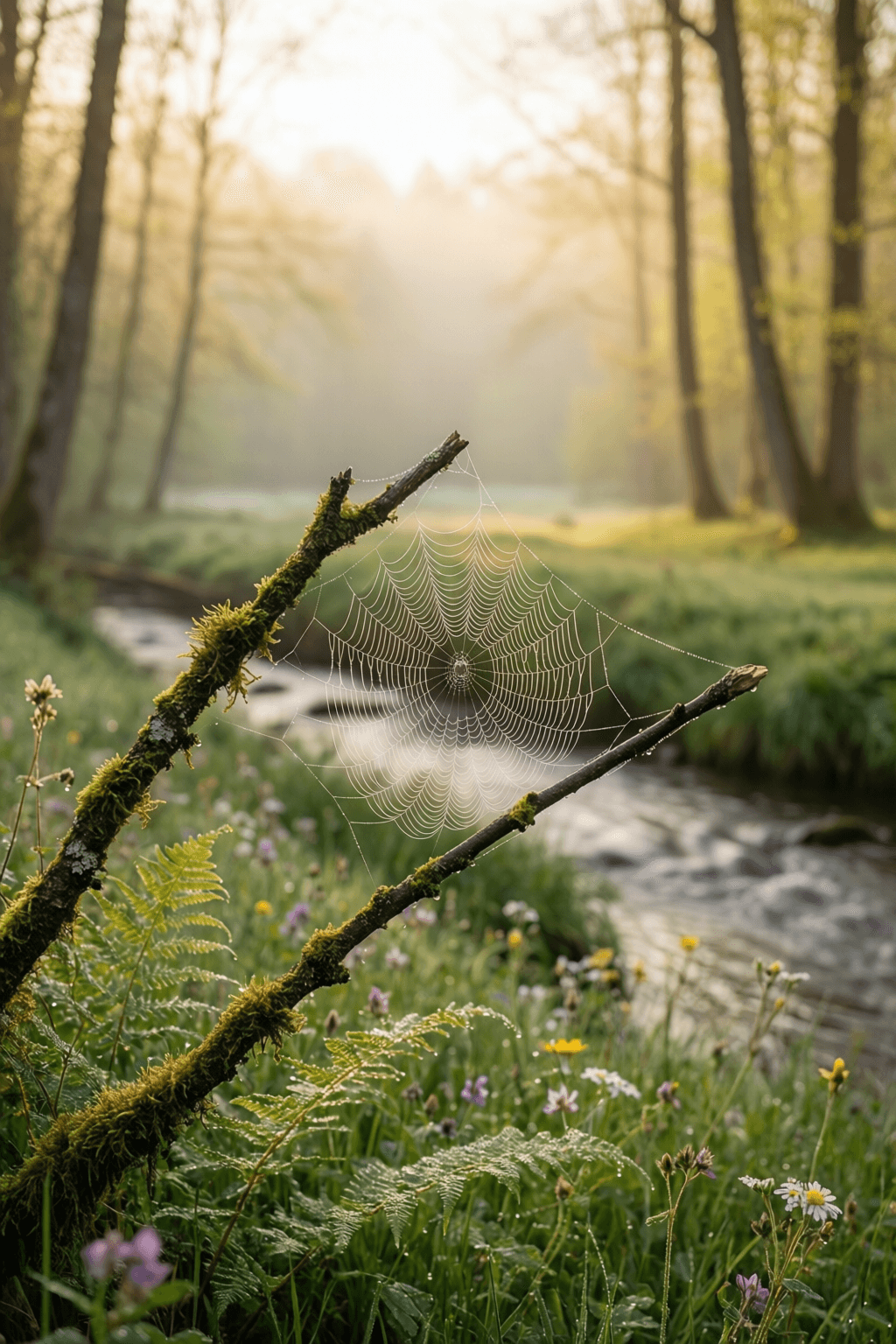
In nature we never see anything isolated, but everything in connection with something else which is before it, beside it, under it and over it. — Johann Wolfgang von Goethe
—What lingers after this line?
The Core Vision of Interdependence
Goethe’s remark begins with a simple observation and expands into a profound worldview: nothing in nature exists alone. Every plant, stone, current, and creature belongs to a web of relations shaped by time, place, and surrounding forces. By listing what is “before it, beside it, under it and over it,” he turns attention away from isolated objects and toward the patterns that bind them. From this starting point, nature appears less like a collection of separate things and more like a living conversation. Goethe, who wrote extensively on morphology and natural form in works such as The Metamorphosis of Plants (1790), often resisted fragmented thinking. In that spirit, the quote invites us to see meaning not merely in individual forms, but in the connections that give those forms life.
A Challenge to Isolated Thinking
Seen this way, Goethe is also gently criticizing the human habit of dividing the world into neat compartments. We often study a leaf without the tree, the tree without the soil, or the soil without the climate that sustains it. Yet the quote reminds us that such separation is useful only up to a point, because reality itself is woven from relationships. This insight anticipates later holistic approaches in science and philosophy. Alexander von Humboldt’s Cosmos (1845–1862), for example, similarly portrayed the natural world as an interconnected whole in which geography, weather, vegetation, and human life influence one another. Goethe’s words therefore feel strikingly modern: they suggest that understanding deepens when we move beyond parts and begin tracing the threads between them.
Ecology Before the Name Existed
As the idea unfolds, Goethe’s statement begins to sound like an early ecological principle. Long before ecology emerged as a formal discipline in the nineteenth century, he recognized that life depends on networks of exchange. A river shapes the forest around it; insects pollinate flowers; fungi nourish roots underground; predators alter the behavior of prey. Nothing stands alone for long. Modern ecology confirms this intuition with countless examples. The reintroduction of wolves to Yellowstone National Park, documented by the U.S. National Park Service, changed deer movement, allowed vegetation to recover, and even influenced riverbanks through trophic cascades. In that sense, Goethe’s quote is not merely poetic. It captures a scientific truth: when one element changes, many others respond, often in ways we do not immediately expect.
The Importance of Place and Perspective
At the same time, the quote emphasizes orientation as much as connection. Goethe does not speak abstractly of relation alone; he names spatial and temporal contexts—what comes before, what stands beside, what lies below and above. In doing so, he suggests that to understand anything, we must ask where it is situated and what surrounds it. This notion has practical force. A mountain flower growing at high altitude cannot be understood apart from wind, temperature, soil minerals, and seasonal light. Likewise, a coral reef is inseparable from water temperature, ocean chemistry, and neighboring species. Gradually, Goethe leads us toward a more disciplined way of seeing: knowledge begins when we learn to place things within their full setting rather than judging them as self-contained objects.
Human Life Within the Same Web
Once we accept this vision in nature, it naturally extends to ourselves. Human beings often imagine that they stand apart from the rest of the world, yet Goethe’s insight quietly removes that illusion. Our bodies depend on air, water, microbes, sunlight, crops, and countless social and material systems. Even our thoughts are shaped by language, memory, education, and inherited culture. For that reason, the quote carries an ethical undertone as well as a descriptive one. Environmental thinkers from Rachel Carson in Silent Spring (1962) onward have shown that when humans disrupt one part of nature, the consequences return through food chains, health, and climate. Goethe’s point, then, is not only that everything is connected, but that recognizing those connections should make us more humble about our place within them.
A Timeless Lesson in Attention
Ultimately, Goethe offers a lesson in how to look at the world. Instead of asking only, “What is this?” he urges us to ask, “What is this connected to?” That small shift transforms observation into insight. A bird is no longer just a bird; it becomes part of migration routes, weather cycles, habitats, and evolutionary history. Because of that, the quote remains enduringly relevant in an age of climate change and ecological strain. It teaches that wisdom begins with attention to relationships, causes, and contexts. By seeing nature as a field of living connections rather than isolated fragments, we gain not only clearer understanding but also a deeper sense of responsibility toward the world that sustains us.
One-minute reflection
What feeling does this quote bring up for you?
Related Quotes
6 selectedEverything in the world is full of signs. All events are coordinated. All things depend on each other. Everything breathes together. — Plotinus
Plotinus
At first glance, Plotinus presents the world not as a collection of isolated objects, but as a living whole in which every part participates in a larger order. His claim that everything is full of signs suggests that rea...
Read full interpretation →We are all so deeply interconnected; we have no option but to love all. — Amit Ray
Amit Ray
Amit Ray’s statement begins with a simple but far-reaching premise: human beings are not isolated units, but participants in a shared web of life. If our lives constantly shape one another through family, community, econ...
Read full interpretation →We are in it together and the company of spiritual friends helps us realize our interconnectedness. — Tara Brach
Tara Brach
Tara Brach’s statement begins with a simple but profound correction to the modern illusion of separateness: we are not moving through life alone. By saying “we are in it together,” she frames human experience as fundamen...
Read full interpretation →We are like islands in the sea, separate on the surface but connected in the deep. — William James
William James
William James’s metaphor begins with a simple visual truth: islands appear isolated when viewed from above. In the same way, human beings often seem self-contained, bounded by private thoughts, personal histories, and in...
Read full interpretation →We are all connected in the great Circle of Life. — Mufasa
Mufasa
At its core, Mufasa’s line presents life as an interconnected whole rather than a collection of isolated beings. The image of a circle suggests continuity, reciprocity, and balance: every creature, action, and moment bel...
Read full interpretation →Small is good, small is all. The large is a reflection of the small. — adrienne maree brown
adrienne maree brown
Adrienne maree brown’s line, “Small is good, small is all,” reframes value away from grand gestures and toward modest, repeatable practice. Instead of treating “big change” as the only change that counts, she argues that...
Read full interpretation →More From Author
More from Johann Wolfgang von Goethe →A really great talent finds its happiness in execution. — Johann Wolfgang von Goethe
Goethe’s remark shifts attention away from talent as mere possession and toward talent as practice. A gift, however impressive, remains incomplete until it is exercised; in this sense, happiness does not come from being...
Read full interpretation →Everybody wants to be somebody; nobody wants to grow. — Johann Wolfgang von Goethe
At first glance, Goethe’s remark exposes a quiet contradiction in human desire: people long for significance, recognition, and identity, yet often resist the difficult transformation such becoming requires. To ‘be somebo...
Read full interpretation →The most original of authors are not so because they advance what is new, but more because they know how to say something as if it had never been said before. — Johann Wolfgang von Goethe
Goethe begins by shifting originality away from mere invention and toward expression. In his view, a writer does not become original simply by producing unheard-of thoughts; rather, originality emerges when familiar trut...
Read full interpretation →Set a clear aim and whittle it with daily craft until it stands complete. — Johann Wolfgang von Goethe
Goethe’s sentence begins by insisting on a “clear aim,” because effort without direction tends to scatter into busywork. An aim is more than a wish; it’s a defined outcome that can guide decisions about what to practice...
Read full interpretation →