
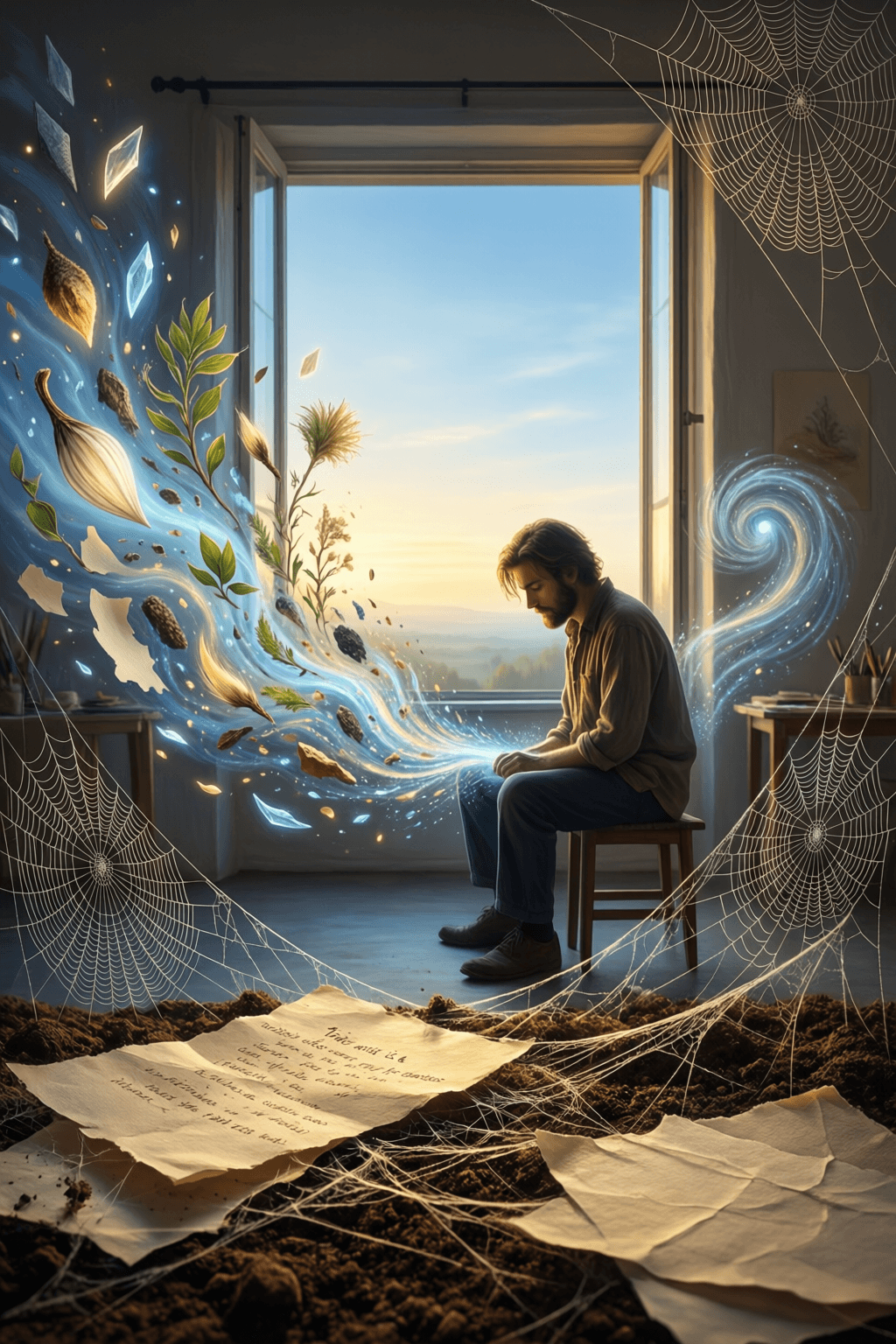
The artist is a receptacle for emotions that come from all over the place: from the sky, from the earth, from a scrap of paper, from a passing shape, from a spider's web. — Pablo Picasso
—What lingers after this line?
An Artist as Receptive Medium
At the heart of Picasso’s remark is a striking redefinition of creativity: the artist is not merely a maker, but a receiver. Rather than inventing emotion from nothing, the artist absorbs impressions that drift in from the world’s countless surfaces and moments. In this sense, creation begins with attentiveness, with the willingness to be moved by what others might overlook. This idea helps explain why artistic vision often feels both personal and universal. The artist filters outside sensations through an inner sensibility, transforming scattered feelings into form. Thus, Picasso presents art not as isolation from life, but as a deep openness to it.
Emotion Arriving from Everywhere
From there, Picasso’s list—sky, earth, paper, passing shape, spider’s web—suggests that emotion has no fixed hierarchy. Grandeur and triviality coexist; a vast horizon can stir the artist just as powerfully as a discarded fragment. By placing the majestic beside the ordinary, he argues that inspiration is democratic, available wherever perception remains alive. This broad receptivity appears throughout art history. William Wordsworth’s poetry, especially in Lyrical Ballads (1798), similarly finds profound feeling in common scenes rather than rare spectacles. Consequently, Picasso’s statement invites us to see that artistic sensitivity depends less on extraordinary subjects than on extraordinary attention.
The Ordinary Object Transformed
Moreover, Picasso’s mention of “a scrap of paper” is especially revealing, because it shows how art can begin in what seems worthless. A torn remnant, detached from its original purpose, becomes emotionally charged once an artist notices its texture, shape, or accidental beauty. In other words, artistic imagination does not wait for perfection; it redeems fragments. This principle aligns with Picasso’s own experiments in collage, such as Still Life with Chair Caning (1912), where humble materials entered high art without apology. As a result, the boundary between refuse and resource collapses, and the artist’s task becomes one of recognition as much as invention.
Nature as a Silent Collaborator
At the same time, the inclusion of the sky, the earth, and a spider’s web points to nature as an inexhaustible emotional partner. These are not simply visual motifs; they are carriers of rhythm, delicacy, scale, and transience. A spider’s web, for instance, can suggest both fragility and astonishing design, reminding the artist that emotional complexity often resides in small natural forms. In this way, Picasso echoes a tradition reaching back to East Asian ink painting and, later, to artists like Paul Klee, who wrote in Creative Credo (1920) that art does not merely reproduce the visible but makes visible. Nature gives the artist clues, and the artist returns them as revelation.
Passing Shapes and Fleeting Impressions
Equally important is Picasso’s reference to “a passing shape,” which emphasizes the speed and instability of inspiration. Not every emotional source arrives fully formed; often it appears briefly, almost disappearing before it can be named. The artist’s gift, then, lies partly in catching these transient impressions before they fade into ordinary forgetfulness. This sensitivity to the fleeting recalls Charles Baudelaire’s idea in The Painter of Modern Life (1863) that modern art must grasp the ephemeral as well as the eternal. Therefore, Picasso’s artist is not simply contemplative but alert, always ready to rescue meaning from motion.
Creation as Emotional Alchemy
Finally, Picasso’s metaphor of the artist as a receptacle leads to a larger truth: reception is only the beginning. The gathered emotions do not remain scattered; they are fused, distilled, and reshaped into something communicable. What enters from many directions leaves as painting, poem, music, or form, carrying traces of the world yet bearing the stamp of an individual spirit. Seen this way, artistic creation resembles alchemy. Random encounters become coherence, and private sensation becomes shared experience. Picasso’s insight ultimately suggests that the artist’s greatness lies not in standing apart from life, but in absorbing its fragments so completely that they return to us transformed.
One-minute reflection
What's one small action this suggests?
Related Quotes
6 selectedWhen you are inspired by some great purpose, some extraordinary project, all your thoughts break their bonds. — Pablo Picasso
Pablo Picasso
This quote highlights how deep inspiration can liberate and elevate the mind. When driven by a meaningful goal, individuals often find themselves thinking in ways they previously thought impossible.
Read full interpretation →Beauty awakens the soul to act. — Dante Alighieri
Dante Alighieri
Dante Alighieri’s assertion situates beauty as a catalyst that stirs the deepest parts of our being. In his seminal work, ‘The Divine Comedy’ (c.
Read full interpretation →For my part I know nothing with any certainty, but the sight of the stars makes me dream. — Vincent van Gogh
Vincent van Gogh
At the outset, van Gogh’s admission that he knows nothing with certainty echoes an ancient stance—Socrates’ famous not-knowing—while also aligning with modern science’s provisional spirit. Rather than a confession of def...
Read full interpretation →It is not the language of painters but the language of nature which one should listen to. — Pablo Picasso
Pablo Picasso
At first glance, Picasso’s remark challenges the authority of artistic convention. By contrasting ‘the language of painters’ with ‘the language of nature,’ he suggests that art should not merely imitate established techn...
Read full interpretation →The chief enemy of creativity is good sense. — Pablo Picasso
Pablo Picasso
At first glance, Picasso’s claim sounds like a provocation against reason itself. Yet his point is subtler: ‘good sense’ often means the habits, rules, and social expectations that keep people from taking imaginative ris...
Read full interpretation →Computers are useless. They can only give you answers. — Pablo Picasso
Pablo Picasso
Pablo Picasso’s jab—“Computers are useless. They can only give you answers.”—is less a literal dismissal than a provocation about what humans value.
Read full interpretation →More From Author
More from Pablo Picasso →It is not the language of painters but the language of nature which one should listen to. — Pablo Picasso
At first glance, Picasso’s remark challenges the authority of artistic convention. By contrasting ‘the language of painters’ with ‘the language of nature,’ he suggests that art should not merely imitate established techn...
Read full interpretation →The chief enemy of creativity is good sense. — Pablo Picasso
At first glance, Picasso’s claim sounds like a provocation against reason itself. Yet his point is subtler: ‘good sense’ often means the habits, rules, and social expectations that keep people from taking imaginative ris...
Read full interpretation →Computers are useless. They can only give you answers. — Pablo Picasso
Pablo Picasso’s jab—“Computers are useless. They can only give you answers.”—is less a literal dismissal than a provocation about what humans value.
Read full interpretation →I'd like to live as a poor man with lots of money. — Pablo Picasso
Picasso’s line sounds like a quip, yet it immediately opens a deeper question: what is money for if not to change how we live? By wishing to be “a poor man” while having “lots of money,” he highlights the tension between...
Read full interpretation →