
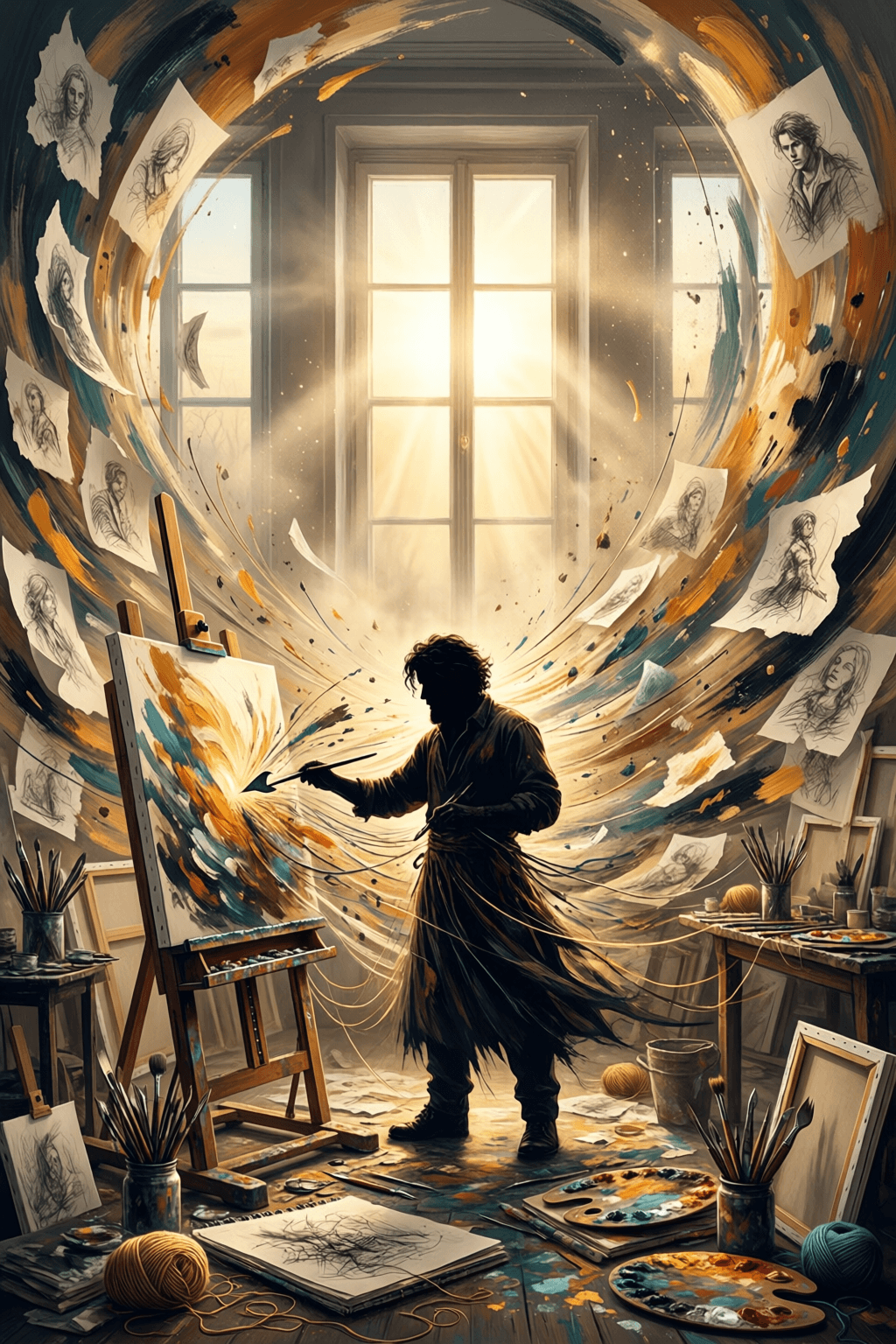
The creative process is a mess, but a beautiful one. Embrace the chaos, because that is where your most authentic creations come to life. — Arastasia
—What lingers after this line?
Creativity Begins in Disorder
At first glance, Arastasia’s quote rejects the tidy myth that meaningful art emerges from perfect planning. Instead, it frames creativity as inherently unruly, full of false starts, contradictions, and unexpected turns. In that sense, the ‘mess’ is not a flaw in the process but its native condition, the place where experimentation breaks open rigid expectations. From there, the statement invites a shift in attitude: rather than resisting confusion, the creator is asked to inhabit it. Much like Jackson Pollock’s improvisational method in the late 1940s, where control and accident worked together on the canvas, authentic work often appears when structure loosens just enough for discovery to occur.
Why Chaos Feels So Necessary
Naturally, chaos matters because originality rarely arrives through repetition alone. When artists, writers, or thinkers move beyond predictable habits, they enter uncertain territory where intuition becomes more important than certainty. That uncertainty can feel uncomfortable, yet it often signals that something genuinely new is taking shape. Psychologist Mihaly Csikszentmihalyi’s studies on creativity, especially in Creativity (1996), suggest that creative breakthroughs often emerge from a dynamic interplay between discipline and openness. In other words, the disorder Arastasia celebrates is not emptiness but fertile instability, a condition that allows unplanned connections to surface.
Authenticity Emerges Through Imperfection
As the quote develops, its deepest claim is that authenticity is born not despite the chaos but within it. A polished surface can be impressive, yet work that carries traces of struggle often feels more human and recognizable. The unfinished draft, the abandoned sketch, or the awkward first version may contain the emotional truth that later refinement risks erasing. This idea echoes Leonard Cohen’s lyric from “Anthem” (1992): ‘There is a crack in everything, that’s how the light gets in.’ Similarly, authentic creation often depends on allowing vulnerability, inconsistency, and accident to remain visible long enough for the real voice underneath to emerge.
The Artist’s Task Is Surrender
Consequently, embracing chaos does not mean abandoning craft; it means surrendering the illusion of total control. Many creators discover that their strongest work appears when they stop forcing the outcome and start responding to what the process itself reveals. The role of the artist becomes less that of a commander and more that of an attentive listener. This pattern appears across artistic history. Beethoven’s surviving sketchbooks, discussed widely in music scholarship, show pages crowded with revisions, crossings-out, and reworkings. Far from weakening the genius of the final compositions, that visible disorder reminds us that mastery often grows through turbulence rather than in spite of it.
Mess as a Path to Discovery
By this point, Arastasia’s message feels almost liberating: the mess is not evidence of failure but proof that discovery is underway. Creative work becomes sterile when every step is predetermined, whereas confusion leaves room for surprise. What initially looks like fragmentation may, with time, reveal itself as exploration. Even scientific innovation offers parallels. Alexander Fleming’s accidental discovery of penicillin in 1928 is often cited as a case where openness to the unexpected mattered as much as expertise. Likewise, in artistic practice, what seems misplaced or accidental can become the very element that gives a work its life.
Living With the Beautiful Unfinished
Finally, the quote encourages creators to make peace with incompletion, ambiguity, and process itself. Not every stage of creation will look elegant, and not every idea will arrive fully formed. Yet this untidiness is often the honest record of a mind reaching beyond what it already knows. Thus, Arastasia’s words offer more than comfort; they present a philosophy of making. To embrace the chaos is to trust that beauty may arrive through uncertainty, and that the most authentic creations are often those willing to pass through disorder before finding their final shape.
One-minute reflection
Where does this idea show up in your life right now?
Related Quotes
6 selectedThe creative process is not a straight line, but a labyrinth. To get lost in it is not a failure; it is the only way to find the hidden things worth saying. — M.C. Richards
M.C. Richards
At its core, M.C. Richards rejects the comforting myth that creative work unfolds through orderly steps.
Read full interpretation →The creative process is a journey through your own vulnerability. When you stop running from the discomfort of the blank page, you finally start creating from the truth of who you are. — Brené Brown
Brené Brown
Brené Brown’s quote begins with a familiar image: the blank page as both invitation and threat. At first, that emptiness can feel exposing because it offers no place to hide behind polish, certainty, or imitation.
Read full interpretation →The painting has a life of its own. I try to let it come through. — Jackson Pollock
Jackson Pollock
At first glance, Jackson Pollock’s remark gives the painting an almost independent existence, as though the canvas carries its own pulse before the artist fully understands it. Rather than describing painting as pure con...
Read full interpretation →To create something new, one must first learn to be comfortable with the mess of the process. — Yayoi Kusama
Yayoi Kusama
At first glance, Yayoi Kusama’s insight reframes creativity as something far less polished than people often imagine. To create something truly new, she suggests, one must stop fearing confusion, failed attempts, and unf...
Read full interpretation →The creative process is a sanctuary for healing, a space where resilience is transformed into art that speaks to our shared humanity. — Ben Okri
Ben Okri
At its heart, Ben Okri’s statement imagines the creative process as more than production; it becomes a refuge. A sanctuary is a place of shelter, and by choosing that word, Okri suggests that making art offers protection...
Read full interpretation →It is through the process of creating that we discover who we are, not by waiting for a finished masterpiece to tell us. — Twyla Tharp
Twyla Tharp
Twyla Tharp’s insight begins with a reversal of a common assumption: we often imagine that identity arrives fully formed and then expresses itself through art, work, or achievement. Instead, she argues that we come to kn...
Read full interpretation →More From Author
More from Arastasia →It is never too late to pick up the brush, to start something new, to rekindle the flame of creativity within you. — Arastasia
At its heart, Arastasia’s quote rejects the quiet belief that creativity belongs only to the young or already accomplished. By saying it is never too late to pick up the brush, the line reframes artistic beginnings as ti...
Read full interpretation →When you feel overwhelmed, remember that your truest art emerges from those moments of vulnerability. — Arastasia
Arastasia’s line reframes overwhelm not as a sign of failure, but as a doorway you’re standing in front of. When emotions surge past what feels manageable, they often reveal what matters most—your fears, longings, and tr...
Read full interpretation →