
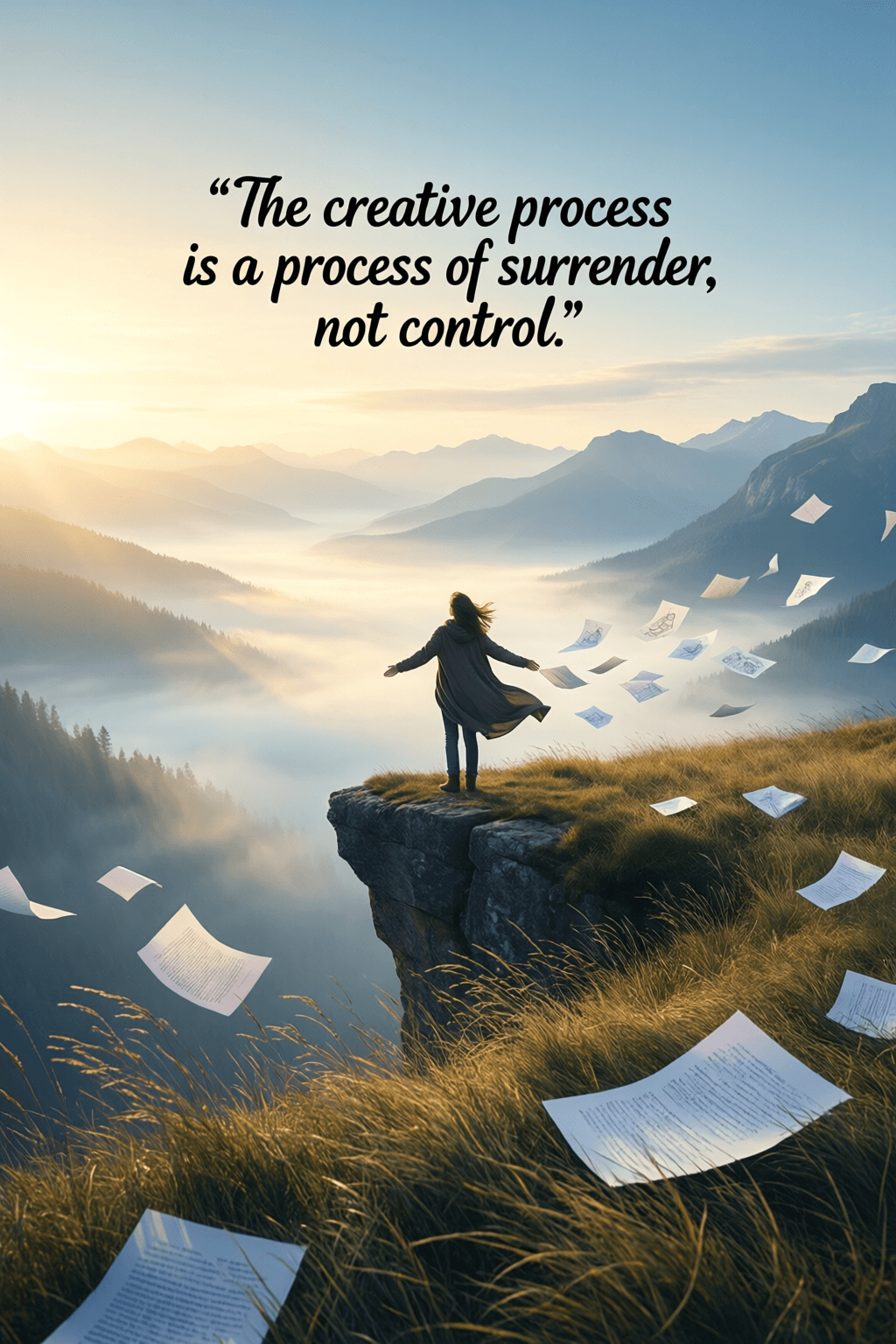
The creative process is a process of surrender, not control. — Bruce Lee
—What lingers after this line?
The Core Paradox of Creation
At first glance, Bruce Lee’s statement seems to overturn a common assumption: that great work comes primarily from discipline, mastery, and strict command. Instead, he argues that creativity emerges through surrender—the willingness to stop forcing outcomes and allow something less predictable to take shape. In this view, control may organize technique, but it cannot fully generate originality. This paradox lies at the heart of many artistic traditions. One can prepare rigorously, yet in the decisive moment, the creator must release excessive self-consciousness. Lee’s insight therefore reframes creativity not as domination over material, but as a responsive partnership with it.
Bruce Lee’s Philosophy in Context
Seen in context, the quote aligns closely with Bruce Lee’s larger philosophy of adaptability. In *Tao of Jeet Kune Do* (published posthumously in 1975), he repeatedly emphasizes fluidity, responsiveness, and freedom from rigid form. His famous image of water—yielding yet powerful—captures the same principle expressed here: creation thrives when the mind stops clinging to fixed patterns. From that perspective, surrender is not passivity. Rather, it is disciplined openness, a state in which training becomes so deeply internalized that spontaneous expression becomes possible. Thus, Lee presents creativity as an act of trust in one’s embodied knowledge.
Why Control Can Inhibit Originality
Building on this idea, excessive control often narrows the imagination. When artists, writers, or thinkers become preoccupied with perfection, audience reaction, or strict plans, they may produce competent work that feels lifeless. The need to manage every detail can silence intuition before it has the chance to speak. Psychologist Mihaly Csikszentmihalyi’s concept of “flow,” developed in *Flow* (1990), helps explain this dynamic. In flow states, people perform at their best when self-monitoring recedes and attention merges with the activity itself. In other words, creativity often deepens precisely when the urge to control begins to loosen.
Surrender as Trust in Process
As the thought unfolds, surrender begins to look less like loss and more like trust. A poet may start with one intention and discover the real poem halfway through; a painter may follow an accidental brushstroke into a new composition. Such moments suggest that creation is not always linear but exploratory, shaped by listening as much as by deciding. Many artists have described this sensation. Paul Klee famously wrote in his *Creative Credo* (1920), “Art does not reproduce the visible; rather, it makes visible.” Implicit in that claim is the idea that the artist uncovers something through the process, rather than merely executing a fully controlled plan.
The Balance Between Skill and Release
Nevertheless, Lee’s quote does not dismiss craft. Surrender matters precisely because it rests on preparation: scales practiced, forms repeated, techniques refined. The pianist can improvise because the hands already know their language; the martial artist can respond freely because the body has been trained beyond hesitation. Therefore, the creative process is best understood as a balance. Control builds the foundation, but surrender animates it. Without skill, release becomes chaos; without release, skill becomes mechanical. Lee’s insight endures because it captures this delicate transition from mastery into living expression.
A Lesson Beyond the Arts
Finally, the quote reaches beyond painting, music, or writing into everyday life. Problem-solving, leadership, and even conversation often improve when people stop gripping too tightly and become more attentive to what the moment requires. Innovation frequently appears not when one insists on certainty, but when one is willing to adapt, revise, and be surprised. In that sense, Bruce Lee offers more than advice for artists. He suggests a way of being in the world: prepare deeply, remain flexible, and trust emergence over force. Creativity, then, becomes a practice of humility—an acceptance that the best outcomes are sometimes invited, not controlled.
One-minute reflection
What does this quote ask you to notice today?
Related Quotes
6 selectedThe painting has a life of its own. I try to let it come through. — Jackson Pollock
Jackson Pollock
At first glance, Jackson Pollock’s remark gives the painting an almost independent existence, as though the canvas carries its own pulse before the artist fully understands it. Rather than describing painting as pure con...
Read full interpretation →The creative process is not a straight line, but a labyrinth. To get lost in it is not a failure; it is the only way to find the hidden things worth saying. — M.C. Richards
M.C. Richards
At its core, M.C. Richards rejects the comforting myth that creative work unfolds through orderly steps.
Read full interpretation →To create something new, one must first learn to be comfortable with the mess of the process. — Yayoi Kusama
Yayoi Kusama
At first glance, Yayoi Kusama’s insight reframes creativity as something far less polished than people often imagine. To create something truly new, she suggests, one must stop fearing confusion, failed attempts, and unf...
Read full interpretation →The creative process is a sanctuary for healing, a space where resilience is transformed into art that speaks to our shared humanity. — Ben Okri
Ben Okri
At its heart, Ben Okri’s statement imagines the creative process as more than production; it becomes a refuge. A sanctuary is a place of shelter, and by choosing that word, Okri suggests that making art offers protection...
Read full interpretation →It is through the process of creating that we discover who we are, not by waiting for a finished masterpiece to tell us. — Twyla Tharp
Twyla Tharp
Twyla Tharp’s insight begins with a reversal of a common assumption: we often imagine that identity arrives fully formed and then expresses itself through art, work, or achievement. Instead, she argues that we come to kn...
Read full interpretation →The craft is not in holding tight, but in release: letting the work reveal its own nature. — Lloyd Alexander
Lloyd Alexander
At first glance, Lloyd Alexander’s line reframes craftsmanship in a surprising way: the maker’s skill does not lie in controlling every outcome, but in knowing when to loosen the grip. Rather than forcing a work into a p...
Read full interpretation →More From Author
More from Bruce Lee →The comfort zone is the great enemy to creativity; moving beyond it necessitates intuition, which in turn configures new perspectives and conquers fears. — Bruce Lee
Bruce Lee begins with a blunt diagnosis: comfort can quietly become the enemy of invention. Familiar routines feel safe because they reduce uncertainty, yet that same predictability often narrows perception and dulls exp...
Read full interpretation →The height of cultivation always runs to simplicity. It is not daily increase, but daily decrease. — Bruce Lee
Bruce Lee’s line reframes growth in a surprising way: the highest form of development does not appear as accumulation, but as refinement. At first glance, cultivation sounds like adding skills, habits, and knowledge.
Read full interpretation →The successful warrior is the average man, with laser-like focus. - Bruce Lee
Bruce Lee’s quote strips away the myth that success belongs only to the naturally gifted. Instead, he argues that the successful warrior is simply an average person who has learned to direct his energy with unusual preci...
Read full interpretation →Long-term consistency trumps short-term intensity. — Bruce Lee
At its heart, Bruce Lee’s statement argues that endurance matters more than brief bursts of effort. A dramatic surge of motivation can feel powerful in the moment, yet it often fades before meaningful results take root.
Read full interpretation →