
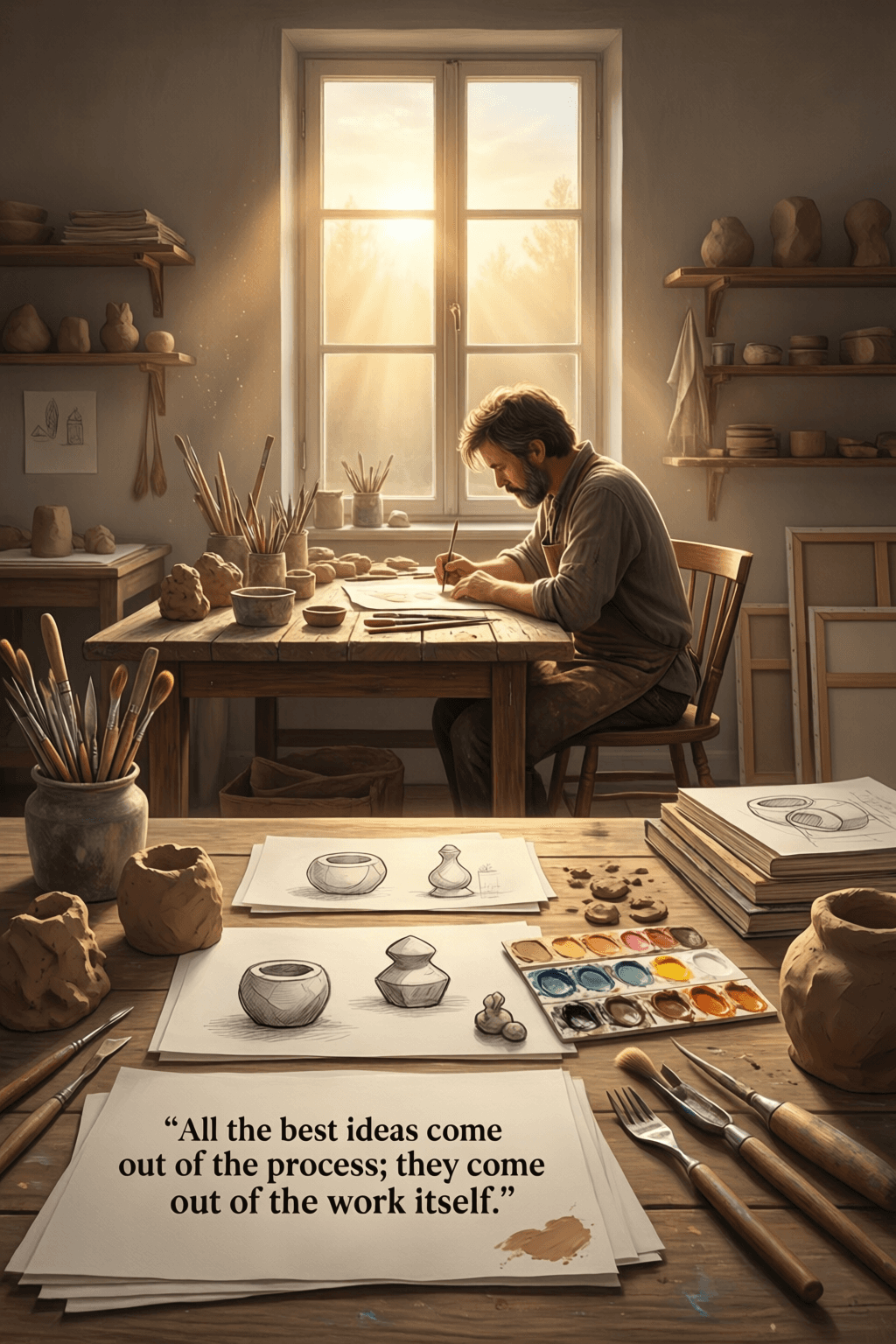
All the best ideas come out of the process; they come out of the work itself. — Alan Watts
—What lingers after this line?
The Core Insight of the Quote
At its heart, Alan Watts’s statement shifts attention away from waiting for inspiration and toward the act of making. He suggests that strong ideas are rarely fully formed at the beginning; instead, they reveal themselves gradually through effort, revision, and engagement with the task itself. In that sense, creativity is less a lightning strike than a discovery made while moving. This perspective immediately challenges the romantic myth of the lone genius who simply receives brilliance. Rather, Watts implies that thinking and doing are intertwined. Once work begins, materials push back, unexpected patterns appear, and new directions become visible—possibilities that could never have been seen from the safety of pure contemplation.
Why Action Precedes Clarity
From there, the quote points to a practical truth: clarity often follows action rather than preceding it. Many people delay creative work because they feel they need a perfect concept first, yet Watts reverses that order. By starting imperfectly, we generate the raw material from which better ideas can emerge. This pattern appears across disciplines. In writing, a rough draft often teaches the writer what the piece is actually about. In design, early sketches expose flaws and suggest alternatives. As Twyla Tharp notes in The Creative Habit (2003), ritualized work habits often matter more than waiting for inspiration, because regular practice creates the conditions in which insight can appear.
The Workshop of Trial and Revision
Moreover, Watts’s insight highlights the value of process as a kind of workshop for thought. Each attempt, even a failed one, provides feedback. A sentence that sounds wrong, a prototype that breaks, or a melody that falls flat does not merely signal error; it also narrows the field and points toward something stronger. Thomas Edison’s often-cited reflections on experimentation capture this spirit: repeated unsuccessful attempts were not meaningless detours but steps that clarified what would eventually work. Likewise, the work itself becomes a teacher. Through revision, the creator enters into dialogue with the material, and the final idea is shaped by that conversation rather than imposed all at once.
Creativity as Participation, Not Control
In a deeper sense, the quote also carries a philosophical undertone consistent with Watts’s broader thought. Rather than treating the mind as a machine that manufactures finished ideas in isolation, he presents creativity as participatory. We do not stand outside the process controlling it completely; we enter it, and in entering it, we are changed by what we encounter. This view echoes John Dewey’s Art as Experience (1934), which portrays artistic creation as an active exchange between person and environment. The maker responds to resistance, accident, rhythm, and context. Consequently, the best ideas are not always planned in advance; they arise from attentive involvement, where control gives way to collaboration with the unfolding work.
A Remedy for Perfectionism
Because of this, Watts’s remark offers a useful antidote to perfectionism. Perfectionism insists that the idea must be excellent before the work begins, but that expectation usually leads to hesitation or paralysis. Watts instead reassures us that beginnings may be clumsy, uncertain, and incomplete—and that this is not a flaw in the process but its necessary starting point. Writers often describe this vividly. Anne Lamott’s Bird by Bird (1994) famously defends the value of “shitty first drafts,” arguing that strong work almost always grows out of weak initial versions. In that light, Watts’s quote becomes liberating: one need not possess the best idea at the outset, only the willingness to begin and continue.
What the Quote Means in Practice
Ultimately, the wisdom of the quote becomes most powerful when applied. It encourages the painter to paint before knowing exactly what the canvas wants, the entrepreneur to prototype before having a flawless strategy, and the student to write before understanding every conclusion. Progress generates perception; the path becomes visible while walking it. Therefore, Watts is not merely describing creativity but prescribing a way of life. Trust the process, commit to the work, and allow understanding to develop through contact with reality. The best ideas, in this view, are not treasures waiting intact in the mind—they are forged in motion, shaped by persistence, and discovered through doing.
One-minute reflection
Why might this line matter today, not tomorrow?
Related Quotes
6 selectedThe painting has a life of its own. I try to let it come through. — Jackson Pollock
Jackson Pollock
At first glance, Jackson Pollock’s remark gives the painting an almost independent existence, as though the canvas carries its own pulse before the artist fully understands it. Rather than describing painting as pure con...
Read full interpretation →The creative process is not a straight line, but a labyrinth. To get lost in it is not a failure; it is the only way to find the hidden things worth saying. — M.C. Richards
M.C. Richards
At its core, M.C. Richards rejects the comforting myth that creative work unfolds through orderly steps.
Read full interpretation →To create something new, one must first learn to be comfortable with the mess of the process. — Yayoi Kusama
Yayoi Kusama
At first glance, Yayoi Kusama’s insight reframes creativity as something far less polished than people often imagine. To create something truly new, she suggests, one must stop fearing confusion, failed attempts, and unf...
Read full interpretation →The creative process is a sanctuary for healing, a space where resilience is transformed into art that speaks to our shared humanity. — Ben Okri
Ben Okri
At its heart, Ben Okri’s statement imagines the creative process as more than production; it becomes a refuge. A sanctuary is a place of shelter, and by choosing that word, Okri suggests that making art offers protection...
Read full interpretation →It is through the process of creating that we discover who we are, not by waiting for a finished masterpiece to tell us. — Twyla Tharp
Twyla Tharp
Twyla Tharp’s insight begins with a reversal of a common assumption: we often imagine that identity arrives fully formed and then expresses itself through art, work, or achievement. Instead, she argues that we come to kn...
Read full interpretation →The craft is not in holding tight, but in release: letting the work reveal its own nature. — Lloyd Alexander
Lloyd Alexander
At first glance, Lloyd Alexander’s line reframes craftsmanship in a surprising way: the maker’s skill does not lie in controlling every outcome, but in knowing when to loosen the grip. Rather than forcing a work into a p...
Read full interpretation →More From Author
More from Alan Watts →You are an aperture through which the universe is looking at and exploring itself. — Alan Watts
At first glance, Alan Watts’s line overturns the ordinary way we think about the self. Instead of imagining a separate individual peering out at a distant world, he suggests that each person is a channel through which th...
Read full interpretation →To find yourself, you must first be willing to lose the version of yourself you thought you had to be. — Alan Watts
At first glance, Alan Watts’s statement sounds contradictory: how can losing yourself be the way to find yourself? Yet this paradox lies at the heart of his philosophy.
Read full interpretation →The meaning of life is just to be alive. It is so plain and so obvious and so simple. — Alan Watts
Alan Watts’s line cuts against the habit of treating life as a riddle to be solved. Instead of offering a grand theory, he points to something embarrassingly direct: the fact of being alive is already the “answer.” In th...
Read full interpretation →You are under no obligation to be the person you were five minutes ago. — Alan Watts
Alan Watts’s line opens with a startling kind of relief: you don’t owe continuity to anyone—not even to yourself. Rather than treating identity as a contract signed in the past, he frames it as something closer to a livi...
Read full interpretation →