
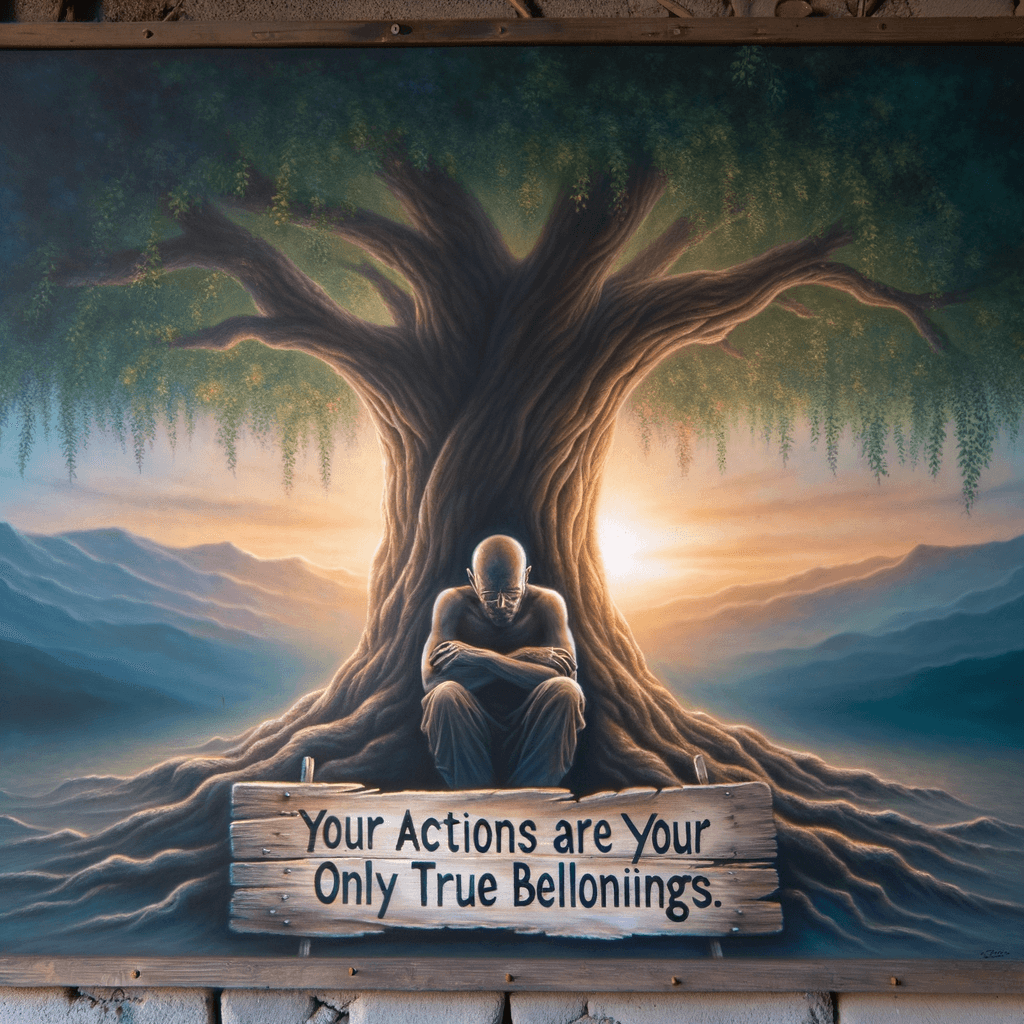
Your actions are your only true belongings. — Thich Nhat Hanh
—What lingers after this line?
Personal Responsibility
This quote emphasizes the importance of personal responsibility. It suggests that our actions define us and are the truest measure of who we are.
Inner Values
It highlights that material possessions are transient and unreliable, whereas our actions, rooted in our inner values, are what truly matter and last.
Legacy and Influence
Our actions create a lasting impact on the world and people around us. This quote underscores that our behavior and decisions form our legacy.
Mindfulness and Choices
The quote encourages mindfulness in our actions, recognizing that each choice we make reflects our true self and contributes to our ongoing personal development.
Buddhist Philosophy
Thich Nhat Hanh, a Vietnamese Buddhist monk, teaches that actions spring from our thoughts and intentions. In Buddhist philosophy, karma is the concept that actions have consequences, shaping our future and enlightenment path.
One-minute reflection
What's one small action this suggests?
Related Quotes
6 selectedTo do anything at all is to make a choice. — Thich Nhat Hanh
Thich Nhat Hanh
This quote highlights the idea that every action we take is a result of making a choice. It implies that action, no matter how small or automatic it may seem, stems from decisions we consciously or unconsciously make.
Read full interpretation →Actions are the seed of fate; deeds grow into destiny. — Harry S. Truman
Harry S. Truman
This quote emphasizes that our actions play a crucial role in shaping our future. Just as seeds grow into trees, the actions we take can lead to significant outcomes in our lives.
Read full interpretation →We are not victims of our impulses or emotions; we have the power to control them. It is time to relinquish the excuses. — Allie Brosh
Allie Brosh
At its core, Allie Brosh’s quote rejects the comforting idea that emotions and impulses are irresistible forces. Instead, it insists that human beings possess agency: the ability to pause, choose, and act deliberately ev...
Read full interpretation →My will shall shape my future. Whether I fail or succeed shall be no man's doing but my own. — Elaine Maxwell
Elaine Maxwell
At its core, Elaine Maxwell’s statement is a declaration of personal agency. By saying that her will shall shape her future, she rejects the idea that destiny is merely handed down by circumstance, luck, or the judgments...
Read full interpretation →You cannot build a life of meaning on a foundation of excuses. Your circumstances are the starting point, not the excuse for staying still. — David Goggins
David Goggins
At its core, David Goggins’s statement redraws the map between hardship and identity. He does not deny that circumstances can be painful, unfair, or limiting; instead, he insists they are only the opening conditions of a...
Read full interpretation →If it is to be, it is up to me. — William H. Johnsen
William H. Johnsen
At first glance, William H. Johnsen’s line compresses an entire philosophy into a few plain words: desired outcomes do not arrive by wish alone, but through personal action.
Read full interpretation →More From Author
More from Thich Nhat Hanh →You must love in such a way that the person you love feels free. — Thich Nhat Hanh
At its core, Thich Nhat Hanh’s statement redefines love as an act of care that does not confine. To love someone so that they feel free means offering affection without turning it into control, guilt, or dependence.
Read full interpretation →We are not islands; we are threads in a tapestry. To pull away from the weave is to lose the very texture that makes life hold together. — Thich Nhat Hanh
At its core, Thich Nhat Hanh’s image of threads in a tapestry rejects the fantasy of total self-sufficiency. A single thread may exist on its own, yet it gains meaning, strength, and beauty only through its relation to o...
Read full interpretation →When you learn how to suffer, you suffer far less. Resilience is not about avoiding the fire; it is about becoming fireproof. — Thich Nhat Hanh
At first glance, Thich Nhat Hanh’s quote appears paradoxical: how could learning to suffer make suffering lighter? Yet his point is that pain intensifies when we resist it, fear it, or treat it as a personal failure.
Read full interpretation →Slow down, and you will find that the rhythm of your own heart becomes the master of your work. — Thich Nhat Hanh
At first glance, Thich Nhat Hanh’s words seem to offer simple advice about working more slowly, yet they point to something deeper: a different relationship with time itself. To slow down is not merely to reduce speed, b...
Read full interpretation →