
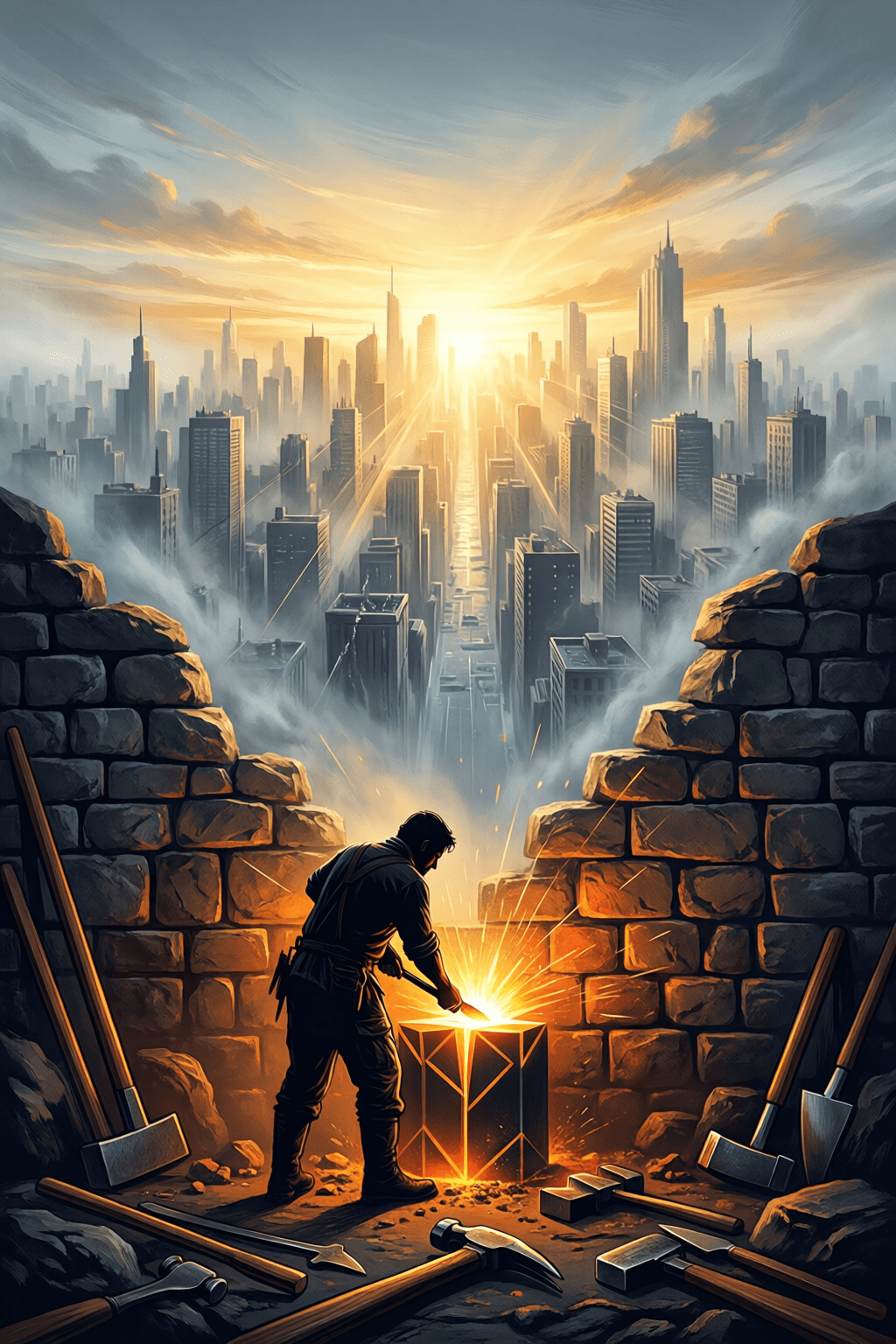
Art is not a mirror held up to reality, but a hammer with which to shape it. — Bertolt Brecht
—What lingers after this line?
Beyond Passive Reflection
Bertolt Brecht’s line rejects the comforting idea that art merely copies the world as it is. A mirror suggests observation, distance, and faithful reproduction, but a hammer implies pressure, intervention, and change. From the beginning, then, the quote frames art as an active social instrument rather than a decorative record of reality. In that sense, Brecht asks us to see every play, poem, painting, or song as capable of altering public feeling and political imagination. Instead of simply showing injustice, art can sharpen awareness, disturb complacency, and move people toward action. The statement is brief, yet it carries a radical demand: artists should not only depict the world but help remake it.
Brecht’s Political Vision
This idea becomes clearer when placed within Brecht’s own career. Writing in the turbulence of Weimar Germany and exile during the rise of fascism, Brecht developed epic theatre precisely to prevent passive emotional consumption. In works such as The Threepenny Opera (1928) and Mother Courage and Her Children (1939), he used songs, interruptions, and visible stagecraft to keep audiences thinking critically rather than surrendering to illusion. Consequently, the “hammer” in his quote is not a metaphor for crude propaganda alone. It is a method of breaking habits of thought. Brecht believed theatre should expose how society is built, who benefits from it, and how it might be reorganized. Art, in his hands, became a tool for historical consciousness.
How Art Changes Public Imagination
From there, the quote opens onto a broader truth: social change often begins in the imagination before it appears in law or policy. Harriet Beecher Stowe’s Uncle Tom’s Cabin (1852), for example, helped many readers in the United States confront the moral horror of slavery through feeling as well as argument. Likewise, Picasso’s Guernica (1937) did not merely depict wartime suffering; it transformed civilian anguish into an unforgettable anti-war symbol. Therefore, art’s shaping power lies partly in its ability to give form to what people half perceive but cannot yet fully say. By turning scattered emotions into shared images and stories, art creates common language. Once a society can imagine injustice clearly, it becomes harder to accept it as natural.
The Artist’s Responsibility
If art can shape reality, then the artist carries a serious ethical burden. Brecht’s metaphor suggests craft joined to consequence: the hammer builds, but it can also damage. For that reason, artists who seek change must ask what kind of change they are encouraging, whose voices they amplify, and whether their work liberates thought or merely manipulates it. At the same time, Brecht does not reduce art to moral instruction. Rather, he calls for work that awakens judgment. Diego Rivera’s murals in 1930s Mexico, for instance, fused beauty with class history, inviting viewers to see labor and power anew. In this way, responsibility in art means not preaching simplistically, but shaping attention so people can confront reality more honestly.
Relevance in Modern Media
Today, Brecht’s statement feels even more urgent because images circulate instantly and influence millions. Documentary films, protest music, street murals, graphic novels, and even viral digital art can frame events before official narratives settle. Ai Weiwei’s installations on displacement and surveillance, for example, show how contemporary art can challenge state power while traveling across global media networks. Yet this reach also complicates the metaphor. In an age of algorithms and spectacle, not every forceful image truly reshapes understanding; some simply intensify outrage for a moment and vanish. Even so, Brecht’s insight survives: art matters most when it interrupts passive consumption and helps audiences see that reality is neither fixed nor untouchable.
A Call to Transform the World
Ultimately, Brecht’s quote is less a definition of art than a challenge to both creators and audiences. It insists that reality is made by human systems and can therefore be remade. Art becomes powerful not when it flatters the world with accurate reflection, but when it reveals pressure points—those places where thought, feeling, and collective will can begin to move history. Thus the hammer is also symbolic of hope. It suggests that imagination is not escapism but a practical force. When art unsettles accepted truths, gives dignity to the unheard, or sketches a more just future, it does exactly what Brecht demands: it does not stand before reality obediently; it strikes it into new shape.
One-minute reflection
What's one small action this suggests?
Related Quotes
6 selectedThe goal of life is rapture. Art is the way we experience it. — Joseph Campbell
Joseph Campbell
Joseph Campbell’s statement begins with a bold claim: life is not merely about survival, achievement, or social approval, but about rapture—a heightened state of wonder, intensity, and felt aliveness. By placing rapture...
Read full interpretation →Where you stand determines what you see and what you do not see; a change in where you stand changes everything. — Søren Kierkegaard
Søren Kierkegaard
Kierkegaard’s insight begins with a simple but unsettling claim: vision is never neutral. Where we stand—socially, emotionally, spiritually, or intellectually—determines not only what comes into view but also what remain...
Read full interpretation →The present changes the past. Looking back you do not find what you left behind. — Kiran Desai
Kiran Desai
At first glance, Desai’s line seems paradoxical, yet it captures a basic truth about human memory: the past is not stored inside us like a sealed archive. Instead, each act of remembering rebuilds events through the lens...
Read full interpretation →Burnout is not a sign of weakness; it is a signal that change is needed. — Arianna Huffington
Arianna Huffington
At first glance, burnout is often mistaken for personal failure, as though exhaustion proves someone is not resilient enough. Arianna Huffington’s quote reverses that assumption by treating burnout not as weakness, but a...
Read full interpretation →When you make a change, it is so easy to interpret your unsettledness as unhappiness. This is normal. This is natural. This is change. — Jeanette Winterson
Jeanette Winterson
Jeanette Winterson’s quote begins by naming a common emotional confusion: when life shifts, inner turbulence can feel like proof that something is wrong. In reality, she suggests, unsettledness is not always a sign of fa...
Read full interpretation →Do not mistake patience for passivity. True growth requires the discipline to walk away from what is stagnant so you can run toward what is vital. — Epictetus
Epictetus
At first glance, the quote draws a sharp line between patience and passivity, two qualities often confused in daily life. Patience, in this sense, is not silent resignation but a disciplined steadiness that allows a pers...
Read full interpretation →More From Author
More from Bertolt Brecht →Because things are the way they are, things will not stay the way they are. — Bertolt Brecht
Bertolt Brecht’s line seems contradictory at first: because things are the way they are, they will not stay that way. Yet the paradox is precisely the point.
Read full interpretation →To desire is to obtain; to strive is to succeed. — Bertolt Brecht
Bertolt Brecht’s quote succinctly connects desire with attainment and striving with success. At first glance, he reduces the complicated pursuit of goals to a cause-and-effect relationship, implying that simply to want s...
Read full interpretation →