
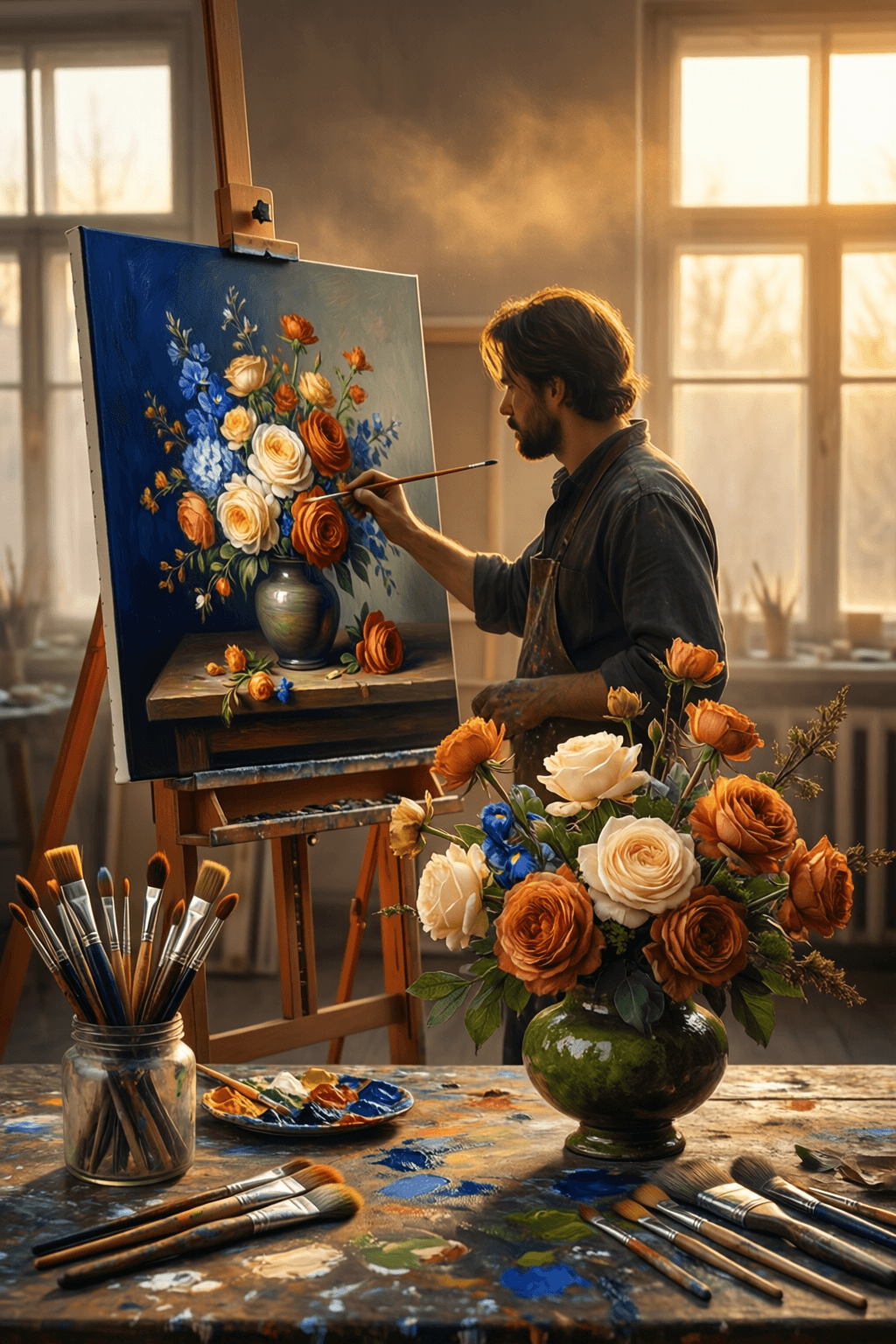
The moment you cheat for the sake of beauty, you know you're an artist. — David Hockney
—What lingers after this line?
Art Begins with a Necessary Betrayal
At first glance, David Hockney’s remark sounds mischievous, yet it points to a serious truth about artistic creation: art often begins when fidelity gives way to expression. To ‘cheat’ for beauty is not simple dishonesty; rather, it is the conscious decision to alter reality so that a deeper feeling, rhythm, or vision can emerge. In that moment, the artist stops merely recording the world and starts interpreting it. This idea helps explain why art so rarely behaves like evidence. A portrait may lengthen a neck, a landscape may intensify color, and a novelist may compress time—not because the creator is careless, but because strict accuracy can sometimes obscure emotional truth. Hockney’s line therefore frames artistry as a deliberate departure from literalism in pursuit of something more resonant.
Why Accuracy Is Not the Highest Goal
From there, Hockney’s insight invites a distinction between correctness and meaning. A mechanically precise image can still feel empty, while a distorted one may reveal character more vividly. Pablo Picasso’s oft-cited claim that ‘art is a lie that makes us realize truth’ echoes this principle, suggesting that invention can illuminate reality more powerfully than replication ever could. In practice, artists across disciplines make these adjustments constantly. A photographer manipulates framing and exposure; a filmmaker edits away ordinary pauses; a poet reshapes speech into pattern and compression. Each of these choices is, in a sense, a form of cheating. Yet precisely through these interventions, the work becomes more capable of expressing the essence of what it wants us to see.
A Long Tradition of Beautiful Distortion
Seen historically, Hockney’s statement belongs to a long artistic tradition. Renaissance painters routinely used perspective not simply to copy vision but to organize it into ideal harmony, while El Greco’s elongated saints in works like The Burial of the Count of Orgaz (1586) depart dramatically from anatomical realism in order to convey spiritual intensity. The deviation is the point, not the flaw. Later movements made this even clearer. Impressionists such as Claude Monet abandoned crisp detail for fleeting light, and Henri Matisse used improbable color to heighten emotional effect. As a result, beauty in art has often depended on selective unfaithfulness. Hockney’s quote crystallizes that inheritance: the artist knows when a rule must bend so that perception can become experience.
The Artist’s Judgment Call
However, not every distortion is artful; what matters is judgment. Hockney is not praising random embellishment but the cultivated instinct to know which departures serve the work. In this sense, cheating for beauty requires discipline as much as daring. An artist must sense when exaggeration clarifies and when it merely decorates, when simplification reveals structure and when it drains life away. That is why the quote also describes a moment of self-recognition. You know you are an artist not when you break rules casually, but when you break them knowingly, with purpose. The act becomes almost ethical in reverse: instead of obeying surface facts, the artist becomes loyal to form, emotion, and visual coherence. Beauty, then, is not an excuse for laziness but a test of refined perception.
Beauty as a Deeper Kind of Truth
Ultimately, Hockney’s line suggests that beauty is not a decorative bonus added after truth has been secured; rather, beauty can be one way truth is discovered. A painting that shifts proportion or a story that rearranges life may come closer to human experience than a strict transcript ever could. What looks like cheating on the surface may actually be fidelity to feeling, memory, or vision. For that reason, the quote remains so compelling. It captures the strange courage art demands: the willingness to depart from fact in order to arrive at significance. In the end, the artist is the one who understands that rules are tools, not masters—and that sometimes only by bending reality can beauty reveal what reality means.
One-minute reflection
What feeling does this quote bring up for you?
Related Quotes
6 selectedThe artist is not a solid, static being. The artist is fluid, like water, moving with the tides and changing form. — James McCrae
James McCrae
James McCrae’s image of the artist as fluid immediately challenges the common idea that creative people possess a single, fixed essence. Instead, he suggests that artistry is a process of becoming, not a stable condition...
Read full interpretation →The artist works by locating the world in himself. — Gertrude Stein
Gertrude Stein
At first glance, Gertrude Stein’s line suggests that art does not begin with the outer world alone, but with the artist’s inner ability to absorb and reinterpret it. To ‘locate the world in himself’ means that experience...
Read full interpretation →The artist must be a master of what he rejects. — Carlos Fuentes
Carlos Fuentes
At first glance, Carlos Fuentes’s remark suggests that artistic refusal is not mere negation but an act of deep knowledge. An artist earns the right to reject a style, convention, or influence only after understanding it...
Read full interpretation →The artist's duty is to stay in the fire, to keep the question alive long after the answers have gone cold. — Adrienne Rich
Adrienne Rich
Adrienne Rich presents the artist not as a maker of neat conclusions, but as someone willing to remain inside uncertainty. The image of “staying in the fire” suggests discomfort, risk, and sustained attention; in other w...
Read full interpretation →The artist must elect to fight for the beauty of the work, stitch by patient stitch, against the rush of the world. — Ursula K. Le Guin
Ursula K. Le Guin
Ursula K. Le Guin’s line begins with a deliberate verb: the artist must “elect.” In other words, beauty is not an accident or a luxury but a conscious choice made in resistance to haste.
Read full interpretation →The artist is a witness to the present moment, not a slave to the machine that wants to replace it. — bell hooks
bell hooks
At its core, bell hooks’s statement insists that art begins with presence. To be a witness to the present moment is to attend closely to lived reality—its tensions, beauties, wounds, and contradictions—rather than merely...
Read full interpretation →More From Author
More from David Hockney →