
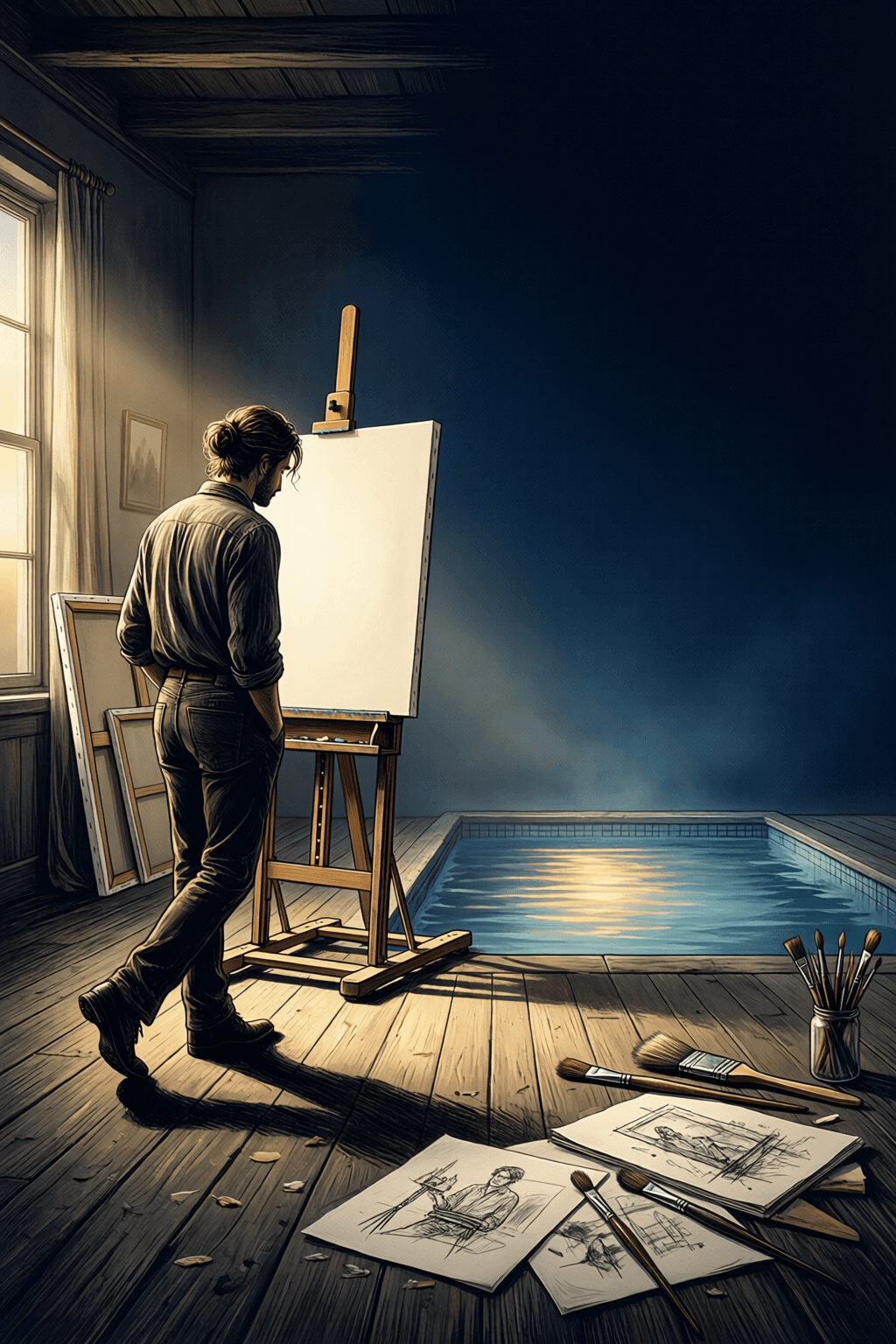
The artist never entirely knows—we guess. We may be wrong, but we take leap after leap in the dark. — Agnes de Mille
—What lingers after this line?
Creation as Informed Guesswork
At its core, Agnes de Mille’s remark rejects the comforting myth that artists work from perfect clarity. Instead, she presents creation as a process of educated guessing, where instinct, craft, and intuition combine long before certainty arrives. The artist does not stand outside the unknown; rather, the unknown is the very medium through which the work is made. In this sense, not knowing is not a failure of talent but a condition of invention. A choreographer, painter, or novelist must often choose a direction before proof appears, trusting that meaning will emerge through the act itself. De Mille, celebrated for works like Rodeo (1942), understood that artistic progress often begins with a decision that cannot yet be fully justified.
The Necessity of Risk
From that starting point, the quote moves naturally toward risk. If the artist only acted when success was guaranteed, nothing genuinely new would be attempted. Each "leap" de Mille describes suggests a willingness to move forward despite ambiguity, accepting that error is not an accident of the process but one of its essential companions. This idea echoes Samuel Beckett’s oft-cited line from Worstward Ho (1983): "Try again. Fail again. Fail better." Although Beckett’s tone is starker, both statements treat misjudgment as part of creative momentum. Art grows not by avoiding darkness, but by entering it repeatedly with enough courage to continue.
Why Mistakes Matter
Because de Mille openly admits, "We may be wrong," her observation carries an unusual humility. The artist is not a prophet delivering fixed truths, but a seeker testing possibilities. That admission matters, because it reframes mistakes as revelations: a failed scene, an awkward gesture, or a discarded melody can clarify what the work truly needs. In practice, many artistic breakthroughs emerge from such missteps. Pablo Picasso’s long path toward Les Demoiselles d’Avignon (1907) involved numerous preparatory studies that altered radically before the final composition appeared. Thus, what looks like confidence from the outside is often a sequence of revisions shaped by error, doubt, and discovery.
Intuition Beyond Complete Knowledge
Yet de Mille does not describe blind chaos. The artist "guesses," which implies sensitivity trained by experience. Intuition here is not the opposite of discipline; rather, it is discipline internalized so deeply that one can act before fully articulating why. Years of practice allow creators to sense patterns that reason alone cannot quickly explain. This balance appears across the arts. Jazz improvisers, for example, leap into the unknown in performance, but their spontaneity rests on rigorous study of rhythm, harmony, and form. In the same way, de Mille’s statement suggests that uncertainty becomes productive when it is met by a prepared imagination.
A Wider Lesson About Human Work
Finally, the quote extends beyond art into any meaningful act of making. Scientists form hypotheses, entrepreneurs test unproven ideas, and individuals make life decisions without complete information. In each case, progress depends on moving forward under conditions of partial knowledge. The darkness de Mille names is therefore not only artistic; it is deeply human. What makes her formulation memorable, however, is its honesty and its resilience. She does not promise certainty at the end of the process, only the necessity of continued movement. That is why the line feels both sobering and liberating: if we cannot know entirely, we can still create, revise, and keep leaping.
Recommended Reading
As an Amazon Associate, we earn from qualifying purchases.
One-minute reflection
What feeling does this quote bring up for you?
Related Quotes
6 selectedIt is not enough to know your craft – you have to have feeling. — Edouard Manet
Edouard Manet
At first glance, Manet’s remark seems simple: skill matters, but skill by itself is incomplete. To know one’s craft is to understand the mechanics—composition, color, timing, form, structure.
Read full interpretation →The position of the artist is humble. He is essentially a channel. — Piet Mondrian
Piet Mondrian
Mondrian’s statement begins by stripping away the romantic myth of the artist as an all-powerful genius. Instead, he places humility at the center of creation, suggesting that the artist does not dominate inspiration but...
Read full interpretation →Fine art is that in which the hand, the head, and the heart of man go together. — John Ruskin
John Ruskin
John Ruskin’s remark defines fine art as a union rather than a single talent. The hand represents skilled execution, the head stands for thought and judgment, and the heart brings feeling and moral sincerity.
Read full interpretation →The moment you cheat for the sake of beauty, you know you're an artist. — David Hockney
David Hockney
At first glance, David Hockney’s remark sounds mischievous, yet it points to a serious truth about artistic creation: art often begins when fidelity gives way to expression. To ‘cheat’ for beauty is not simple dishonesty...
Read full interpretation →I am against the picture of the artist as a starry-eyed visionary. I'd almost prefer the word 'craftsman.' — William Golding
William Golding
William Golding pushes back against a familiar cultural fantasy: the artist as a mystical figure swept along by inspiration alone. At once blunt and corrective, his preference for the word “craftsman” suggests that art i...
Read full interpretation →You don't make art out of good intentions. — Gustave Flaubert
Gustave Flaubert
At first glance, Gustave Flaubert’s remark sounds severe, yet its force lies in its refusal to confuse moral sincerity with artistic achievement. Good intentions may motivate a person to create, but intention by itself d...
Read full interpretation →More From Author
More from Agnes de Mille →