
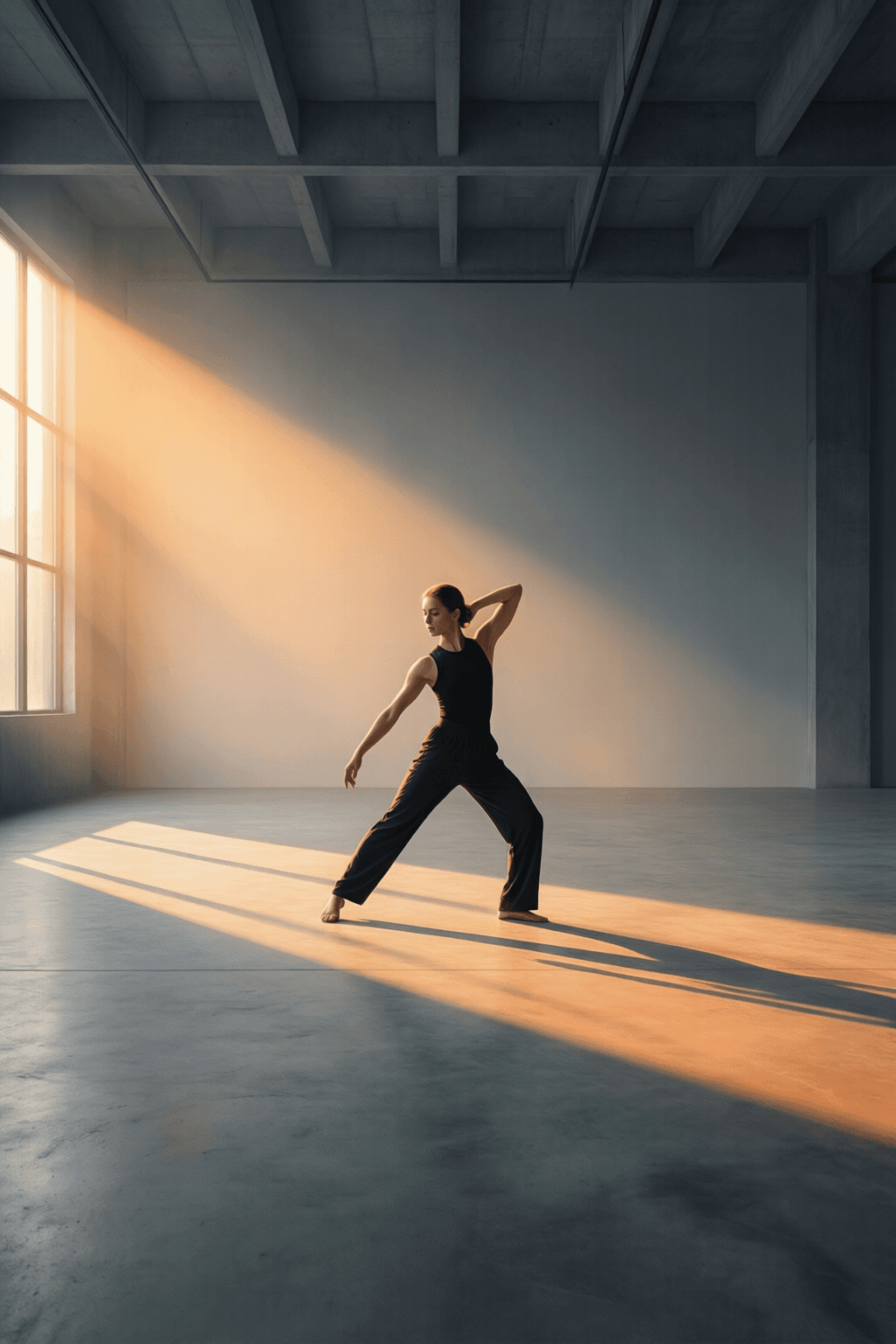
The artist is a sort of emotional athlete who is constantly stretching the limits of what is felt and what can be expressed. — Marina Abramović
—What lingers after this line?
Training the Inner Life
Marina Abramović’s remark recasts the artist not as a passive dreamer but as a disciplined performer of feeling. Just as an athlete trains muscles through repetition, strain, and recovery, the artist repeatedly enters difficult emotional territory in order to expand sensitivity and control. In this view, emotion is not merely experienced; it is practiced, tested, and refined. From the beginning, the comparison suggests endurance as much as inspiration. Abramović’s own performance work, including The Artist Is Present (2010), demonstrates how sustained attention can become a form of emotional labor. Consequently, art appears less like spontaneous expression and more like a rigorous exercise in vulnerability.
Stretching the Boundaries of Feeling
Building on that athletic metaphor, Abramović emphasizes stretching limits—an image that implies discomfort, discipline, and growth. Artists often push themselves toward sensations that ordinary life encourages people to avoid: grief, shame, longing, fear, or ecstatic joy. By going further into these states, they enlarge the emotional vocabulary available to everyone else. This is why powerful art can make familiar feelings seem newly visible. Virginia Woolf’s A Room of One’s Own (1929) and Sylvia Plath’s Ariel (1965) each transform private intensity into language that feels startlingly precise. Thus, the artist’s task is not simply to feel deeply, but to extend the range of what a culture can recognize as human experience.
Expression as a Discipline
Yet feeling alone is not enough; Abramović also points to what can be expressed. Here the artist resembles an athlete mastering form, technique, and restraint. A runner must convert raw energy into movement, and similarly an artist must shape unruly emotion into image, gesture, sound, or narrative. Without craft, intensity remains inarticulate. Accordingly, artistic expression becomes a disciplined translation of the inner world. Beethoven’s late string quartets, composed in the 1820s, channel profound struggle into highly structured music, while Frida Kahlo’s self-portraits turn pain into exact visual symbolism. In both cases, expression is not the opposite of emotion but its most demanding training ground.
Risk, Exposure, and Vulnerability
As the idea develops further, the phrase “emotional athlete” also highlights risk. Athletes risk injury when they test physical limits; artists risk exposure when they test emotional ones. To make something honest, they often reveal instability, desire, or suffering that social life teaches people to conceal. That vulnerability is part of the labor Abramović honors. Her performance Rhythm 0 (1974), in which audience members were invited to act on her passive body, starkly illustrates how artistic experimentation can involve genuine danger. In turn, the quote suggests that artistic courage lies not only in technical ambition but in the willingness to stand defenseless before others.
Why Audiences Need Such Artists
From there, Abramović’s insight opens onto the social function of art. If artists stretch the limits of feeling and expression, they become pioneers for collective emotion. They articulate states that audiences may sense but cannot yet name, and by doing so they widen public empathy. The artist’s private exertion therefore becomes a shared human resource. This helps explain why certain works endure across generations. Toni Morrison’s Beloved (1987), for example, gives haunting form to trauma, memory, and love in ways that reach far beyond one historical moment. Ultimately, the emotional athlete matters because their effort enlarges what society is able to feel, face, and communicate.
Art as Endurance and Renewal
Finally, Abramović’s comparison implies that artistic life is ongoing rather than occasional. An athlete does not train once, and an artist does not confront feeling only when inspiration appears. The work requires repetition, resilience, and the ability to return after exhaustion. Each new project becomes another test of emotional stamina and expressive reach. For that reason, the quote carries both admiration and warning. It celebrates the artist’s unusual capacity, yet it also acknowledges the cost of living so close to extremes. In the end, Abramović presents art as a lifelong practice of endurance—one that continuously renews the boundaries of human feeling by daring to exceed them.
Recommended Reading
As an Amazon Associate, we earn from qualifying purchases.
One-minute reflection
What's one small action this suggests?
Related Quotes
6 selectedThe artist is not a solid, static being. The artist is fluid, like water, moving with the tides and changing form. — James McCrae
James McCrae
James McCrae’s image of the artist as fluid immediately challenges the common idea that creative people possess a single, fixed essence. Instead, he suggests that artistry is a process of becoming, not a stable condition...
Read full interpretation →The artist works by locating the world in himself. — Gertrude Stein
Gertrude Stein
At first glance, Gertrude Stein’s line suggests that art does not begin with the outer world alone, but with the artist’s inner ability to absorb and reinterpret it. To ‘locate the world in himself’ means that experience...
Read full interpretation →The artist must be a master of what he rejects. — Carlos Fuentes
Carlos Fuentes
At first glance, Carlos Fuentes’s remark suggests that artistic refusal is not mere negation but an act of deep knowledge. An artist earns the right to reject a style, convention, or influence only after understanding it...
Read full interpretation →The artist's duty is to stay in the fire, to keep the question alive long after the answers have gone cold. — Adrienne Rich
Adrienne Rich
Adrienne Rich presents the artist not as a maker of neat conclusions, but as someone willing to remain inside uncertainty. The image of “staying in the fire” suggests discomfort, risk, and sustained attention; in other w...
Read full interpretation →The artist must elect to fight for the beauty of the work, stitch by patient stitch, against the rush of the world. — Ursula K. Le Guin
Ursula K. Le Guin
Ursula K. Le Guin’s line begins with a deliberate verb: the artist must “elect.” In other words, beauty is not an accident or a luxury but a conscious choice made in resistance to haste.
Read full interpretation →The artist is a witness to the present moment, not a slave to the machine that wants to replace it. — bell hooks
bell hooks
At its core, bell hooks’s statement insists that art begins with presence. To be a witness to the present moment is to attend closely to lived reality—its tensions, beauties, wounds, and contradictions—rather than merely...
Read full interpretation →More From Author
More from Marina Abramović →