
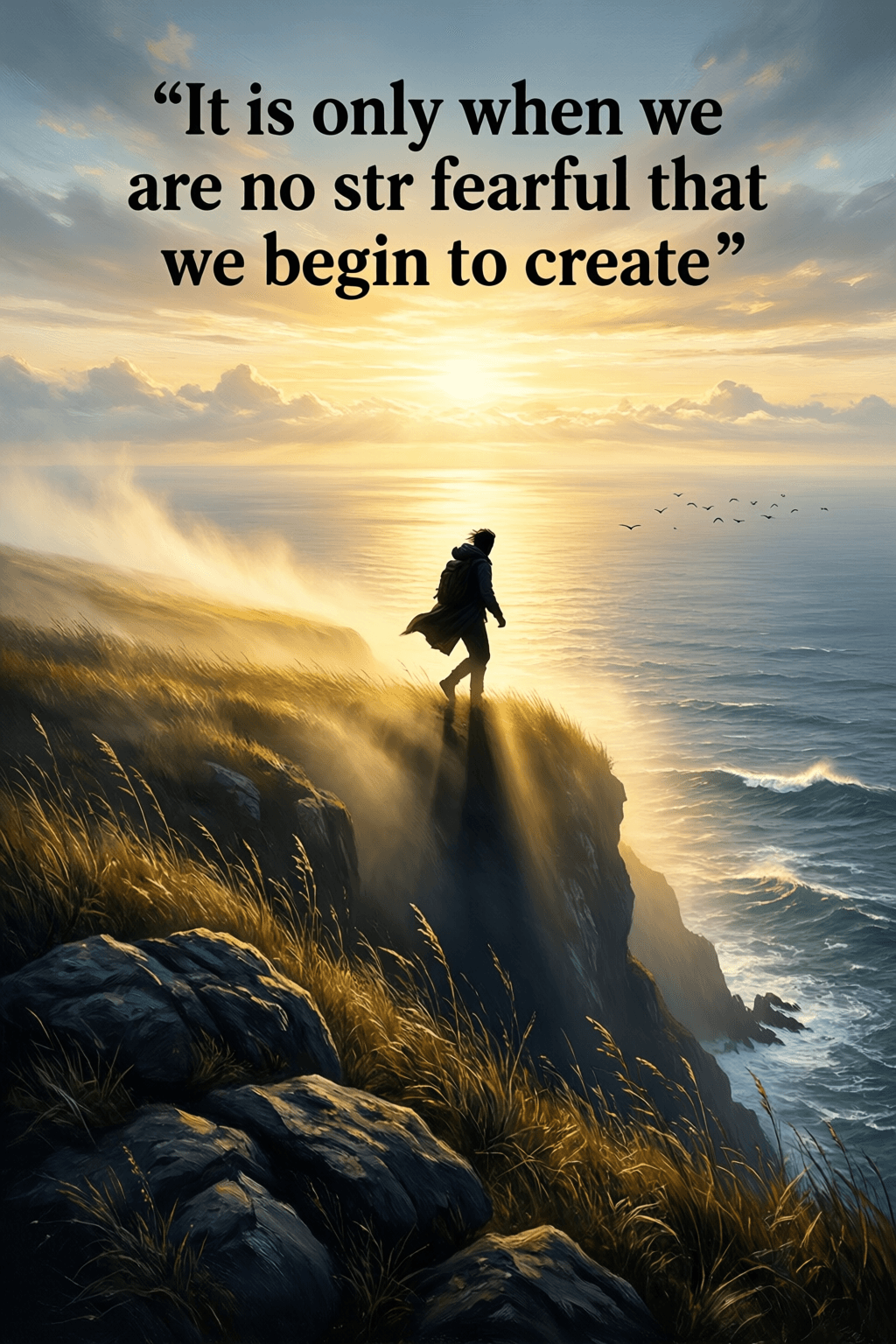
It is only when we are no longer fearful that we begin to create. — J.M.W. Turner
—What lingers after this line?
Fear as the First Barrier
Turner’s statement begins with a simple but profound insight: fear often stands between imagination and expression. Before a person can create, they must first loosen the grip of self-doubt, judgment, and uncertainty. In this sense, creativity is not merely a talent but a condition of inner freedom. This idea feels especially fitting coming from J.M.W. Turner, whose later paintings baffled many viewers with their atmospheric forms and luminous abstraction. By pushing beyond convention, Turner’s career itself suggests that creation requires a willingness to risk misunderstanding.
Why Safety Rarely Produces Innovation
From there, Turner’s words point to a larger truth: people rarely invent anything new while clinging to safety. Fear urges repetition, imitation, and caution, whereas creation asks for experiment and exposure. To make something original is to enter territory where outcomes are uncertain and approval is never guaranteed. This is why so many breakthroughs begin as acts of courage. Whether in art, science, or personal life, the creator must accept the possibility of failure before discovery becomes possible. In other words, innovation often starts where protection ends.
The Artist’s Courage to Risk Failure
Seen more personally, Turner’s quote honors the emotional labor behind making art. Every act of creation exposes something inward—taste, longing, perception, even vulnerability. Consequently, fear of ridicule or inadequacy can silence people long before they ever begin. Yet history repeatedly shows that meaningful work emerges from those who persist anyway. Vincent van Gogh’s letters (1880s) reveal constant insecurity alongside relentless production, reminding us that courage is not the absence of fear so much as the decision not to obey it. Turner’s point, however, is even sharper: genuine creation flourishes most fully when fear loses its authority.
Freedom, Play, and the Creative Mind
Once fear recedes, the mind regains its capacity for play, and this transition is crucial. Creativity thrives in states of curiosity, improvisation, and open attention—qualities that fear quickly constricts. A fearful mind scans for danger; a liberated mind notices possibility. Psychological research supports this contrast. Studies in creativity, such as Teresa Amabile’s work on intrinsic motivation (1983 onward), suggest that people produce more original work when they feel internally engaged rather than externally pressured. Thus, Turner’s observation reaches beyond poetry: freedom is not a luxury added to creation but one of its essential conditions.
Creation as an Act of Becoming
Ultimately, Turner’s quotation speaks not only to artists but to anyone trying to bring something new into the world. Creation may mean painting, writing, building a business, changing a life, or speaking an honest truth for the first time. In each case, fear keeps the self fixed, while creativity asks the self to evolve. For that reason, the quote carries both warning and invitation. As long as fear rules, our energies go toward preservation; once it loosens, they can turn toward invention. Turner leaves us with a liberating premise: we begin to create at the moment we stop living defensively and start living imaginatively.
One-minute reflection
What does this quote ask you to notice today?
Related Quotes
6 selectedIn order to be open to creativity, one must have the capacity for constructive use of solitude. One must overcome the fear of being alone. — Rollo May
Rollo May
Rollo May’s insight begins with a quiet but demanding premise: creativity requires the ability to stand apart from constant noise, approval, and distraction. To be open to new ideas, a person must first become comfortabl...
Read full interpretation →Anxiety is the precursor to creativity, and every great creation is born from anxiety. — T.S. Eliot
T. S. Eliot
At its core, Eliot’s statement frames anxiety not as a purely destructive force but as the restless tension that often precedes invention. Anxiety unsettles the mind, making ordinary answers feel insufficient; in that di...
Read full interpretation →To live a creative life, we must lose our fear of being wrong. — Joseph Chilton Pearce
Joseph Chilton Pearce
This quote emphasizes the importance of embracing uncertainty and the unknown. Creativity often involves exploring uncharted territories, and fearing mistakes can stifle that exploration.
Read full interpretation →Creativity takes courage. — Henri Matisse
Henri Matisse
This quote highlights that being creative often involves exposing one's inner thoughts and feelings, which requires a significant amount of courage as it makes one vulnerable to criticism and judgment.
Read full interpretation →The moment a man begins to talk about technique, that's proof that he is fresh out of ideas. — Dylan Thomas
Dylan Thomas
Dylan Thomas’s remark begins with a sharp suspicion: when an artist talks too much about technique, the living impulse behind the work may already be gone. Technique, in this sense, becomes a substitute language, a way o...
Read full interpretation →Imperfection inspires invention, imagination, and creativity. — Mary Sharratt
Mary Sharratt
Mary Sharratt’s insight begins with a reversal of ordinary expectations: imperfection is not merely something to fix, but something that awakens possibility. When a plan fails, a surface cracks, or an idea refuses to fit...
Read full interpretation →More From Author
More from J.M.W. Turner →