
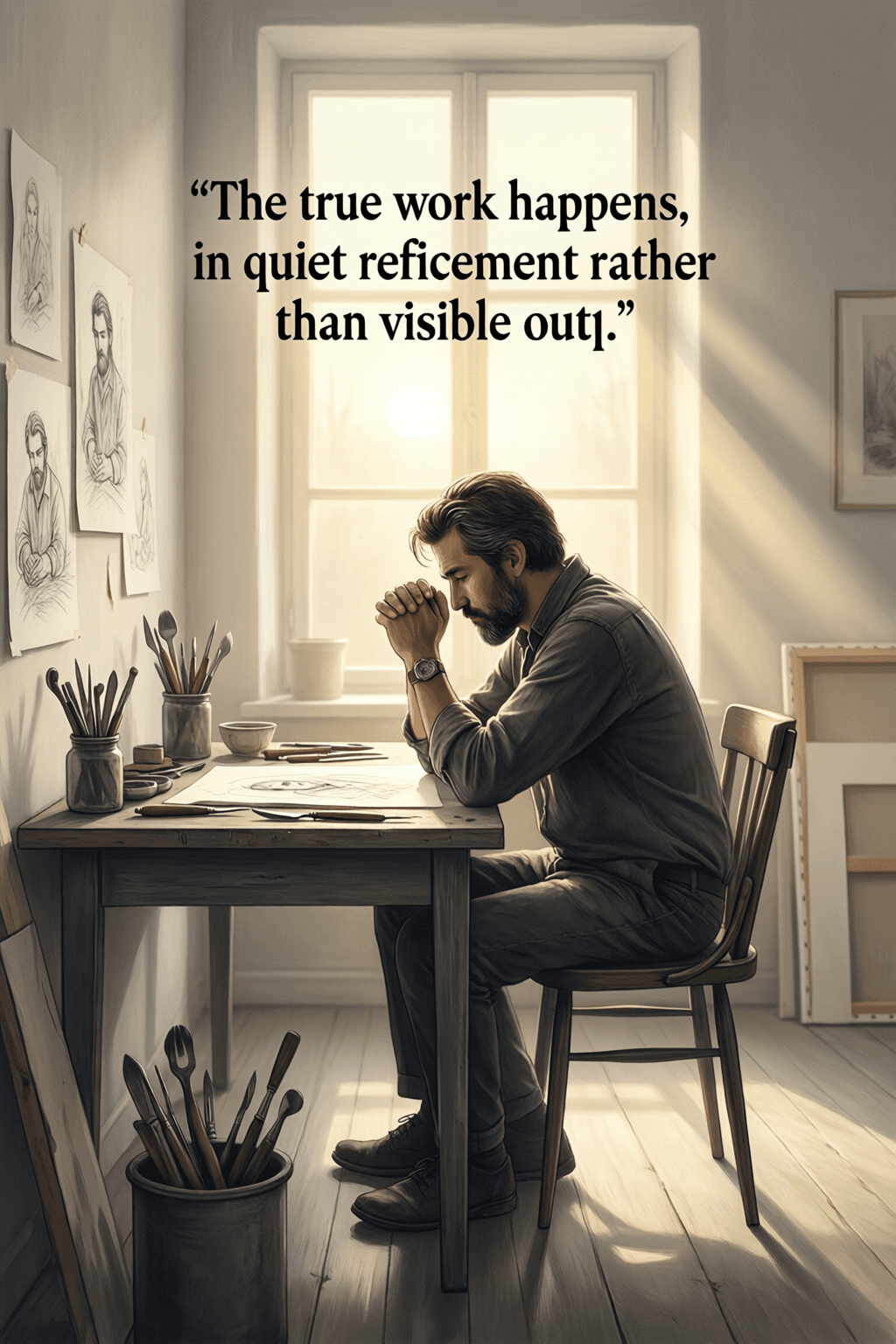
The most important work you do will not be the content you feed the machine, but the craft you refine in silence. — Rick Rubin
—What lingers after this line?
The Quote’s Central Claim
Rick Rubin’s statement shifts attention away from visible output and toward the invisible discipline that shapes it. At first glance, he contrasts “the content you feed the machine” with “the craft you refine in silence,” suggesting that tools, systems, and technologies matter less than the depth of the maker behind them. In other words, what endures is not merely what is produced, but the quality of attention, taste, and practice that produces it. This idea lands with particular force in an age obsessed with speed and volume. As a result, Rubin reminds us that creation is not only an act of delivery but also an act of inward cultivation. The unseen work—listening, revising, noticing, withholding—becomes the true foundation of anything worth sharing.
Silence as a Creative Workshop
From there, the phrase “refine in silence” opens a deeper meaning: silence is not emptiness, but a workshop for discernment. In many artistic traditions, solitude allows creators to hear what noise obscures. Johann Sebastian Bach’s careful revisions across manuscripts, preserved in eighteenth-century sources, suggest that great work often emerges not from immediate expression but from repeated, quiet shaping. Likewise, silence here can mean privacy from performance. Before an audience sees the polished result, the artist must spend time away from applause, metrics, and reaction. Consequently, Rubin’s insight honors the hidden hours when instinct is sharpened and superficial impulses are stripped away.
Why Tools Cannot Replace Taste
The mention of “the machine” naturally evokes modern creative technology, including algorithmic tools and artificial intelligence. Yet Rubin’s point is not anti-technology; rather, it is hierarchical. A machine can accelerate output, but it cannot by itself supply judgment, restraint, or vision. As Marshall McLuhan argued in Understanding Media (1964), tools extend human capacities, but they do not determine the wisdom of their use. Therefore, the real differentiator is not access to powerful systems but the refinement of taste. Two people may use the same tool and produce very different results because one has cultivated sensitivity to structure, tone, and meaning. The machine amplifies, but the human maker still decides what is worth amplifying.
A Tradition of Inner Discipline
Seen more broadly, Rubin’s thought belongs to a long tradition that prizes interior formation over outward display. Marcus Aurelius, in Meditations (c. 180 AD), repeatedly returns to self-command, urging attention to the inner life as the source of right action. Although he wrote as a philosopher-emperor rather than an artist-producer, the principle is similar: external results depend on inward order. In the same way, writers from Virginia Woolf to Toni Morrison described the necessity of protected mental space for serious work. Their example reinforces Rubin’s claim that craft matures where ego quiets down. Thus, the silent refinement he celebrates is less a romantic image than a practical requirement for excellence.
The Ethical Side of Making
As the quote unfolds, it also suggests an ethical dimension. If creators focus only on feeding machines—whether platforms, markets, or content pipelines—they may begin optimizing for output instead of truth. The result can be work that is plentiful yet hollow. By contrast, refined craft implies responsibility: to language, to form, to audience, and to one’s own standards. This tension appears across cultural history. For example, George Orwell’s essay “Politics and the English Language” (1946) argues that careless expression reflects and encourages careless thought. Rubin’s statement extends that warning into contemporary creation: what we make is shaped by how seriously we take the invisible labor of making it well.
A Practical Lesson for Modern Creators
Finally, Rubin offers more than a poetic observation; he offers a working principle. In practical terms, creators should spend less energy chasing constant production and more energy deepening perception, patience, and technique. A musician practicing phrasing alone, a writer cutting a paragraph no one will miss, or a designer studying proportion in silence is doing the work Rubin values most. For that reason, the quote is ultimately encouraging. It reassures people that their quiet labor is not secondary to visible performance; it is the source of it. What appears effortless or brilliant in public is usually born in private refinement, where craft grows slowly enough to become unmistakably human.
One-minute reflection
Where does this idea show up in your life right now?
Related Quotes
6 selectedWisdom comes only to the silent mind. — Krishnamurti
Krishnamurti
Krishnamurti’s statement begins with a simple but demanding insight: wisdom is not merely accumulated information, nor is it the reward for constant thinking. Instead, it arises when the mind becomes quiet enough to perc...
Read full interpretation →There is a time for many words, and there is also a time for sleep. — Homer
Homer
Homer’s line turns on a simple but profound contrast: there is a season for speaking at length, and there is another for surrendering to sleep. At once, he suggests that wisdom is not merely knowing what matters, but kno...
Read full interpretation →Silence the noise, strengthen the soul. — Marcus Aurelius
Marcus Aurelius
At first glance, Marcus Aurelius’s line condenses the heart of Stoic practice into a simple command: reduce distraction so that character can grow. In his Meditations (c.
Read full interpretation →Silence is a place of great power and healing. — Rachel Naomi Remen
Rachel Naomi Remen
At first glance, Rachel Naomi Remen’s quote seems simple, yet it points to a profound truth: silence is not mere absence, but a living space where strength gathers. In a noisy world that rewards constant reaction, silenc...
Read full interpretation →The beauty of the world is that it is a craft, not a product. — Simone Weil
Simone Weil
Simone Weil’s remark shifts our attention from the world as a finished object to the world as a living act of making. A product suggests completion, closure, and fixed utility, whereas a craft implies care, patience, rev...
Read full interpretation →The craft of the master is not in the final product alone, but in the devotion to the process that brought it into being. — Richard Sennett
Richard Sennett
At first glance, Richard Sennett’s remark shifts attention away from the polished artifact and toward the labor that shaped it. He argues that true mastery cannot be measured only by what the audience sees at the end; ra...
Read full interpretation →More From Author
More from Rick Rubin →Don't worry about being original; worry about being authentic. Originality is a side effect of truth. — Rick Rubin
Rick Rubin’s remark immediately overturns a common creative anxiety: the pressure to be unlike anyone else. Instead, he argues that authenticity should come first, because work grounded in honest perception carries a for...
Read full interpretation →The creative process is a journey of letting go of the need for perfection to make space for the truth of expression. — Rick Rubin
Rick Rubin’s quote begins with a reversal of a common assumption: many people believe great art comes from flawless execution, yet he argues that the creative process starts by releasing that demand. In this view, perfec...
Read full interpretation →The goal is to get to the point where you're not thinking anymore. You're just reacting to the magic. — Rick Rubin
Rick Rubin’s line points to a subtle creative destination: the moment thinking stops being the driver and becomes, at most, a quiet passenger. Instead of deliberating over each choice, the artist responds in real time—li...
Read full interpretation →You have to be willing to be bad at something to become good at it. — Rick Rubin
Rick Rubin’s line points to an uncomfortable truth: the first step toward competence often looks like incompetence. In a culture that rewards polished outcomes, beginners can feel exposed, as if early mistakes are eviden...
Read full interpretation →