
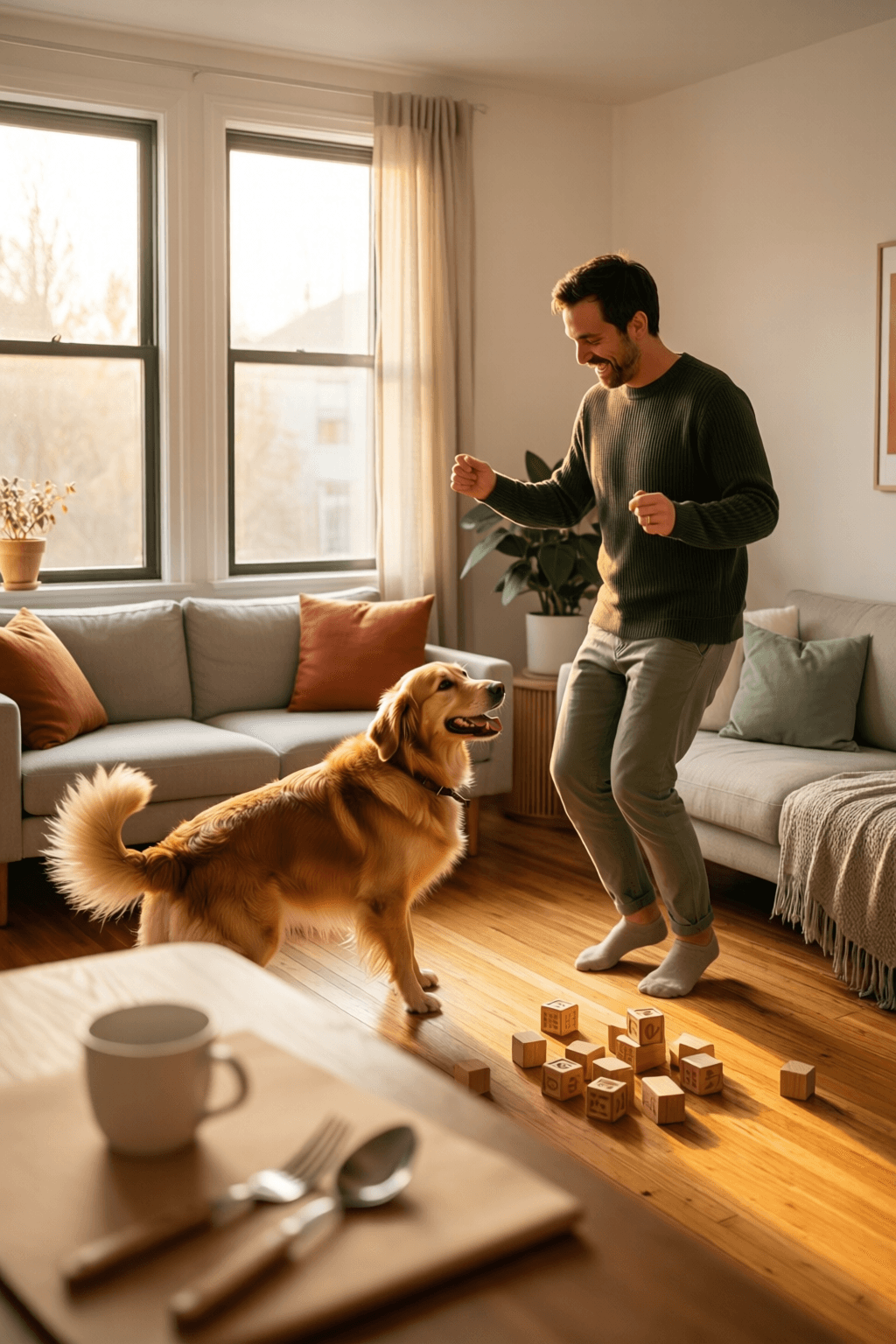
Adults can benefit from play as much as children. Go ahead and dance with your dog or build something just for fun. — Dr. Elinore McCance-Katz
—What lingers after this line?
A Reminder Adults Often Forget
At first glance, Dr. Elinore McCance-Katz’s quote sounds almost disarmingly simple, yet it challenges a common adult assumption: that play belongs mainly to childhood. By urging grown-ups to dance with a dog or build something purely for enjoyment, she reframes play as a valid and necessary part of mature life rather than a childish distraction. In that sense, the statement invites adults to reclaim activities with no productive goal beyond delight. What children do instinctively, many adults suppress in the name of efficiency, so the quote serves as a gentle correction—one that restores joy, spontaneity, and freedom to everyday living.
Play as Emotional Renewal
From there, the deeper value of play becomes clear: it refreshes the mind and softens emotional strain. When adults engage in playful acts, whether tossing a ball, doodling, or improvising a silly game, they interrupt cycles of stress and self-monitoring. What appears trivial on the surface often becomes a form of emotional repair. Research echoes this intuition. Stuart Brown’s Play: How It Shapes the Brain, Opens the Imagination, and Invigorates the Soul (2009) argues that play is not ornamental but essential to well-being across the lifespan. In this light, McCance-Katz’s examples are more than cute suggestions; they are practical invitations to recover balance.
Creativity Without a Deadline
Just as importantly, the quote celebrates making things ‘just for fun,’ which pushes back against the pressure to monetize every talent or justify every hobby. Adults are often taught that building, drawing, singing, or tinkering should lead to achievement, but play restores the freedom to create without evaluation. That freedom can be unexpectedly powerful. Indeed, many creative breakthroughs begin in low-stakes experimentation. The history of invention is full of curious detours, and even Einstein reportedly valued imagination alongside disciplined thought. By encouraging purposeless creation, the quote suggests that joy itself can be fertile ground for insight.
Connection Through Shared Absurdity
Moreover, the image of dancing with your dog highlights another overlooked function of play: connection. Playful behavior dissolves formality and invites presence, whether between friends, partners, parents, or pets. A ridiculous moment shared without embarrassment can deepen bonds more quickly than serious conversation alone. This idea appears in social science as well. Psychologist Jaak Panksepp’s work on affective neuroscience, including Affective Neuroscience (1998), identified play as a primary emotional system linked to social development and attachment. Seen this way, playful interaction is not frivolous at all; it is one of the simplest ways to strengthen relationship and trust.
Resisting the Tyranny of Usefulness
Taken further, the quote quietly resists a culture that prizes usefulness above all else. Adult life is often organized around deadlines, measurable outcomes, and constant self-improvement, so an activity done solely for pleasure can feel almost rebellious. Yet that rebellion is healthy because it protects a part of the self that productivity cannot define. Philosophers have long recognized this tension. Josef Pieper’s Leisure, the Basis of Culture (1948) argues that a meaningful life requires spaces free from pure utility. McCance-Katz’s advice belongs to that tradition, reminding us that not every worthwhile act must produce profit, status, or progress.
A More Playful Model of Adulthood
Ultimately, the quote offers a fuller vision of adulthood—one in which responsibility and play are not enemies but partners. To be grown-up does not mean becoming humorless or mechanically efficient; rather, it means knowing how to sustain vitality amid obligation. Play keeps that vitality alive by preserving curiosity, movement, and delight. Therefore, the suggestion to dance, build, or simply be silly is not an escape from adult life but a way of inhabiting it more fully. In a world that often rewards seriousness, McCance-Katz reminds us that joy can be a discipline too, and perhaps a deeply restorative one.
One-minute reflection
What does this quote ask you to notice today?
Related Quotes
6 selectedWe need joy as we need air. We need love as we need water. We need each other as we need the earth we share. — Maya Angelou
Maya Angelou
Maya Angelou’s words turn emotional needs into elemental ones, placing joy beside air, love beside water, and human connection beside the earth itself. By doing so, she refuses to treat happiness, affection, and communit...
Read full interpretation →Joy is a net of love by which you can catch souls. — Mother Teresa
Mother Teresa
Mother Teresa’s saying begins with a striking metaphor: joy is not merely a private feeling, but an instrument that reaches outward. By calling it a “net of love,” she suggests that joy gathers people in without force, p...
Read full interpretation →Serious art is born from serious play. — Julia Cameron
Julia Cameron
At first glance, Julia Cameron’s line seems contradictory: how can play be serious, and how can seriousness produce art without becoming rigid? Yet that tension is precisely her point.
Read full interpretation →There is no true joy in a life lived closed up in the little shell of the self. — The Dalai Lama
The Dalai Lama
At its core, the Dalai Lama’s statement argues that a life centered only on personal comfort, status, or protection becomes emotionally cramped. The image of a ‘little shell’ suggests not strength but confinement: when p...
Read full interpretation →Whenever you recover or discover something that nourishes your soul and brings joy, care enough about yourself to make room for it in your life. — Jean Shinoda Bolen
Jean Shinoda Bolen
Jean Shinoda Bolen’s words begin with a gentle but radical premise: joy is not a luxury to be postponed, but something worthy of deliberate space in our lives. Rather than treating soul-nourishing experiences as accident...
Read full interpretation →It takes a long time to become young. — Pablo Picasso
Pablo Picasso
Picasso’s line flips the usual story of aging: instead of youth being something we naturally possess and then lose, he frames it as something we arrive at. In this view, “young” isn’t merely an age but a quality of atten...
Read full interpretation →More From Author
More from Katz →