
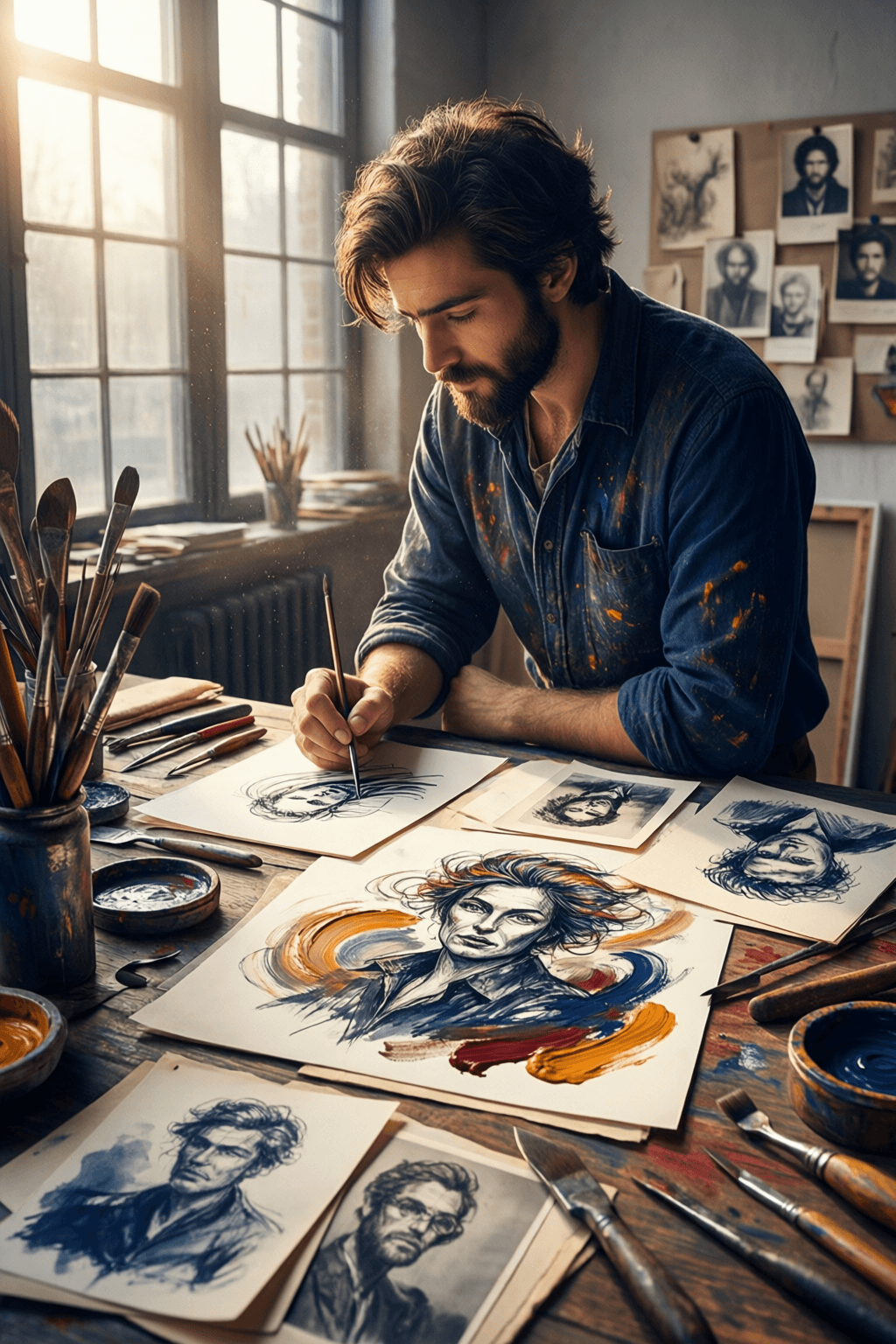
Creativity is a wild mind with a disciplined eye. — Jon Acuff
—What lingers after this line?
The Productive Tension
Jon Acuff’s remark presents creativity as a union of opposites: the mind must be free enough to wander, yet the eye must remain trained enough to judge what is worth keeping. In that sense, invention does not arise from chaos alone. Rather, it emerges when untamed ideas meet a standard of selection, shaping raw inspiration into something meaningful.
Why Wildness Matters
To begin with, the ‘wild mind’ points to curiosity, play, and the willingness to make unusual connections. Many breakthroughs begin this way. Leonardo da Vinci’s notebooks, for example, move restlessly from anatomy to engineering to art, showing how expansive thinking feeds originality. Without this openness, creative work risks becoming predictable repetition rather than discovery.
The Role of the Disciplined Eye
Yet imagination alone is not enough. Acuff’s ‘disciplined eye’ suggests discernment: the ability to revise, refine, and recognize proportion, timing, and truth. Here the artist becomes an editor of the self. As Ira Glass famously observed in interviews about creative practice, taste often exceeds skill at first, and discipline is what closes that gap through repeated effort and honest evaluation.
Art Shaped by Revision
From there, it becomes clear that many admired works are not sudden miracles but carefully reworked creations. T. S. Eliot’s manuscript of The Waste Land (1922), heavily edited with Ezra Pound’s help, shows how brilliance can depend on severe pruning. The wild impulse generated the material, but disciplined seeing gave it form, coherence, and lasting power.
A Lesson Beyond the Arts
Moreover, Acuff’s insight applies far beyond painting or writing. In business, science, and education, innovation depends on this same balance. Thomas Edison’s often-quoted process of repeated experimentation illustrates it well: bold ideas require structured testing. Thus creativity is not merely self-expression; it is the practice of turning possibility into reality through both freedom and control.
Cultivating Both Habits
Ultimately, the quote encourages people to nurture two habits at once: fearless generation and careful judgment. One can brainstorm without restraint, then return later with a sharper eye for structure and quality. By separating these stages while honoring both, creators avoid the traps of sterile perfectionism and aimless spontaneity, allowing imagination to become effective work.
One-minute reflection
What feeling does this quote bring up for you?
Related Quotes
6 selectedYou can be cautious or you can be creative, but there's no such thing as a cautious creative. — George Lois
George Lois
George Lois draws a sharp line between two mindsets: caution protects what already exists, while creativity risks making something new. At first glance, the statement sounds absolute, yet that severity is exactly its poi...
Read full interpretation →Creativity is intelligence having fun. — George Scialabba
George Scialabba
At first glance, George Scialabba’s line turns creativity into something disarmingly simple: intelligence at play. Rather than presenting invention as grim labor or mystical inspiration, the quote suggests that original...
Read full interpretation →Creativity is a habit, and the best creativity is the result of good work habits. — Twyla Tharp
Twyla Tharp
At first glance, Twyla Tharp’s quote challenges the popular myth that creativity arrives as a sudden flash of genius. Instead, she reframes it as something built through repetition, structure, and deliberate effort.
Read full interpretation →Discipline is not the enemy of creativity; it is the structure that gives your wild ideas a place to land. — Martha Graham
Martha Graham
At first glance, discipline and creativity seem like opposites: one suggests rules, repetition, and restraint, while the other evokes freedom, spontaneity, and risk. Yet Martha Graham’s insight dissolves that false divid...
Read full interpretation →Creativity takes courage. — Henri Matisse
Henri Matisse
This quote highlights that being creative often involves exposing one's inner thoughts and feelings, which requires a significant amount of courage as it makes one vulnerable to criticism and judgment.
Read full interpretation →Imperfection inspires invention, imagination, and creativity. — Mary Sharratt
Mary Sharratt
Mary Sharratt’s insight begins with a reversal of ordinary expectations: imperfection is not merely something to fix, but something that awakens possibility. When a plan fails, a surface cracks, or an idea refuses to fit...
Read full interpretation →More From Author
More from Jon Acuff →A bad day for your ego is a great day for your soul. — Jon Acuff
The quote contrasts the ego, which is associated with pride and self-importance, with the soul, which represents one's true, humble self.
Read full interpretation →Your dreams don’t have deadlines. — Jon Acuff
Jon Acuff’s statement that 'your dreams don’t have deadlines' offers a liberating perspective on personal ambition. In a world often fixated on timetables and milestones, his words encourage us to think of dreams as life...
Read full interpretation →