
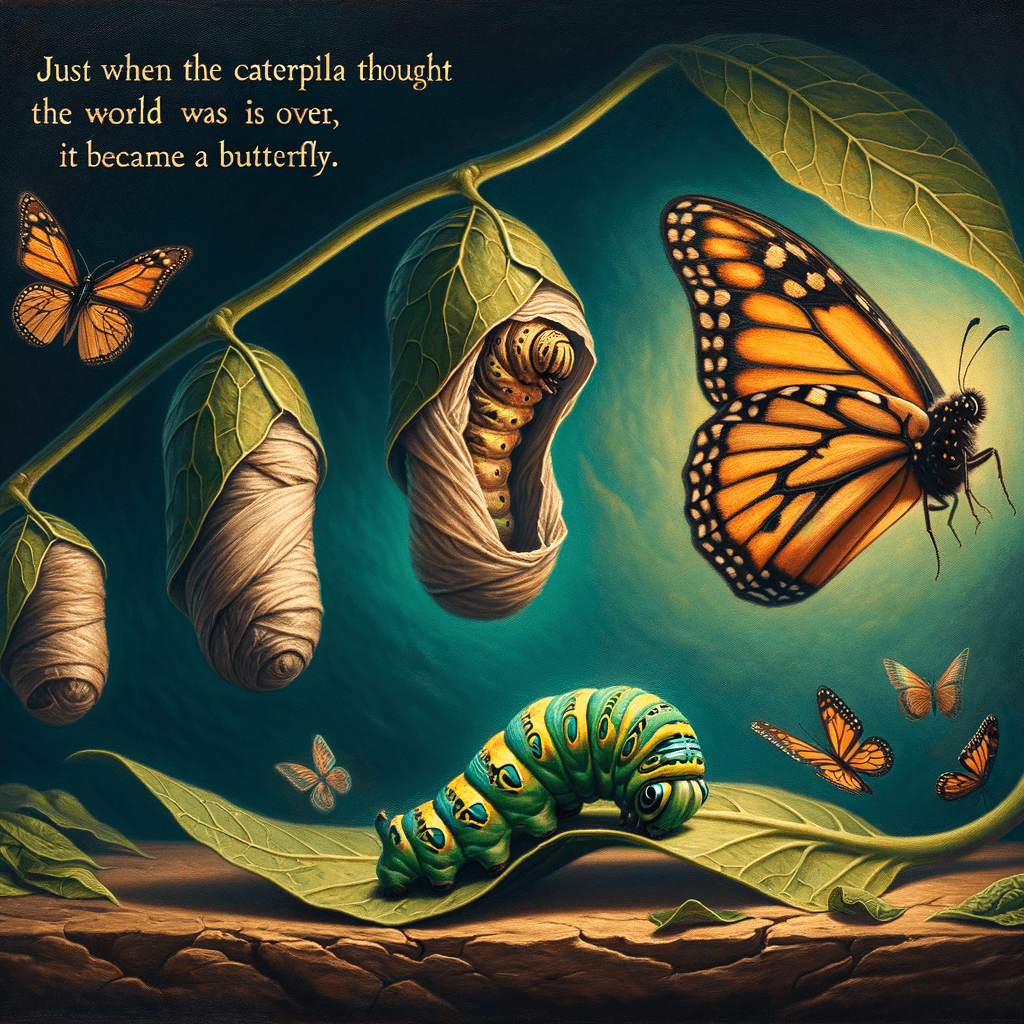
Just when the caterpillar thought the world was over, it became a butterfly. — Proverb
—What lingers after this line?
Transformation and Growth
This proverb highlights the concept of transformation. It suggests that periods of hardship or end may be prerequisites for personal growth and renewal.
Hope and Positivity
The quote promotes a message of hope, indicating that when situations seem bleak or difficult, better times or opportunities may be just around the corner.
Resilience
It emphasizes the importance of resilience in life. Like the caterpillar, enduring tough times can lead to unexpected and beautiful transformations.
Cyclical Nature of Life
The proverb metaphorically illustrates the cycles of life, where endings often lead to new beginnings and continuous growth.
Metamorphosis as a Symbol
The caterpillar's transformation into a butterfly is a common symbol of change and rebirth, indicating that profound changes are often necessary for achieving one's full potential.
Interpretation in Various Fields
This proverb can be applied in various contexts, such as personal development, career challenges, and emotional growth, underscoring its universal relevance.
Philosophical Perspective
From a philosophical viewpoint, the proverb suggests that perceived endings should not be viewed with despair, but rather as an integral part of an ongoing process of evolution.
One-minute reflection
Why might this line matter today, not tomorrow?
Related Quotes
6 selectedNo matter how long the winter, spring is sure to follow. — Proverb
Proverb
This proverb emphasizes that difficult times do not last forever and that better days are certain to come, just as spring inevitably follows winter.
Read full interpretation →Just because your light flickers does not mean it is about to go out. — Yohancé Salimu
Yohancé Salimu
At first glance, Yohancé Salimu’s line separates appearance from reality. A flicker suggests instability, fatigue, or interruption, yet it does not automatically signal extinction.
Read full interpretation →Today's tears water tomorrow's gardens. — Matshona Dhliwayo
Matshona Dhliwayo
At first glance, Matshona Dhliwayo’s line transforms grief into something unexpectedly fertile. Tears, usually seen as signs of pain or loss, become water for a future garden, suggesting that suffering is not merely endu...
Read full interpretation →Hope is passion for the possible. — Søren Kierkegaard
Søren Kierkegaard
At first glance, Kierkegaard’s line transforms hope from a passive feeling into an active force. To call hope “passion for the possible” means that hope is not mere daydreaming; rather, it is an inward energy that leans...
Read full interpretation →A ship should not ride on a single anchor, nor life on a single hope. — Epictetus
Epictetus
At first glance, Epictetus turns a practical image into a moral lesson: a ship secured by only one anchor is vulnerable to shifting winds, rough tides, and hidden strain. In the same way, a life fastened to a single hope...
Read full interpretation →We need never be hopeless because we can never be irreparably broken. — John Green
John Green
At its core, John Green’s line reframes hope not as naive optimism but as a durable truth about being human. To say we need never be hopeless is to suggest that no injury, failure, or grief fully cancels the possibility...
Read full interpretation →More From Author
More from Proverb →Your nervous system is a landscape, not a machine; it requires the soft rain of rest, not the constant lightning of urgency. — Proverb
The proverb begins by rejecting the idea that the nervous system is a simple machine with replaceable parts and predictable outputs. Instead, it frames the body as a landscape—complex, interconnected, and shaped over tim...
Read full interpretation →If you bring forth what is within you, what you bring forth will save you. If you do not, it will destroy you. — Proverb
The proverb frames self-expression as a decisive fork in the road: what lies within us is not neutral, and it will shape our fate one way or another. In this view, inner fears, desires, convictions, and gifts resemble a...
Read full interpretation →The world will provide you with a label if you are too lazy to define yourself. Pick your own name before someone else names you their tool. — Proverb
The proverb begins with a blunt warning: if you don’t articulate who you are, other people will do it for you. In everyday life, that labeling can be subtle—“quiet,” “difficult,” “gifted,” “unreliable”—but once applied,...
Read full interpretation →I am allowed to have limits. My needs matter too. I deserve moments of rest. — Proverb
The proverb begins with a simple but radical permission: you are allowed to have limits. In many families, workplaces, or cultures, saying “no” can be treated as selfishness, yet limits are often the very structure that...
Read full interpretation →