
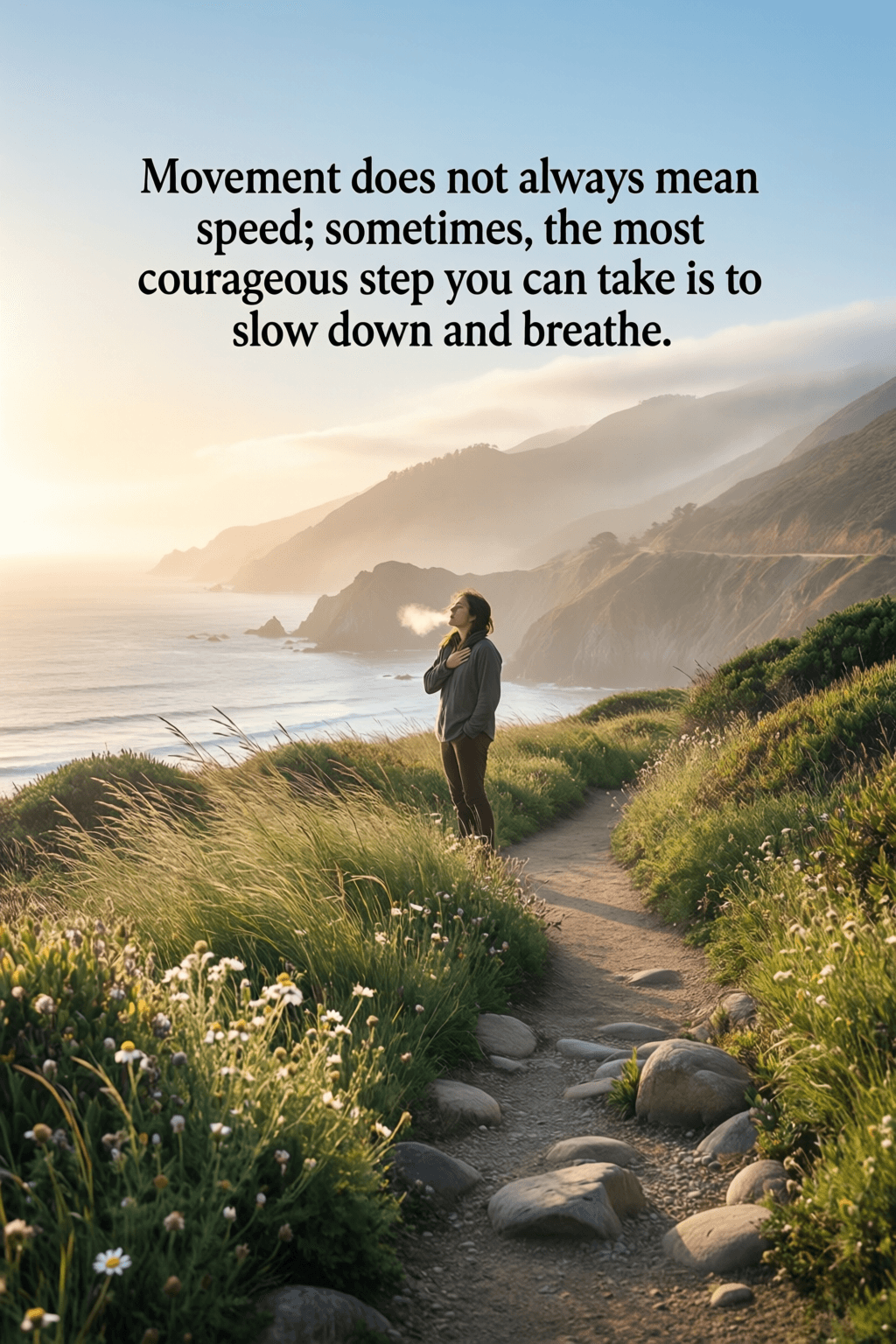
Movement does not always mean speed; sometimes, the most courageous step you can take is to slow down and breathe. — Sarah Ban Breathnach
—What lingers after this line?
Redefining What Movement Means
At first glance, movement is often confused with speed, productivity, or constant visible progress. Sarah Ban Breathnach’s quote gently corrects that assumption by suggesting that motion can also take the form of pause, reflection, and deliberate breathing. In this sense, slowing down is not the opposite of moving forward; rather, it can be a wiser and more sustainable way of doing so. This reframing matters because modern life frequently rewards urgency over clarity. Yet a rushed life can create the illusion of advancement while leaving people emotionally depleted. By contrast, choosing stillness at the right moment becomes an active decision, one that honors the body’s need for rest and the mind’s need for perspective.
Slowness as an Act of Courage
From there, the quote deepens into a moral insight: slowing down is not laziness but bravery. It takes courage to resist cultural pressure that equates worth with busyness. In many settings, people fear that pausing will make them appear weak or unproductive, so they keep pushing even when exhaustion has already blurred their judgment. However, real courage often appears in quieter forms. The person who admits, ‘I need a moment,’ may be showing more strength than the one who never stops. In that way, Breathnach’s words honor restraint as a form of self-respect, reminding us that intentional pause can be a disciplined response to chaos rather than an escape from responsibility.
The Restorative Power of Breath
Naturally, the quote’s focus on breathing gives this insight a physical and immediate dimension. Breath is the body’s simplest reset mechanism, capable of calming stress and restoring attention in a matter of moments. Even brief breathing practices have been linked to reduced anxiety and better emotional regulation; for example, many mindfulness-based programs influenced by Jon Kabat-Zinn’s work in the late 20th century emphasize breath as an anchor to the present. Because breathing is always available, it becomes a democratic tool for resilience. One deep breath before answering a difficult email or entering a tense conversation can interrupt reactivity. Thus, what seems like a small act becomes a quiet turning point, allowing the next step to arise from steadiness rather than panic.
A Counterpoint to Hustle Culture
Seen in a wider social context, the quotation also challenges the ethos of hustle culture. Contemporary ideals often celebrate relentless acceleration, as if a full schedule were proof of significance. Yet writers on simplicity and well-being, including Breathnach in works such as Simple Abundance (1995), have long argued that a life packed with motion can still feel spiritually empty. Consequently, slowing down becomes a form of resistance. It asks whether every demand deserves compliance and whether every opportunity deserves pursuit. By refusing automatic speed, a person begins to reclaim agency over time, attention, and energy. The quote therefore speaks not only to personal wellness but also to the deeper question of how one wants to live.
Presence Before Progress
In practical terms, the wisdom here suggests that presence should come before progress. When people rush from task to task, they may complete more actions while understanding less about why those actions matter. Slowing down creates room to notice feelings, priorities, and patterns that are otherwise drowned out by momentum. This is why many turning points in life begin not with dramatic action but with a pause: a walk after burnout, a breath before a difficult decision, a quiet morning that reveals what has been ignored. In those moments, stillness is not empty. Instead, it gathers scattered experience into insight, making future movement more honest and more aligned.
A Gentler Vision of Strength
Finally, Breathnach offers a gentler definition of strength itself. Strength is often imagined as endurance without complaint, but her words suggest that true strength includes tenderness toward one’s limits. To breathe, to slow down, and to continue thoughtfully is not failure; it is mature, grounded perseverance. As a result, the quote leaves readers with both comfort and instruction. It reassures those who feel behind that not all forward motion is fast, and it encourages them to trust measured steps. In a world addicted to acceleration, that reminder is both humane and radical: sometimes the bravest way forward begins by simply breathing.
One-minute reflection
What does this quote ask you to notice today?
Related Quotes
6 selectedThe best people possess a feeling for beauty, the courage to take risks, the discipline to tell the truth, the capacity for sacrifice. — Ernest Hemingway
Ernest Hemingway
Hemingway’s line presents goodness not as politeness or success, but as a demanding inner code. The “best people” are those who combine sensitivity, bravery, honesty, and self-denial—qualities that do not always coexist...
Read full interpretation →If you are not willing to look stupid, nothing great is ever going to happen to you. — Julia Cameron
Julia Cameron
Julia Cameron’s remark begins with a hard truth: many people do not fail because they lack talent, but because they fear embarrassment. In that sense, ‘looking stupid’ becomes shorthand for being seen trying, stumbling,...
Read full interpretation →We need, above all things, to slow down and get ourselves to amble through life instead of to rush through it. — Bertrand Russell
Bertrand Russell
At its core, Bertrand Russell’s remark argues that the speed of modern life can become a form of self-impoverishment. To rush through existence is not merely to move quickly; it is to miss texture, reflection, and the qu...
Read full interpretation →You don't have to bully yourself out of feeling fear. You just have to move while it's still there. — Annie Wright
Annie Wright
At its core, Annie Wright’s quote challenges the common belief that courage begins only after fear has disappeared. Instead, it reframes fear as something that can accompany action rather than prevent it.
Read full interpretation →For what matters in life is not whether we receive a round of applause; what matters is whether we have the courage to venture forth despite the uncertainty of acclaim. — Amor Towles
Amor Towles
At its core, Amor Towles shifts attention away from public approval and toward private resolve. The quote argues that a life’s value is not determined by applause—those visible signs of recognition—but by the willingness...
Read full interpretation →Confidence doesn't mean being fearless. It means creating, even when your hands shake. — Lisa Golightly
Lisa Golightly
At first glance, Lisa Golightly’s quote overturns a common myth: that confident people move through life without fear. Instead, she presents confidence as action taken in spite of fear, not in the absence of it.
Read full interpretation →More From Author
More from Sarah Ban Breathnach →Our deepest wishes are whispers of our authentic self. We must learn to respect them. We must learn to listen. — Sarah Ban Breathnach
Sarah Ban Breathnach’s quote begins with a gentle but radical claim: our deepest wishes are not random fantasies but signals from the truest part of who we are. Rather than treating longing as weakness or distraction, sh...
Read full interpretation →The pain of self-discipline will never be as great as the pain of regret. — Anonymous (Skip: Replace with: It is easier to discipline yourself now than to regret your lack of discipline later. — Anonymous) -> *Correction*: It is easier to discipline yourself now than to regret your lack of discipline later. — Sarah Ban Breathnach
Sarah Ban Breathnach’s corrected line reframes discipline as a smaller, more manageable discomfort chosen in the present to avoid a heavier sorrow in the future. At first glance, it sounds like simple advice, yet its for...
Read full interpretation →We must look at the lens through which we see the world, as well as the world we see. — Sarah Ban Breathnach
Sarah Ban Breathnach’s line reminds us that perception is never a simple act of receiving reality; it is also an act of interpretation. We do not merely look outward at events, people, and circumstances—we also look thro...
Read full interpretation →Whatever we are waiting for—peace of mind, contentment, grace—it will surely come to us, but only when we are ready to receive it with an open and grateful heart. — Sarah Ban Breathnach
Sarah Ban Breathnach’s quote offers comfort, but it also places gentle responsibility on the reader. Peace of mind, contentment, and grace are not described as prizes seized by force; instead, they arrive when a person b...
Read full interpretation →