
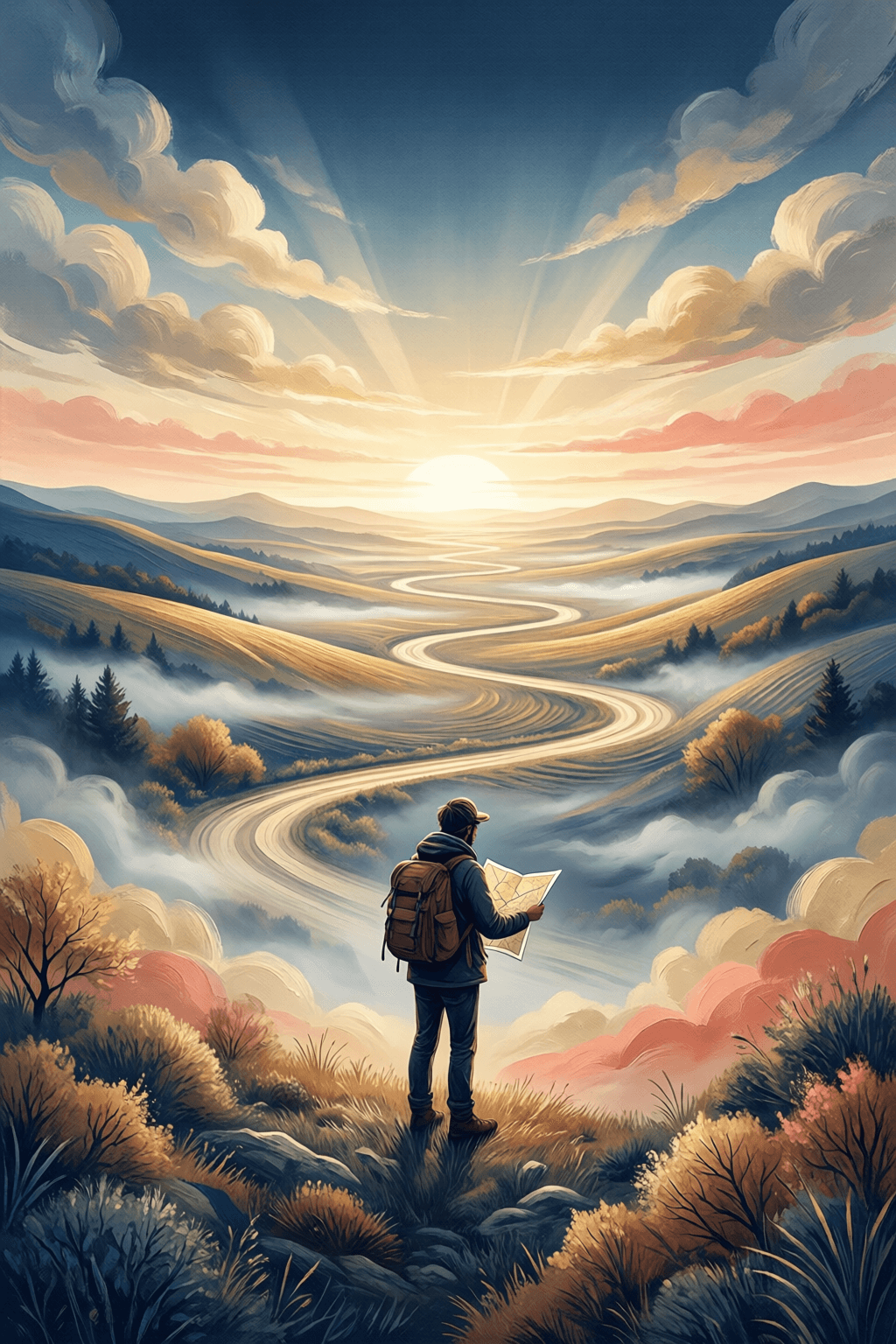
Art is the act of navigating without a map. — Seth Godin
—What lingers after this line?
The Essence of Unscripted Making
At its core, Seth Godin’s line defines art not as technical polish but as a willingness to move forward without guaranteed direction. To create without a map is to accept uncertainty as part of the process, trusting intuition, judgment, and responsiveness instead of fixed instructions. In this sense, art becomes an act of discovery rather than mere execution. From there, the quote quietly challenges a common assumption: that value comes from control. Instead, Godin suggests that genuine creation begins where predictability ends. What matters is not perfectly following a route, but daring to enter terrain no blueprint can fully describe.
Risk as a Condition of Creativity
Because there is no map, the artist must confront risk at every turn. A blank canvas, an unfinished manuscript, or an experimental performance all require decisions that cannot be fully validated in advance. That vulnerability is precisely what makes the work alive; if every step were known beforehand, the result might be efficient, but it would no longer feel like art. In this way, Godin’s statement aligns with creative history. Pablo Picasso’s constant reinvention across his Blue Period, Cubism, and later work shows an artist repeatedly abandoning familiar routes. Each shift carried the danger of failure, yet that danger also opened the possibility of invention.
Uncertainty and the Creative Self
As this idea deepens, the quote also speaks to the inner life of the maker. Navigating without a map demands tolerance for doubt, false starts, and moments when meaning is not yet visible. Many artists describe this phase as disorienting, but it is often where the most original work emerges, because uncertainty strips away formula and forces authentic choice. Virginia Woolf’s diary entries and essays, including A Room of One’s Own (1929), often reveal how creative thought develops through hesitation as much as confidence. Her process reminds us that not knowing is not a flaw in art-making; rather, it is one of its essential conditions.
Beyond Technique Toward Discovery
Consequently, Godin’s view separates art from mere craftsmanship, even while respecting skill. Technique provides tools, just as a compass might help a traveler, but tools are not the journey itself. Art begins when the maker uses skill to explore something not fully understood—an emotion, a perspective, or a possibility that cannot be reached by procedure alone. This is why works that break form can feel so powerful. James Joyce’s Ulysses (1922), for example, did not simply display mastery of language; it ventured into narrative territory that had no clear template. The achievement lies not only in control, but in discovery.
A Lesson for Work and Life
Finally, the quote expands beyond galleries and books into everyday life. Anyone starting a business, changing careers, raising a family, or speaking honestly in uncertain circumstances is, in a sense, making art. The absence of a map does not signal incompetence; often, it signals that the path is new enough to require imagination. Seen this way, Godin’s sentence becomes both a definition and an encouragement. It tells us that creativity is not reserved for experts with perfect plans. Rather, art happens whenever someone steps into the unknown with enough courage to keep going, shaping meaning while the route is still being made.
One-minute reflection
What does this quote ask you to notice today?
Related Quotes
6 selectedCreativity takes courage. — Henri Matisse
Henri Matisse
This quote highlights that being creative often involves exposing one's inner thoughts and feelings, which requires a significant amount of courage as it makes one vulnerable to criticism and judgment.
Read full interpretation →The moment a man begins to talk about technique, that's proof that he is fresh out of ideas. — Dylan Thomas
Dylan Thomas
Dylan Thomas’s remark begins with a sharp suspicion: when an artist talks too much about technique, the living impulse behind the work may already be gone. Technique, in this sense, becomes a substitute language, a way o...
Read full interpretation →Imperfection inspires invention, imagination, and creativity. — Mary Sharratt
Mary Sharratt
Mary Sharratt’s insight begins with a reversal of ordinary expectations: imperfection is not merely something to fix, but something that awakens possibility. When a plan fails, a surface cracks, or an idea refuses to fit...
Read full interpretation →Don't think. Thinking is the enemy of creativity. It's self-conscious, and anything self-conscious is lousy. — Ray Bradbury
Ray Bradbury
At first glance, Ray Bradbury’s line sounds almost rebellious: “Don’t think. Thinking is the enemy of creativity.” Yet his target is not intelligence itself, but the paralyzing kind of self-awareness that makes an artist...
Read full interpretation →You can be cautious or you can be creative, but there's no such thing as a cautious creative. — George Lois
George Lois
George Lois draws a sharp line between two mindsets: caution protects what already exists, while creativity risks making something new. At first glance, the statement sounds absolute, yet that severity is exactly its poi...
Read full interpretation →Almost always, the creative dedicated minority has made the world better. — Martin Luther King, Jr.
Martin Luther King Jr.
Martin Luther King, Jr. distills a sweeping historical truth into a single sentence: progress is often driven not by the passive majority but by a small, committed group willing to imagine a better order.
Read full interpretation →More From Author
More from Seth Godin →Connection is not a warm-fuzzy. It's a strategic tool that helps you connect and engage with others. Empathy is essential for understanding why people care. — Seth Godin
At first glance, Seth Godin challenges the common idea that connection is merely a soft, sentimental feeling. By calling it “not a warm-fuzzy,” he reframes connection as something more deliberate: a practical way to reac...
Read full interpretation →The rest of the world isn't nearly as important as the few who are here. — Seth Godin
At first glance, Seth Godin’s line challenges a deeply ingrained assumption: that importance is measured by scale. Instead of chasing the approval of ‘the rest of the world,’ he redirects attention to the people who are...
Read full interpretation →You don't have enough time to be both unhappy and mediocre. It's not just pointless, it's painful. — Seth Godin
Seth Godin’s line compresses a hard truth: carrying both unhappiness and mediocrity is an expensive way to live. Mediocrity already implies a quieter life—less agency, fewer risks, and smaller rewards—yet unhappiness add...
Read full interpretation →Art is what we call it when the human soul shows up. — Seth Godin
Seth Godin’s line reframes art as a moment of arrival: art happens when something distinctly human becomes visible through what we make. In this view, technique and output matter, but they are secondary to presence—the f...
Read full interpretation →