
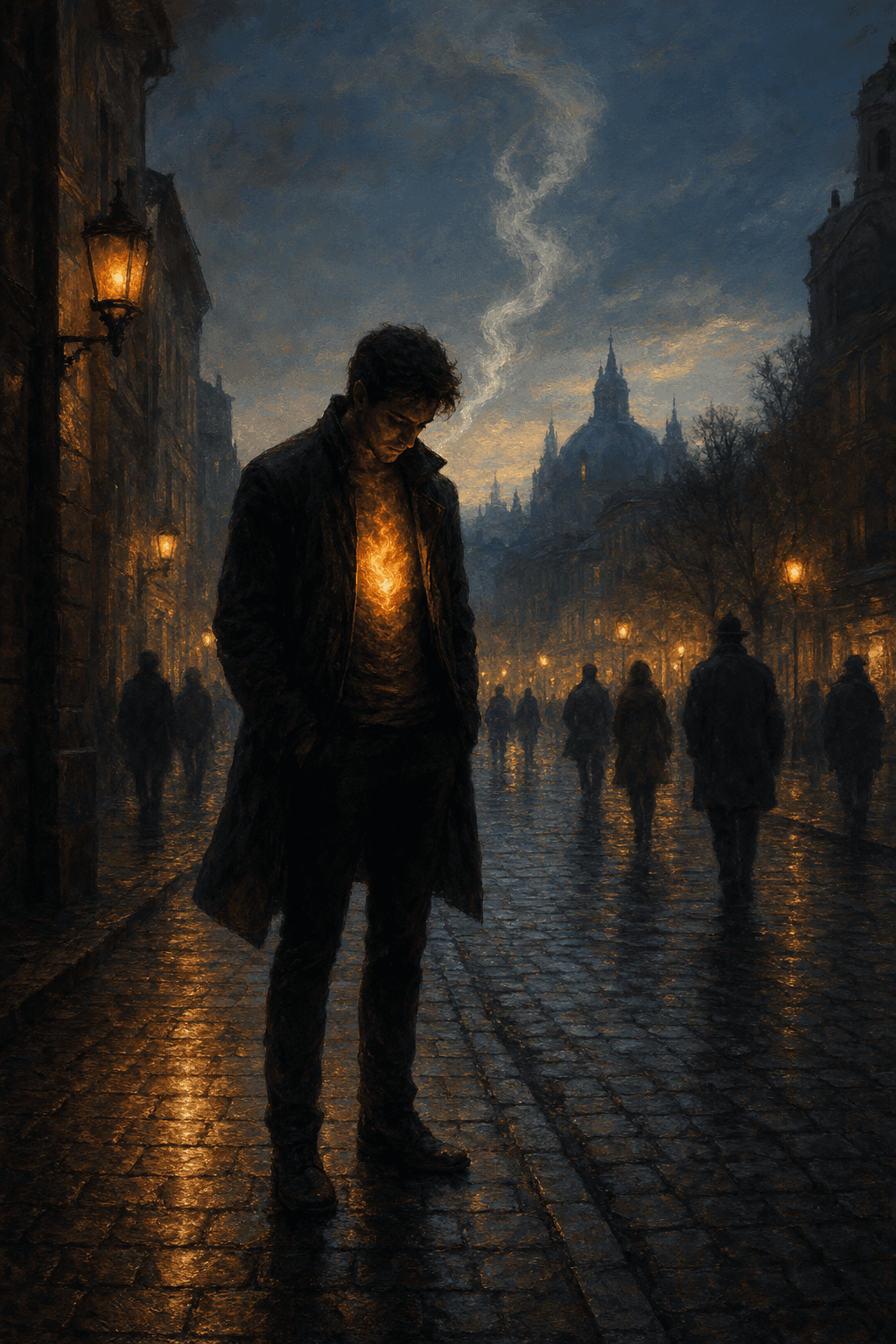
A great fire burns within me, but no one stops to warm themselves at it, and passers-by only see a wisp of smoke. — Vincent van Gogh
—What lingers after this line?
An Inner Fire Without Witnesses
Van Gogh’s image begins with a painful contrast: immense inner warmth exists, yet it goes unreceived. The “great fire” suggests passion, generosity, and creative force, while the absence of anyone who “stops to warm themselves” turns that abundance into loneliness. In other words, the tragedy is not emptiness but unused depth. From the start, the quote frames suffering as invisibility rather than silence alone. Van Gogh implies that something powerful lives within him, but the world does not pause long enough to recognize it. As a result, the distance between what one feels inwardly and what others perceive outwardly becomes the emotional center of the line.
Smoke as a Misread Signal
The second image shifts naturally from fire to smoke, and this transition sharpens the quote’s meaning. Smoke is only evidence, not essence; it hints at a blaze but does not reveal its intensity. Thus, passers-by notice merely a faint external sign, mistaking a vast inner life for something vague, minor, or momentary. This metaphor reflects a common human experience: people often judge others by fragments—an awkward gesture, a troubled face, a brief remark—while missing the force beneath them. Van Gogh’s phrasing therefore captures how easily visible symptoms replace true understanding. What others read as a “wisp” may in fact arise from a consuming fire.
The Artist’s Need to Be Felt
Seen in light of Van Gogh’s life, the quote also speaks to the artist’s longing not merely to be seen, but to be received. His letters, especially those collected in The Letters of Vincent van Gogh, repeatedly reveal a man convinced of the seriousness of his vocation yet wounded by neglect. Accordingly, the fire can be read as artistic devotion that sought communion and found indifference instead. This deepens the sadness of the line. A painting, a letter, or a cry of feeling is often an invitation for others to draw near. Yet when no one does, creativity itself can begin to feel like a warmth offered to an empty road.
Misrecognition and Modern Psychology
From there, the quote opens into a psychological truth about being misunderstood. Modern psychology often distinguishes between inner experience and outward expression: depression, intensity, or emotional richness may be poorly communicated through behavior alone. Consequently, others may perceive withdrawal, oddness, or instability without grasping the deeper humanity underneath. Van Gogh’s metaphor anticipates this insight with remarkable precision. The fire stands for lived feeling in its fullness, while the smoke resembles the partial signals visible to outsiders. What hurts, then, is not simply pain itself, but the failure of recognition—the sense that one’s most vital energies are reduced to faint, distorted traces.
A Universal Plea for Human Attention
Ultimately, the quotation reaches beyond biography and becomes a universal plea: look more carefully at one another. Many lives contain hidden stores of tenderness, conviction, grief, and love that remain unnoticed because the world moves too quickly. In that sense, Van Gogh is not only describing himself; he is describing anyone whose depths exceed their appearance. Therefore, the line endures because it asks for a richer form of attention. To stop and “warm oneself” at another person’s fire is to recognize their inner reality rather than their outward haze. What begins as a private lament finally becomes an ethical challenge: to see more than smoke, and to honor the unseen blaze in others.
One-minute reflection
Why might this line matter today, not tomorrow?
Related Quotes
6 selectedJust because you haven't found your talent yet doesn't mean you don't have one. — Ken Robinson
Ken Robinson
This quote acknowledges that the journey to finding one’s talents can take time. It reassures individuals that even if they haven't yet identified their unique abilities, it doesn't imply they lack them.
Read full interpretation →Learning technique is a way to make your soul grow. So do it. — Vincent van Gogh
Vincent van Gogh
Van Gogh’s brief statement turns learning into more than a practical task; it becomes an ethical and spiritual imperative. By saying that learning technique helps the soul grow, he suggests that disciplined study does no...
Read full interpretation →I cannot rest, I must draw, however poor the result, and when I have a bad time come over me it is a stronger desire than ever. — Vincent van Gogh
Vincent van Gogh
Van Gogh’s words present drawing not as a hobby or even a disciplined profession, but as an inner command he cannot silence. The phrase “I must draw” carries the force of survival, suggesting that artistic creation answe...
Read full interpretation →As we advance in life it becomes more and more difficult, but in fighting the difficulties the inmost strength of the heart is developed. — Vincent van Gogh
Vincent van Gogh
Van Gogh’s sentence begins with a sober observation: life does not necessarily become simpler as we grow older. Instead, responsibilities deepen, losses accumulate, and choices carry heavier consequences.
Read full interpretation →Work with wild curiosity; a single brushstroke can begin a new horizon. — Vincent van Gogh
Vincent van Gogh
Van Gogh’s line opens by treating curiosity not as a casual interest, but as a way of moving through the world—“wild” enough to break routine perception. Rather than waiting for certainty, the artist begins by wondering,...
Read full interpretation →Starve the need for certainty and feed the appetite for meaning. — Vincent van Gogh
Vincent van Gogh
Vincent van Gogh’s line urges a deliberate reversal of instinct: instead of constantly soothing ourselves with clear, final conclusions, we should loosen our grip and make room for significance. Certainty can feel like s...
Read full interpretation →More From Author
More from Vincent van Gogh →Learning technique is a way to make your soul grow. So do it. — Vincent van Gogh
Van Gogh’s brief statement turns learning into more than a practical task; it becomes an ethical and spiritual imperative. By saying that learning technique helps the soul grow, he suggests that disciplined study does no...
Read full interpretation →I cannot rest, I must draw, however poor the result, and when I have a bad time come over me it is a stronger desire than ever. — Vincent van Gogh
Van Gogh’s words present drawing not as a hobby or even a disciplined profession, but as an inner command he cannot silence. The phrase “I must draw” carries the force of survival, suggesting that artistic creation answe...
Read full interpretation →As we advance in life it becomes more and more difficult, but in fighting the difficulties the inmost strength of the heart is developed. — Vincent van Gogh
Van Gogh’s sentence begins with a sober observation: life does not necessarily become simpler as we grow older. Instead, responsibilities deepen, losses accumulate, and choices carry heavier consequences.
Read full interpretation →Work with wild curiosity; a single brushstroke can begin a new horizon. — Vincent van Gogh
Van Gogh’s line opens by treating curiosity not as a casual interest, but as a way of moving through the world—“wild” enough to break routine perception. Rather than waiting for certainty, the artist begins by wondering,...
Read full interpretation →