
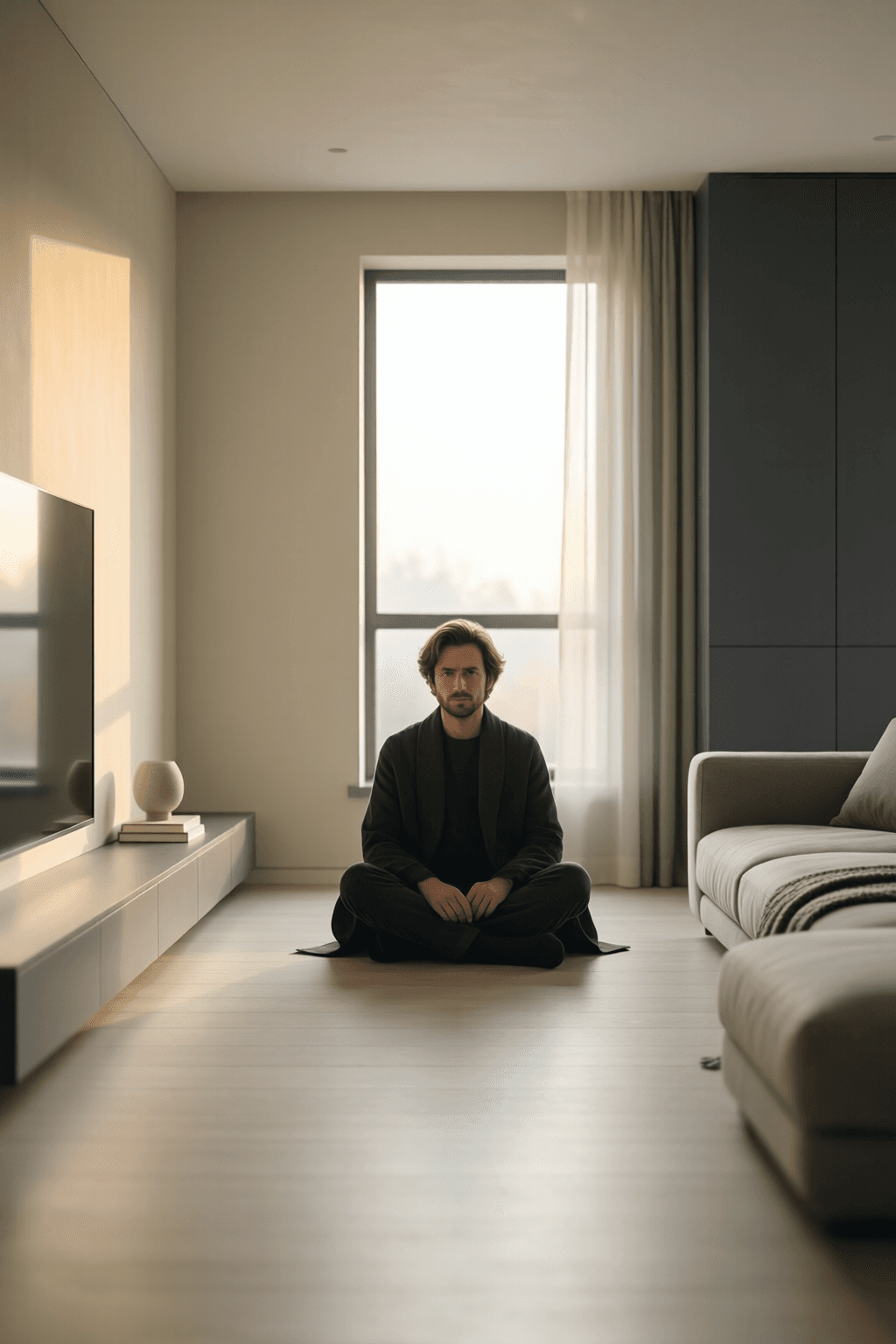
To be at home in oneself is the most revolutionary act in an age of constant distraction. — Pico Iyer
—What lingers after this line?
Coming Home to the Self
Pico Iyer’s remark begins with a deceptively simple image: being at home in oneself. Yet this inner home is not a place of withdrawal so much as a state of ease, where a person can sit with thoughts, feelings, and silence without immediately fleeing into noise. In that sense, the quote suggests that self-possession has become rare precisely because modern life trains us to look everywhere except inward.
Why Distraction Has Become the Norm
From there, the quote sharpens into social criticism. An “age of constant distraction” evokes phones, notifications, endless feeds, and the cultural pressure to remain perpetually reachable. As Nicholas Carr argued in The Shallows (2010), digital habits can fragment attention and make sustained reflection more difficult. Consequently, what once seemed ordinary—quiet concentration, inward steadiness, unhurried thought—now appears almost rebellious.
The Meaning of a Revolutionary Act
Calling this condition “revolutionary” is especially striking because Iyer relocates revolution from the street to the soul. Rather than dramatic upheaval, he points to a subtler resistance: refusing to let one’s inner life be colonized by urgency, spectacle, and interruption. In this way, the revolution is not loud defiance but disciplined presence, a refusal to be scattered by every demand for attention.
Echoes in Philosophy and Spiritual Practice
This idea has deep roots. Marcus Aurelius’s Meditations (c. 180 AD) describes the mind as a place to which one can retreat and recover composure, while Buddhist traditions similarly train attention through stillness and observation. Seen in that light, Iyer’s insight is both contemporary and ancient: although technologies change, the struggle to remain centered amid chaos is a perennial human challenge.
Presence as Freedom
Moreover, to be at home in oneself is not mere comfort; it is a form of freedom. A person who can remain present without constant stimulation is less easily manipulated by trends, outrage, or the fear of missing out. Viktor Frankl’s Man’s Search for Meaning (1946) famously emphasizes the space between stimulus and response, and Iyer’s line fits that tradition by implying that inner groundedness creates the possibility of choice.
A Practice for Everyday Life
Finally, the quote gains power because it is practical as well as poetic. Being at home in oneself may begin with small acts: walking without headphones, sitting quietly for ten minutes, or resisting the impulse to fill every pause with a screen. Through such habits, presence becomes less an abstract ideal than a daily discipline. Thus Iyer’s revolution unfolds not in grand gestures, but in the recovered ability to inhabit one’s own life fully.
One-minute reflection
Why might this line matter today, not tomorrow?
Related Quotes
6 selectedInner calm is not a state you wait for, but a space you build within the daily noise. — Pico Iyer
Pico Iyer
At its core, Pico Iyer’s line shifts calm from something passive to something made. Rather than imagining peace as a rare mood that descends when life finally becomes quiet, he presents it as an inner architecture built...
Read full interpretation →Self-mastery begins the moment you decide that your internal peace is more valuable than the external approval you were chasing. — Epictetus
Epictetus
At its core, this saying frames self-mastery as a decisive inner shift. The moment a person values peace of mind over praise, status, or acceptance, power begins to move inward rather than outward.
Read full interpretation →Quiet confidence is not about being loud; it is about knowing who you are and being comfortable in your own skin. — Julie Andrews
Julie Andrews
Julie Andrews’ observation begins by separating confidence from volume. In a culture that often rewards assertive display, she reminds us that genuine self-assurance does not need constant announcement.
Read full interpretation →Breathe in calm, breathe out chaos, and anchor yourself in peace. — Lori Deschene
Lori Deschene
Lori Deschene’s words begin with a simple invitation: return to the breath. In moments of stress, the mind often rushes ahead, but breathing offers an immediate way back to the present.
Read full interpretation →Stop shrinking yourself to make others comfortable. Your peace is worth more than their approval. — Nedra Glover Tawwab
Nedra Glover Tawwab
Nedra Glover Tawwab’s words begin with a quiet but powerful warning: when we constantly make ourselves smaller to keep others comfortable, we often pay with our confidence, honesty, and emotional well-being. This kind of...
Read full interpretation →Your peace is worth more than their approval. — Karen Salmansohn
Karen Salmansohn
Karen Salmansohn’s quote draws a clear boundary between inner well-being and the exhausting pursuit of validation. At its heart, it reminds us that approval from others can feel rewarding, but it is often unstable, condi...
Read full interpretation →More From Author
More from Pico Iyer →Connection is not found in the scrolling, but in the pausing. Look up, breathe, and find the person standing right in front of you. — Pico Iyer
Pico Iyer’s reflection begins with a quiet reversal of modern habit: instead of searching for connection through constant motion, he locates it in stillness. The phrase “not found in the scrolling, but in the pausing” su...
Read full interpretation →The mind needs solitude in the same way a forest needs quiet after a storm. It is not because nothing is happening; it is because that is when everything begins to grow. — Pico Iyer
Pico Iyer compares the mind to a forest recovering after a storm, and the image immediately shifts our understanding of solitude. Rather than treating aloneness as emptiness, he presents it as a necessary period of renew...
Read full interpretation →To do one thing well is the only way to endure a world that demands we do everything at once. — Pico Iyer
At its core, Pico Iyer’s line argues that endurance now depends less on speed than on concentration. In a culture that praises multitasking, constant updates, and endless availability, he reframes survival as an act of d...
Read full interpretation →Inner calm is not a state you wait for, but a space you build within the daily noise. — Pico Iyer
At its core, Pico Iyer’s line shifts calm from something passive to something made. Rather than imagining peace as a rare mood that descends when life finally becomes quiet, he presents it as an inner architecture built...
Read full interpretation →