
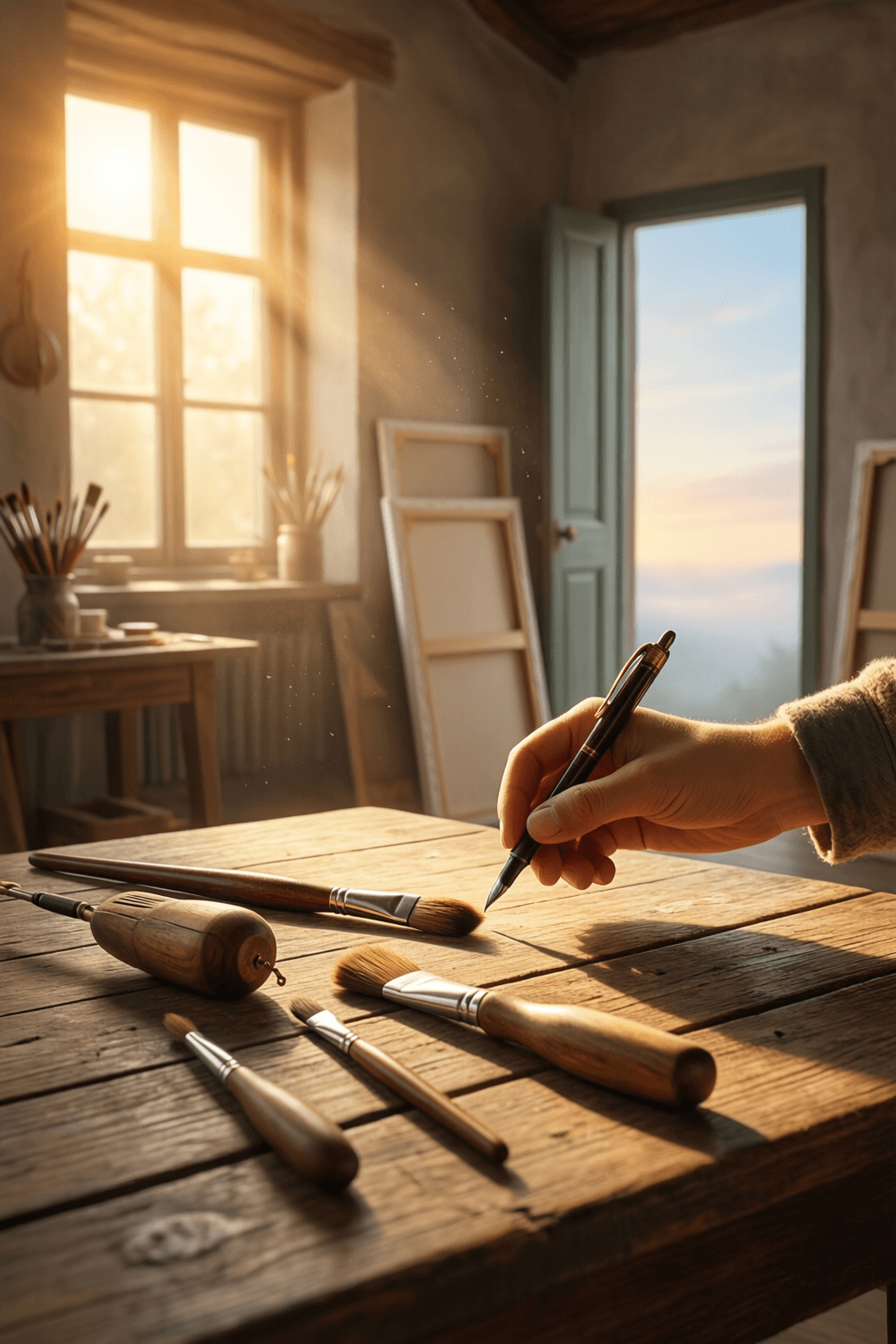
Have pity on those who are fearful of taking up a pen, or a paintbrush, or an instrument, or a tool because they are afraid that someone has already done so better than they could. — Paulo Coelho
—What lingers after this line?
The Fear Behind the Blank Page
Coelho’s line begins with compassion rather than criticism. He asks us to pity those who hesitate before the pen, brush, instrument, or tool because their fear is not laziness but self-erasure. They imagine a long line of geniuses standing before them, and that imagined comparison convinces them their own attempt is unnecessary. Yet this fear quietly misunderstands creativity. Art is not a contest in which only the best version deserves to exist. Instead, every act of making carries the trace of a particular life, and no predecessor can fully replace that.
Comparison as a Creative Paralysis
From there, the quote points to one of the most common forms of artistic paralysis: comparison. A beginning painter may think of Van Gogh, a young musician of Mozart, a novice writer of Virginia Woolf, and conclude that silence is safer than imperfection. In this way, admiration becomes a trap when it turns into self-doubt. However, history shows that every master began as someone imitating, failing, and learning. The existence of greatness should not close the door; it should prove that the door can be opened.
The Value of an Individual Voice
What Coelho protects, above all, is the uniqueness of individual expression. Even if a subject has been painted, sung, carved, or written about countless times, it has not yet been expressed through this particular person’s memory, wounds, humor, rhythm, or hope. That difference matters. For example, love poems existed long before Pablo Neruda’s *Twenty Love Poems and a Song of Despair* (1924), yet his voice still made the old theme feel newly alive. Likewise, creative work need not be unprecedented to be meaningful; it only needs to be honestly inhabited.
Tools as Invitations, Not Judgments
The objects Coelho names—a pen, a paintbrush, an instrument, a tool—are humble and practical. They do not demand genius before they can be touched. Rather, they invite practice, experimentation, and contact with the world. A tool becomes powerful only when someone is brave enough to use it badly at first. This shift is essential: the first purpose of creating is not to impress an audience but to enter a relationship with the craft. Skill develops through use, and confidence often arrives only after the fearful beginning has already been made.
Creativity as Human Participation
Seen more broadly, Coelho’s statement defends creativity as a basic human participation in life. To sing, build, draw, write, or repair is to say, in some small way, that one’s presence matters. When fear prevents this, the loss is not only personal; the world also misses a voice it might have needed. This idea echoes Martha Graham’s famous counsel to Agnes de Mille, recorded in *Dance to the Piper* (1952): there is a unique vitality that can come only through each person. Coelho’s pity, then, is also a plea: do not let comparison rob the world of your contribution.
The Gentle Courage to Begin
Finally, the quote does not command people to be fearless; it recognizes that fear may remain. The task is gentler and more realistic: begin while afraid. Pick up the pen, touch the keys, mix the color, shape the wood, and let the first imperfect gesture become evidence of courage. In the end, someone may indeed have done it better. But no one can do it with the same inner weather, the same history, or the same necessity. That is why the act of beginning is already a quiet victory.
One-minute reflection
What does this quote ask you to notice today?
Related Quotes
6 selectedStop walking through the world looking for confirmation that you don't belong. You will always find it because you've made that your mission. — Brené Brown
Brené Brown
Brené Brown’s statement begins with a striking image: moving through the world while searching for proof of exclusion. In other words, she suggests that many experiences of not belonging are filtered through an expectati...
Read full interpretation →The biggest wall you have to climb is the one you build in your mind. Never let your mind talk you out of your dreams. — Janice Trachtman
Janice Trachtman
Janice Trachtman’s quote begins with a striking reversal: the greatest obstacle is not always the world outside us, but the wall we quietly construct within. Fear, self-doubt, and imagined failure can become more limitin...
Read full interpretation →There is hope, even when your brain tells you there isn't. — John Green
John Green
John Green’s line begins by acknowledging a familiar conflict: the mind can deliver convincing arguments for despair, yet hope can still exist alongside them. Rather than treating hope as a naïve feeling, he frames it as...
Read full interpretation →Let your hands answer the questions your doubts raise. — Søren Kierkegaard
Søren Kierkegaard
Kierkegaard compresses an existential method into a single imperative: when thought multiplies uncertainties, embodied action brings clarity. He contends that excessive reflection spins into paralysis, while decisions cr...
Read full interpretation →Stand where you are and turn your doubts into the ground for courage to grow. — Seamus Heaney
Seamus Heaney
Heaney’s imperative to “stand where you are” reframes courage as composure before motion. Instead of scrambling for escape or certainty, he invites a pause that gathers scattered attention back into the body—feet planted...
Read full interpretation →The only limit to our realization of tomorrow will be our doubts of today. - Franklin D. Roosevelt
Franklin D. Roosevelt
This quote suggests that doubt is a significant barrier to achieving future goals. It emphasizes how our own uncertainties and lack of confidence can prevent us from realizing our full potential.
Read full interpretation →More From Author
More from Paulo Coelho →One doesn't get to be a master of one's own life by rushing. You have to learn the patience of a gardener who knows the harvest cannot be hurried. — Paulo Coelho
At its core, Paulo Coelho’s reflection challenges a modern obsession with speed. He argues that mastery over one’s life does not come from frantic action or constant acceleration, but from learning when to wait, observe,...
Read full interpretation →It is a good idea always to do something relaxing prior to making an important decision in your life. — Paulo Coelho
Paulo Coelho’s remark begins with a simple but powerful premise: important decisions are rarely improved by agitation. When the mind is tense, it tends to confuse urgency with clarity, pushing us toward choices made out...
Read full interpretation →Your 'yes' has no value until you learn to say 'no'. — Paulo Coelho
Paulo Coelho’s line hinges on a simple contrast: a “yes” only carries weight when an alternative is genuinely available. If you can’t—or won’t—say “no,” agreement becomes automatic rather than chosen, and it starts to re...
Read full interpretation →Dare to begin where fear says to stop; the first step redraws the map — Paulo Coelho
Paulo Coelho’s line treats fear less as a warning and more as a border we mistakenly accept as permanent. When fear says “stop,” it often isn’t pointing to actual danger; it’s signaling uncertainty, inexperience, or the...
Read full interpretation →