
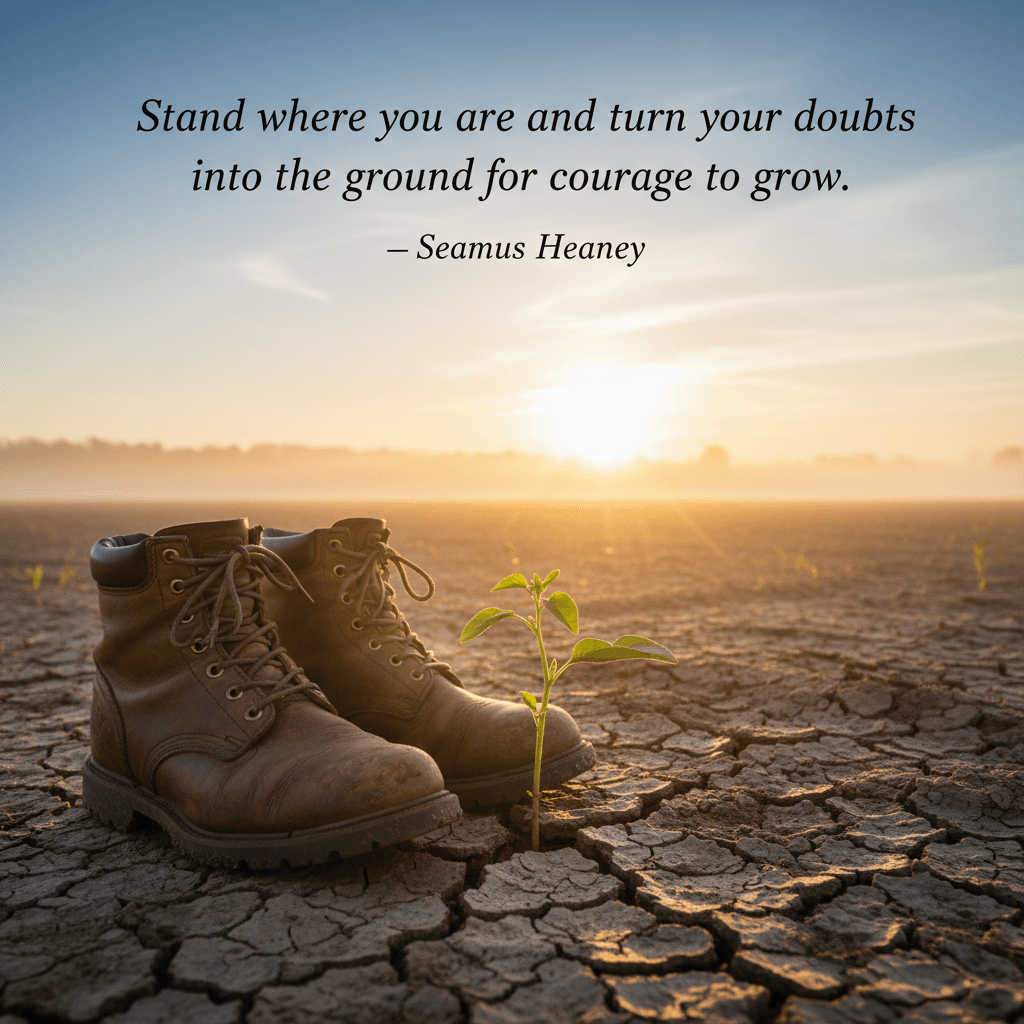
Stand where you are and turn your doubts into the ground for courage to grow. — Seamus Heaney
—What lingers after this line?
Standing Still as a Beginning
Heaney’s imperative to “stand where you are” reframes courage as composure before motion. Instead of scrambling for escape or certainty, he invites a pause that gathers scattered attention back into the body—feet planted, breath steady, gaze clear. This stillness is not passivity; it is orientation. By refusing to flinch, we see the lay of the land and name what is actually there. From that steadied stance, fear stops being a blur and becomes legible. Doubts cease to chase us from behind and line up in front of us like terrain features on a map. Only then can we work with them rather than be worked over by them.
Turning Doubt into Fertile Ground
The line’s core alchemy is agricultural: doubt becomes soil, not waste. Composting unease into nourishment echoes what psychologists call cognitive reappraisal—shifting the meaning of an emotion so it serves rather than sabotages. Carol Dweck’s research on growth mindset (2006) shows that seeing difficulty as feedback, not verdict, predicts resilience. Likewise, Alison Wood Brooks (2014) found that recasting anxiety as excitement measurably improves performance. Thus, the flutter in the gut is not an alarm to flee but a seedbed for readiness. When uncertainty is tilled rather than denied, it releases energy we can direct toward the next right action.
Heaney’s Earth Imagery and Resolve
Heaney often turns to ground as moral vocabulary. In “Digging” (1966), he aligns the heft of a spade with the heft of a pen, rooting craft in ancestry and effort. “Bogland” (1969) and “The Tollund Man” (Wintering Out, 1972) press into peat’s depths, where memory and history preserve what surface life forgets. The terrain is literal, but it is also ethical: depth requires patience, and patience breeds courage. Later, “The Cure at Troy” (1990) offers his most cited hope—when “hope and history rhyme”—suggesting that steadfast attention can ripen into change. Doubt, then, is not erased but metabolized, like earth taking seed.
Practices that Anchor Courage
To till doubt into courage, begin with the body: the 5–4–3–2–1 grounding exercise anchors attention to five sights, four sounds, three touches, two smells, one taste. Next, write two columns: Doubts and Uses. Turn each doubt into a task (“I might freeze” becomes “I will rehearse my first sentence twice”). Then set one micro-commitment—90 seconds of focused effort—to break inertia. Implementation intentions also help: “If I feel my voice shake, then I’ll slow my exhale to six counts” (Gollwitzer, 1999). Finally, carry a talismanic routine—sharpen a pencil, lace shoes the same way—so the body remembers steadiness even when the mind forgets.
From Personal Firmness to Collective Bravery
Standing one’s ground scales from private steadiness to public stance. During the Troubles, Heaney’s “Whatever You Say Say Nothing” (North, 1975) records the pressure to keep quiet; yet the poem’s integrity models a way to stay present without surrendering truth. His Nobel lecture, “Crediting Poetry” (1995), argues for the redress of poetry—language weighting reality with just measures. In this light, courage is not swagger but witness. When individuals root their doubts and speak from that groundedness, communities find a center of gravity sturdy enough to change the weather of a room, a meeting, even a moment in history.
A Small Story of Reframed Fear
Consider a junior nurse on her first night shift. Her hands tremble as alarms flicker. She writes three doubts on a scrap—too slow, not enough, will falter—then turns each into ground: slow means double-check; not enough means ask; will falter means call for backup early. Between rounds, she practices one slow exhale at each doorway. By dawn, nothing miraculous has happened—only charts filled, calls made, a patient comforted. Yet she recognizes it: the place where her doubts were planted now holds roots. The ground did not change; her footing did.
Choosing the Right Ground
To be clear, “stand where you are” is not a command to endure harm. Good gardeners sometimes transplant. If the soil is toxic—abuse, illegality, corrosive cynicism—courage may mean stepping to safer ground and then standing. The point is not stubbornness but rootedness. Consequently, the practice becomes a cycle: stand, name, till, seed, step. Repeat as needed. Over time, the very doubts that once scattered you become the mulch that holds your courage in place.
One-minute reflection
What's one small action this suggests?
Related Quotes
6 selectedTo be courageous is to act with the heart. — Molière
Molière
Molière’s line suggests that courage is not merely the absence of fear, but the decision to move despite it. By connecting courage with the heart, he frames bravery as an emotional and moral act rather than a simple disp...
Read full interpretation →The best people possess a feeling for beauty, the courage to take risks, the discipline to tell the truth, the capacity for sacrifice. — Ernest Hemingway
Ernest Hemingway
Hemingway’s line presents goodness not as politeness or success, but as a demanding inner code. The “best people” are those who combine sensitivity, bravery, honesty, and self-denial—qualities that do not always coexist...
Read full interpretation →Stop walking through the world looking for confirmation that you don't belong. You will always find it because you've made that your mission. — Brené Brown
Brené Brown
Brené Brown’s statement begins with a striking image: moving through the world while searching for proof of exclusion. In other words, she suggests that many experiences of not belonging are filtered through an expectati...
Read full interpretation →If you are not willing to look stupid, nothing great is ever going to happen to you. — Julia Cameron
Julia Cameron
Julia Cameron’s remark begins with a hard truth: many people do not fail because they lack talent, but because they fear embarrassment. In that sense, ‘looking stupid’ becomes shorthand for being seen trying, stumbling,...
Read full interpretation →You don't have to bully yourself out of feeling fear. You just have to move while it's still there. — Annie Wright
Annie Wright
At its core, Annie Wright’s quote challenges the common belief that courage begins only after fear has disappeared. Instead, it reframes fear as something that can accompany action rather than prevent it.
Read full interpretation →For what matters in life is not whether we receive a round of applause; what matters is whether we have the courage to venture forth despite the uncertainty of acclaim. — Amor Towles
Amor Towles
At its core, Amor Towles shifts attention away from public approval and toward private resolve. The quote argues that a life’s value is not determined by applause—those visible signs of recognition—but by the willingness...
Read full interpretation →More From Author
More from Seamus Heaney →Walk on air against your better judgement. — Seamus Heaney
Heaney’s line hinges on a sharp contradiction: to “walk on air” is to do what gravity says you cannot, and to do it “against your better judgement” is to move despite the mind’s careful warnings. From the outset, the quo...
Read full interpretation →Turn the ordinary into a story worth taking further. — Seamus Heaney
Seamus Heaney’s line, “Turn the ordinary into a story worth taking further,” urges us to reconsider what we dismiss as mundane. Rather than waiting for dramatic events, he suggests that meaning emerges when we treat ever...
Read full interpretation →Light a small fire of kindness and watch it become a blaze that warms many. — Seamus Heaney
Seamus Heaney’s image of a “small fire of kindness” invites us to see gentle acts as sources of unexpected power. Just as a single match alters the darkness around it, a quiet gesture—a thoughtful word, a seat offered on...
Read full interpretation →Hold fast to small habits; they shape the landscape of a life. — Seamus Heaney
Seamus Heaney’s line invites us to see routine as terrain. His poems return to earth, craft, and the shaping touch—consider Digging from Death of a Naturalist (1966), where the pen becomes a spade and steady strokes repl...
Read full interpretation →