
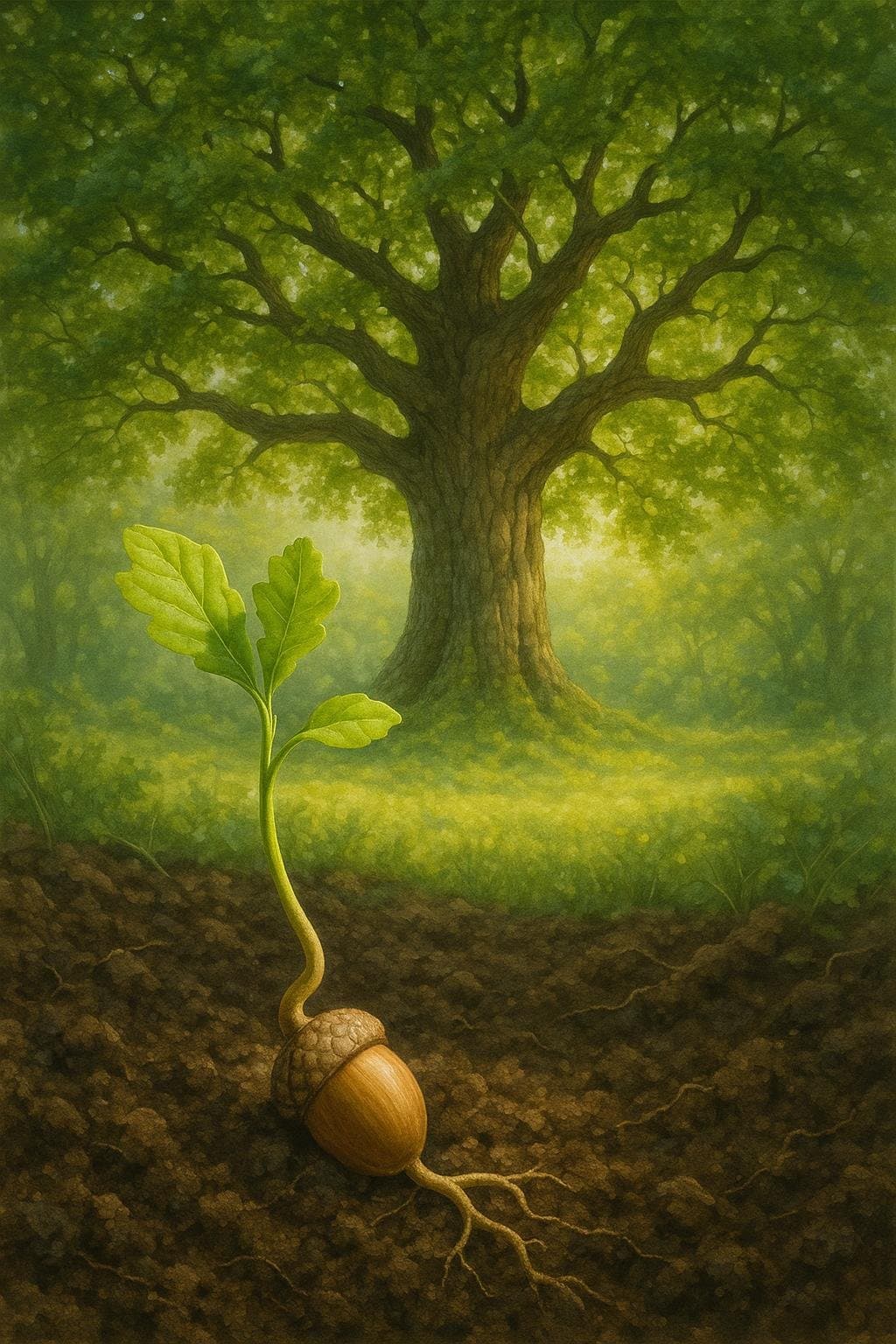
From little acorns grow mighty oaks. — David R. Walters
—What lingers after this line?
The Power of Small Beginnings
This saying highlights how significant achievements often arise from the humblest origins. The metaphor of an acorn transforming into a towering oak symbolizes the exponential potential hidden within modest starts. For example, J.K. Rowling's initial draft of *Harry Potter* was written in cafes during difficult times, eventually leading to a multibillion-dollar franchise.
Persistence and Patience in Growth
An acorn does not become an oak overnight. The proverb stresses the necessity of patience and perseverance, since meaningful change requires time. In Aesop’s fable 'The Oak and the Reed,' the oak tree is a symbol of enduring strength—achieved only through slow, steady growth.
Encouragement for the Underdog
By reminding us that great things start small, the quote inspires hope for those who face daunting odds. This is echoed in Abraham Lincoln’s journey from log cabin origins to the presidency, as detailed in Doris Kearns Goodwin’s *Team of Rivals* (2005).
Universal Application
The principle applies across fields—whether building relationships, developing skills, or launching a business. The tech giant Apple famously began in a garage, as recounted in Walter Isaacson’s *Steve Jobs* (2011), illustrating how small ventures can ultimately change the world.
Natural Cycles and Transformation
Nature serves as a reminder of potential within the unremarkable. Just as the acorn’s transformation relies on the right environment, so too must people nurture their ideas and efforts. Rachel Carson’s *Silent Spring* (1962) demonstrates this, as her single book catalyzed a global environmental movement.
One-minute reflection
Where does this idea show up in your life right now?
Related Quotes
6 selectedFrom a small seed, a mighty trunk may grow. — Aeschylus
Aeschylus
This quote emphasizes the potential for growth and development from humble beginnings. It suggests that even something small and seemingly insignificant can grow into something powerful and influential.
Read full interpretation →From little acorns grow mighty oaks. — David Cooper
David Cooper
David Cooper’s phrase evokes the vivid transformation from a tiny acorn to a towering oak tree. This imagery immediately communicates the broader idea that even the most formidable accomplishments often arise from humble...
Read full interpretation →Over the years I've grown more comfortable with making people uncomfortable because that is when growth can happen. You need a little conflict. — Jamie Lee Curtis
Jamie Lee Curtis
Jamie Lee Curtis’s reflection begins with a hard-won realization: discomfort is not always a sign that something has gone wrong. Often, it signals that a person, group, or relationship has reached the edge of its familia...
Read full interpretation →Everything that is great in life is the product of slow growth; the newer, and greater, and higher, and nobler the work, the slower is its growth. — William George Jordan
William George Jordan
William George Jordan’s reflection begins with a quiet but demanding truth: the most meaningful achievements rarely arrive quickly. He suggests that greatness is not manufactured in sudden bursts but cultivated through t...
Read full interpretation →We are powerful because we have survived, and that is what it is all about—survival and growth. — Audre Lorde
Audre Lorde
At its core, Audre Lorde’s statement redefines power not as domination, status, or control, but as the hard-won strength that comes from continuing despite adversity. To survive is already to have resisted erasure, and L...
Read full interpretation →If you aren't in over your head, how do you know how tall you are? — T. S. Eliot
T. S. Eliot
At first glance, Eliot’s question turns self-knowledge into a matter of pressure rather than comfort. We do not truly learn our limits while standing safely on familiar ground; instead, we discover our height only when c...
Read full interpretation →More From Author
More from David R. Walters →