
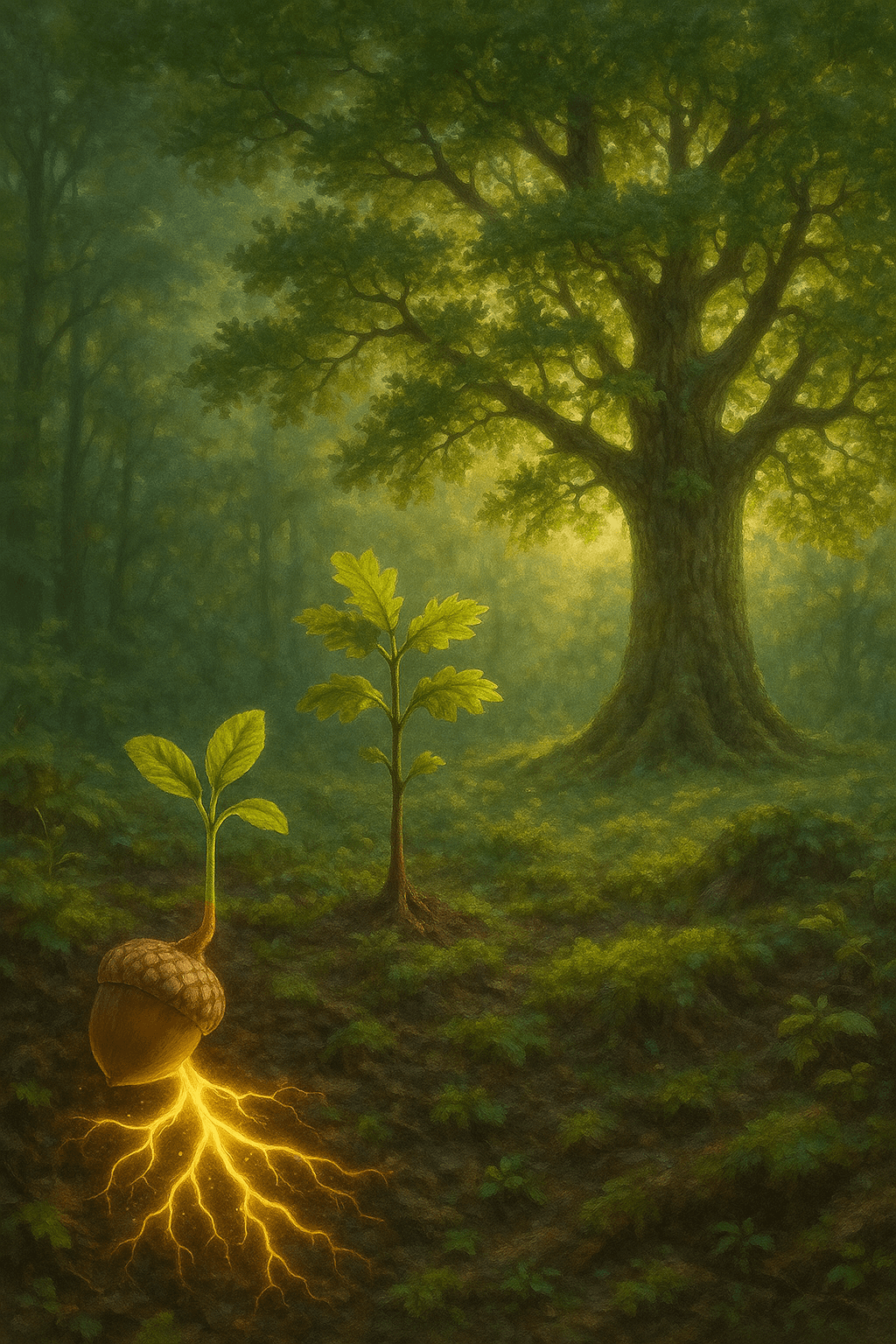
From little acorns grow mighty oaks. — David Cooper
—What lingers after this line?
Understanding the Proverb’s Imagery
David Cooper’s phrase evokes the vivid transformation from a tiny acorn to a towering oak tree. This imagery immediately communicates the broader idea that even the most formidable accomplishments often arise from humble, seemingly insignificant origins. Much like the acorn, which contains within itself the potential for greatness, every major endeavor typically starts with a small, determined step.
Historical Examples of Modest Origins
Looking to history, countless figures illustrate this concept. For instance, Abraham Lincoln began life in a log cabin yet shaped the course of American history. Similarly, the world’s largest companies—Apple and Amazon—emerged from garages and dorm rooms. Their narratives mirror the growth of an acorn into an oak, emphasizing that perseverance and nurturing multiply the power of humble starts.
The Slow and Steady Nature of Growth
Transitioning from historical anecdotes to the nature of progress, it’s worth noting that the journey from acorn to oak is gradual. Growth seldom happens overnight; instead, small incremental actions compound over time. This echoes Aesop’s fable of the tortoise and the hare, reinforcing that patience and consistency often yield the most enduring successes.
Applications in Personal Development
Expanding upon this, many self-improvement experts encourage setting manageable, incremental goals rather than aiming for immediate greatness. James Clear, in his book ‘Atomic Habits’ (2018), stresses that tiny, repeated actions can build remarkable results. The proverb thus inspires individuals to value and tend to their smallest efforts, knowing these will eventually shape lasting achievements.
Societal and Collective Implications
Finally, the growth of mighty oaks from small acorns also metaphorically applies to collective initiatives. Social movements, for example, often begin with just a few voices before blossoming into widespread change—consider the early Civil Rights sit-ins that sparked nationwide reform. Through this lens, the proverb champions not only personal perseverance but also the potent ripple effects of small, persistent beginnings in shaping communities and societies.
One-minute reflection
Why might this line matter today, not tomorrow?
Related Quotes
6 selectedThe creation of a thousand forests is in one acorn. — Ralph Waldo Emerson
Ralph Waldo Emerson
This quote highlights the immense potential contained within a small beginning. Just as a single acorn can ultimately lead to the creation of vast forests, small actions or ideas can result in significant and widespread...
Read full interpretation →From a small seed, a mighty trunk may grow. — Aeschylus
Aeschylus
This quote emphasizes the potential for growth and development from humble beginnings. It suggests that even something small and seemingly insignificant can grow into something powerful and influential.
Read full interpretation →Everything that is great in life is the product of slow growth; the newer, and greater, and higher, and nobler the work, the slower is its growth. — William George Jordan
William George Jordan
William George Jordan’s reflection begins with a quiet but demanding truth: the most meaningful achievements rarely arrive quickly. He suggests that greatness is not manufactured in sudden bursts but cultivated through t...
Read full interpretation →We are powerful because we have survived, and that is what it is all about—survival and growth. — Audre Lorde
Audre Lorde
At its core, Audre Lorde’s statement redefines power not as domination, status, or control, but as the hard-won strength that comes from continuing despite adversity. To survive is already to have resisted erasure, and L...
Read full interpretation →If you aren't in over your head, how do you know how tall you are? — T. S. Eliot
T. S. Eliot
At first glance, Eliot’s question turns self-knowledge into a matter of pressure rather than comfort. We do not truly learn our limits while standing safely on familiar ground; instead, we discover our height only when c...
Read full interpretation →Today's tears water tomorrow's gardens. — Matshona Dhliwayo
Matshona Dhliwayo
At first glance, Matshona Dhliwayo’s line transforms grief into something unexpectedly fertile. Tears, usually seen as signs of pain or loss, become water for a future garden, suggesting that suffering is not merely endu...
Read full interpretation →More From Author
More from David Cooper →