
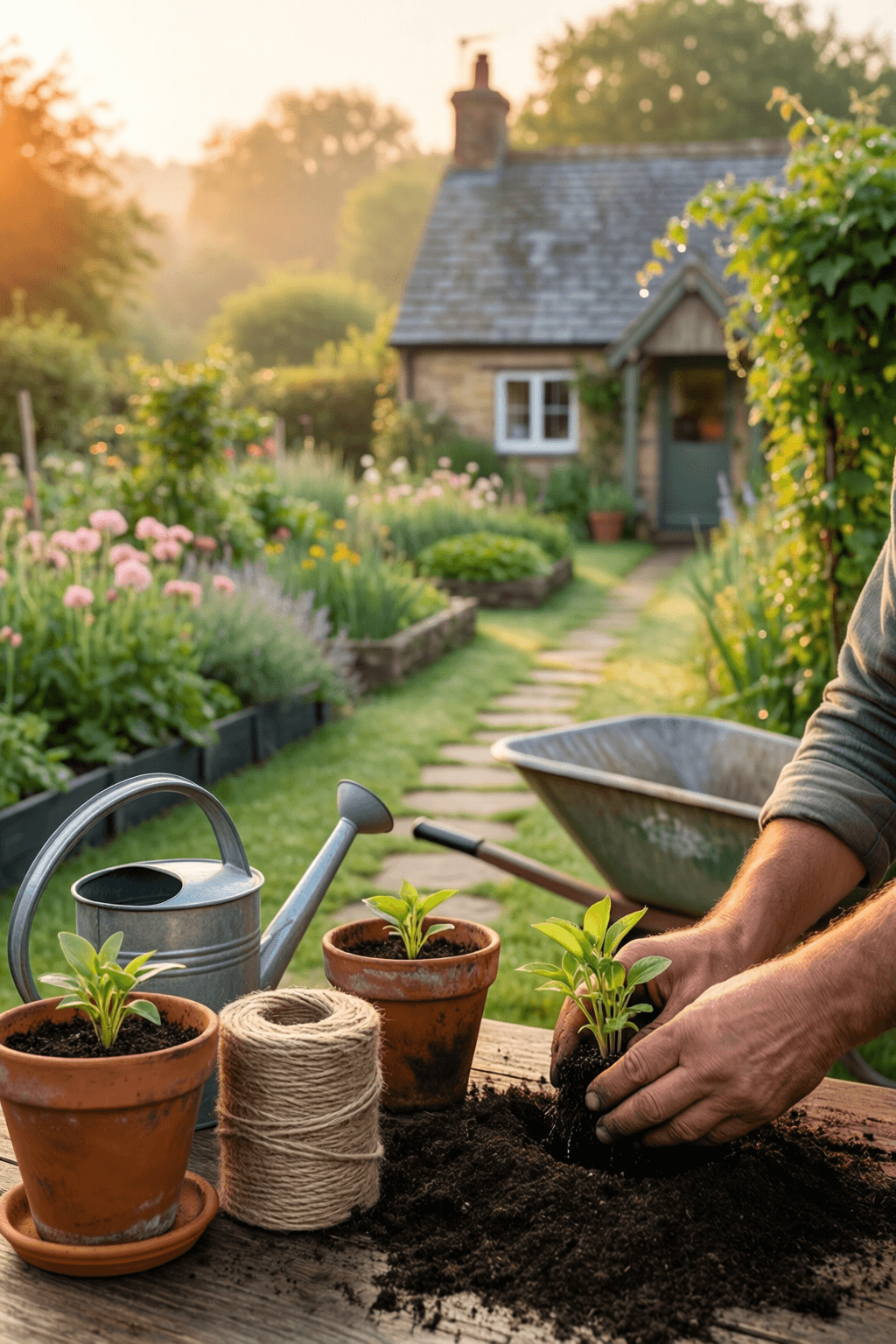
A garden is not made in a year; it is never made in the sense of finality. It grows, and with the labor of love should go on growing. — Frederick Eden
—What lingers after this line?
The Refusal of Finality
Frederick Eden begins by rejecting the idea that a garden can ever be finished. At first, this sounds like a practical observation about plants, seasons, and weather; yet it quickly becomes something larger. A garden is alive, and because it is alive, it resists the neat human desire for completion. What appears settled in one season will shift in the next, asking again for attention, patience, and revision. In that sense, Eden’s statement turns gardening into a lesson about all living things. Unlike a building, which aims toward an end point, a garden is defined by ongoing change. Its beauty lies not in permanence but in renewal, and so the gardener’s task is never to declare victory, but to remain in relationship with growth.
Time as a Creative Partner
From this idea of incompletion, Eden naturally moves us toward time itself. A garden is not made in a year because time is not merely a backdrop to cultivation; it is one of the makers. Seeds must germinate, roots must deepen, and failures must teach their quiet lessons. Even the most carefully designed plot cannot be rushed into maturity without losing something essential. Writers on gardens have often recognized this partnership with time. Vita Sackville-West, in her garden columns for The Observer during the 1940s and 1950s, repeatedly described gardening as a long conversation with seasons rather than a single act of control. Eden’s line carries the same wisdom: the gardener does not impose instant perfection, but collaborates with duration.
Labor Guided by Affection
Just as important, Eden does not describe this ongoing work as mere toil; he calls it a ‘labor of love.’ That phrase changes the emotional texture of the quote. The repeated digging, pruning, weeding, and replanting are not framed as burdens alone, but as expressions of care. Effort becomes meaningful because it is directed toward something cherished and alive. This distinction matters because love makes room for repetition without resentment. Anyone who has tended a garden knows the humble cycle of tasks that always return, and yet those tasks can become a source of devotion. In the same way, the Japanese gardening tradition seen in Kyoto temple grounds such as Ryōan-ji reminds us that maintenance itself can be an art, where care is not separate from beauty but one of its deepest forms.
Growth as an Ongoing Relationship
Once love enters the picture, the garden becomes more than a managed space; it becomes a relationship. Eden’s phrase ‘should go on growing’ suggests that both the plants and the gardener are being shaped over time. The person who tends the garden learns observation, restraint, and humility, while the garden answers with new forms, surprises, and occasional disappointments. This reciprocal quality appears throughout garden literature. In Francis Bacon’s essay “Of Gardens” (1625), the garden is imagined as a place of continual delight, but also of arrangement and judgment. Eden adds a gentler emphasis: delight does not come from mastering nature once and for all, but from staying engaged with its ongoing life. Thus growth is shared, not possessed.
A Philosophy Beyond Horticulture
Because of this, Eden’s remark easily extends beyond horticulture into a broader philosophy of living. Families, friendships, creative work, and even personal character are never finished in the sense of finality. They require return, revision, patience, and affection if they are to remain alive. The garden becomes a metaphor for any meaningful human undertaking that cannot be reduced to quick results. Ultimately, the quote offers a quiet corrective to modern impatience. It tells us that worthwhile things are not completed once but continually tended. By presenting growth as both endless and loving, Eden transforms the garden into an image of stewardship itself: a reminder that the richest forms of making are those we never truly finish.
Recommended Reading
As an Amazon Associate, we earn from qualifying purchases.
One-minute reflection
What's one small action this suggests?
Related Quotes
6 selectedTo cultivate anything—a garden, a skill, a soul—requires the courage to wait for what you have planted. — Wendell Berry
Wendell Berry
At first glance, Wendell Berry’s quote seems to praise patience, yet it goes further by naming patience as courage. To plant anything—a seed, a habit, a belief in oneself—is to act without immediate proof of success.
Read full interpretation →Beautiful things aren't rushed. A garden, a book, a work of art… they grow with time, care, and heart. — Angelika Regossi
Angelika Regossi
At its core, Angelika Regossi’s reflection challenges the modern obsession with speed. By saying that beautiful things are not rushed, she reminds us that what truly matters often emerges slowly, through patience rather...
Read full interpretation →A farmer is helpless to grow grain; all he can do is provide the right conditions for the growing of grain. — Richard J. Foster
At first glance, Foster’s farming metaphor shifts attention away from control and toward humility. A farmer cannot command a seed to sprout, just as a person cannot force true growth—whether spiritual, personal, or relat...
Read full interpretation →It is easy finding reasons why other folks should be patient. — George Eliot
George Eliot
George Eliot’s remark turns on a quiet but piercing irony: patience is a virtue we readily prescribe when someone else must practice it. In other words, distance makes endurance look simple.
Read full interpretation →Learning is a lifelong process of unlearning the need for immediate results. Patience is the discipline of trusting the slow, quiet compounding of your efforts. — Confucius
Confucius
At its core, this saying presents learning not as a race toward instant achievement, but as a gradual reshaping of expectation. The phrase “unlearning the need for immediate results” suggests that education is not only a...
Read full interpretation →If you want to move forward, you must first give yourself permission to stand still. Perspective is often the result of stopping long enough to actually see. — Alain de Botton
Alain de Botton
At first glance, Alain de Botton’s line seems contradictory: how can standing still help us move forward? Yet that tension is precisely his point.
Read full interpretation →More From Author
More from Frederick Eden →