
Courage Doesn't Always Roar - Sometimes It's the Quiet Voice at the End of the Day
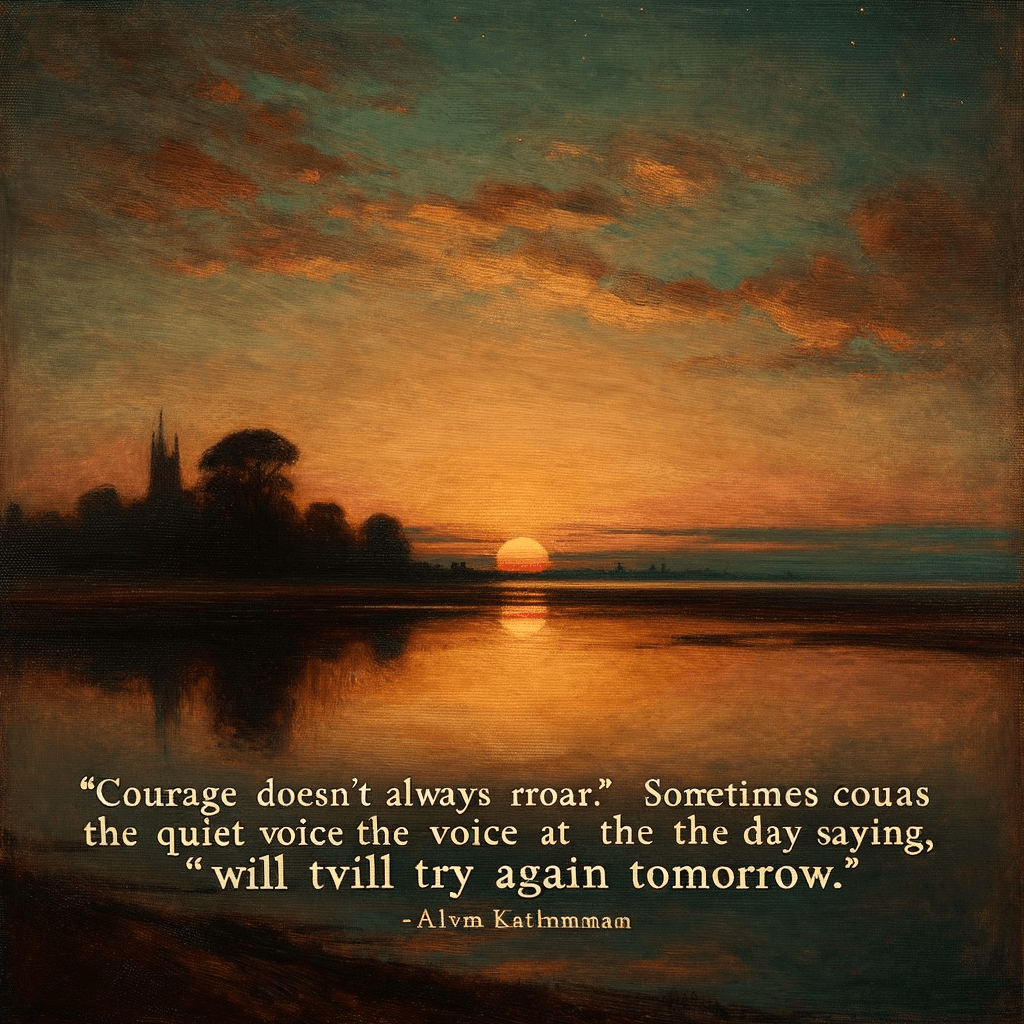
Courage doesn't always roar, sometimes it's the quiet voice at the end of the day saying: 'I will try again tomorrow.'
—What lingers after this line?
Everyday Bravery
This quote suggests that courage is not always about grand, bold actions. Sometimes, it is embodied in small, quiet acts of resilience and determination.
Perseverance
Perseverance is highlighted here as a form of courage. The willingness to face another day and try again despite failures or challenges requires significant inner strength.
Self-Compassion
The quote encourages self-compassion and understanding. It acknowledges that it’s okay to struggle and that giving oneself permission to try again tomorrow is a courageous act.
Mental Strength
Mental strength is portrayed as an essential aspect of courage. The quiet voice signifies one’s inner dialogue that keeps pushing forward even when the external world might not recognize the effort.
Resilience in Adversity
This emphasizes the idea that courage can be found in the resilience shown during tough times. It’s about the ability to continue, even when things are difficult and success is uncertain.
Recommended Reading
As an Amazon Associate, we earn from qualifying purchases.
One-minute reflection
What feeling does this quote bring up for you?
Related Quotes
6 selectedYou don't need to feel brave to act bravely. The feeling follows the action, not the other way around. — Unknown
Unknown
The quote challenges a common assumption: that bravery is a feeling you must summon before you can do brave things. Instead, it argues that courageous action can come first, even while fear is still present.
Read full interpretation →Courage is less about fearlessness than training the mind to act with clarity and conviction. — Ranjay Gulati
Ranjay Gulati
Ranjay Gulati’s line begins by overturning a common myth: that courage belongs to people who simply don’t feel afraid. Instead, he frames fear as normal—and even expected—while locating courage in what happens next.
Read full interpretation →Rise with the sun of your intentions and work until the horizon answers — Chinua Achebe
Chinua Achebe
Achebe’s line opens with a vivid image: rising “with the sun of your intentions.” Intention here isn’t a vague wish—it’s something bright, scheduled, and unavoidable, like sunrise itself. By pairing waking with purpose,...
Read full interpretation →Dare to begin where fear says to stop; the first step redraws the map — Paulo Coelho
Paulo Coelho
Paulo Coelho’s line treats fear less as a warning and more as a border we mistakenly accept as permanent. When fear says “stop,” it often isn’t pointing to actual danger; it’s signaling uncertainty, inexperience, or the...
Read full interpretation →I do not know where I am going, but I am on my way. — Carl Sandburg
Carl Sandburg
Carl Sandburg’s line captures a deceptively simple truth: progress often begins before clarity arrives. By admitting he does not know where he is going, the speaker rejects the comfort of certainty, yet the second half—“...
Read full interpretation →You have survived everything life has thrown at you so far. That is a 100 per cent success rate. — Matt Haig
Matt Haig
Matt Haig frames survival as a blunt, almost mathematical truth: if you are here, you have already endured every hard day you have faced. By calling it a “100 per cent success rate,” he converts a messy emotional history...
Read full interpretation →More From Author
More from Unknown →The language is the substrate. The architecture is the contract.
The line sets up a deliberate pairing: language lies beneath everything, while architecture governs everything above it. In other words, what you can express determines what you can build, and what you commit to structur...
Read full interpretation →A scroll is not a break; it is a trap disguised as rest. — Unknown
The quote begins by challenging a familiar story we tell ourselves: that a brief scroll is a harmless pause between tasks. On the surface, it looks like recovery—no effort, no decision, no commitment.
Read full interpretation →Don't let your ice cream melt while you're counting someone else's sprinkles. — Unknown
The quote uses ice cream as a simple stand-in for life’s fleeting pleasures: what you have is delicious, but it won’t last forever if you ignore it. Meanwhile, “counting someone else’s sprinkles” captures the habit of mo...
Read full interpretation →If your absence doesn't affect them, your presence never mattered. — Unknown
The quote frames absence as a revealing experiment: remove yourself, and the reaction—concern, curiosity, indifference—becomes a kind of data. If nothing changes when you’re gone, it suggests your role was never integrat...
Read full interpretation →