
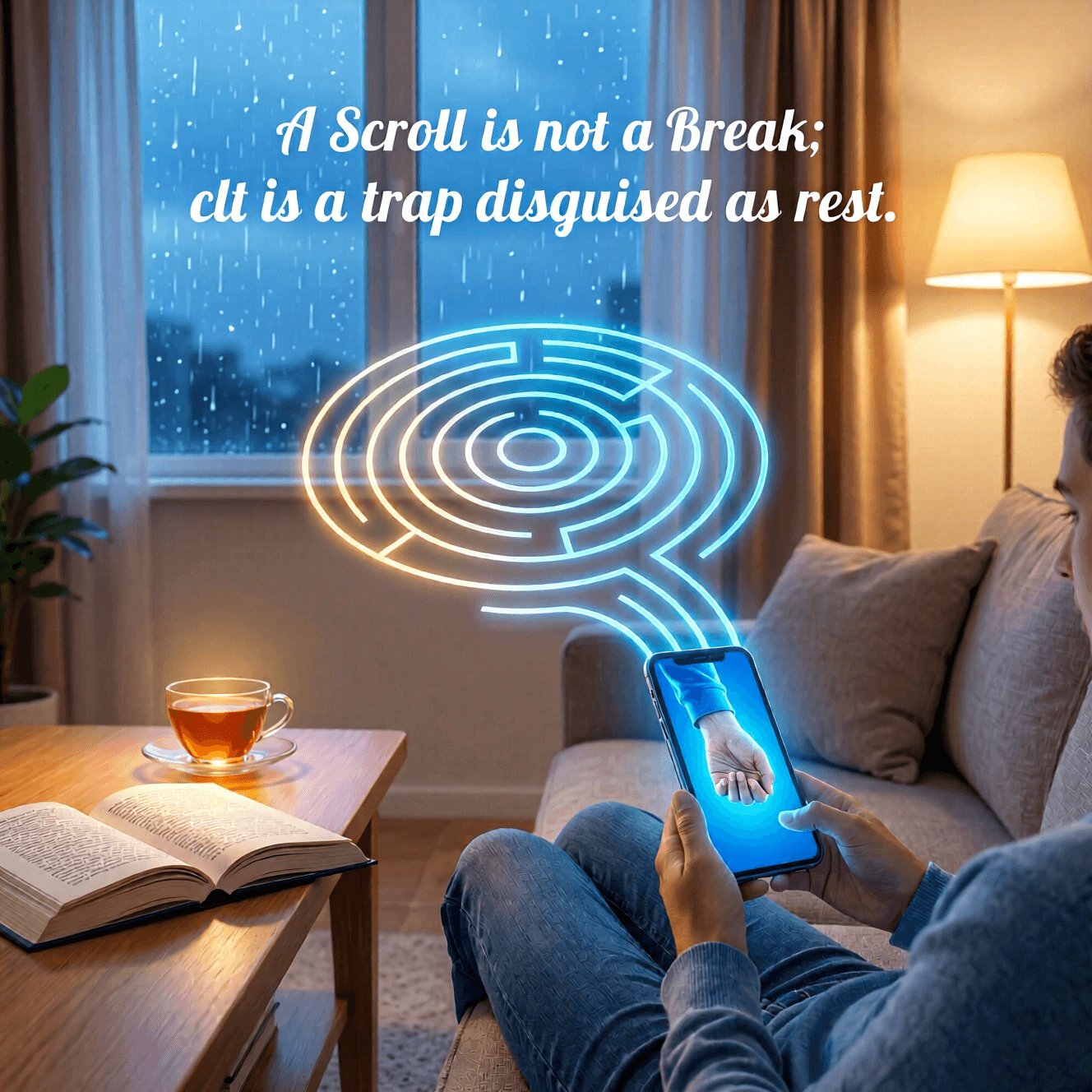
A scroll is not a break; it is a trap disguised as rest. — Unknown
—What lingers after this line?
The False Promise of a “Quick Break”
The quote begins by challenging a familiar story we tell ourselves: that a brief scroll is a harmless pause between tasks. On the surface, it looks like recovery—no effort, no decision, no commitment. Yet the line insists that this is not genuine rest but something that mimics it, offering the appearance of relief while quietly extending exhaustion. From there, the metaphor of a “trap” reframes the act as intentional design rather than personal weakness. The issue isn’t simply willpower; it’s that the experience is engineered to feel like a break while making it difficult to stop, turning an intended moment of restoration into a prolonged detour.
Why Scrolling Doesn’t Restore the Mind
Real rest typically replenishes attention: a walk, a nap, a brief stretch, even a few minutes of silence. Scrolling, however, often does the opposite by continuing to tax perception and emotion. Each post asks for micro-judgments—agree or disagree, envy or delight, click or ignore—so the brain keeps working even when the body is still. As a result, what felt like “doing nothing” can leave you more scattered than before. The transition from work to scrolling may be immediate, but the return to work becomes harder, because the mind hasn’t had downtime; it has simply swapped one stream of demands for another.
Infinite Feeds and the Architecture of Entrapment
Calling it a trap also points to structure. Infinite scroll, autoplay, and algorithmic recommendations remove natural stopping cues—the modern equivalent of a book’s last page or a show’s end credits. Without boundaries, the user must supply the ending, and that requirement arrives precisely when attention is most depleted. This is why “just five minutes” so easily becomes thirty. The experience is smooth by design: one more swipe, one more clip, one more headline. In that smoothness, the feed disguises continuation as choice, making the path of least resistance lead deeper into the session.
Emotional Friction Masquerading as Relaxation
Even when content is entertaining, it frequently carries emotional hooks—outrage, comparison, anxiety, or urgency. That emotional churn can feel like engagement and distraction, but it is rarely soothing. In practice, many people notice they exit a long scroll not calmer, but slightly keyed up or vaguely dissatisfied. This is where the disguise becomes most convincing: stimulation can resemble recovery because it momentarily drowns out fatigue. Yet the nervous system remains activated, so the “rest” doesn’t settle you; it keeps you primed, which makes the next task feel heavier and the next break more tempting.
Attention as the Real Cost
The trap isn’t only lost time; it’s fragmented attention. Each interruption trains the mind toward novelty, rewarding quick shifts rather than sustained focus. Over days and weeks, that pattern can make deep work, reading, or even conversation feel strangely effortful, because the baseline expectation has become constant input. Seen this way, the quote is less a moral critique than a warning about drift. Scrolling quietly converts idle minutes into a habit of partial presence, and the price is paid later—when you try to concentrate and discover your attention has become harder to hold.
What Real Breaks Look Like Instead
If scrolling is “rest-shaped” but not restful, the alternative is to choose breaks with clear endings and genuine recovery. A short walk, a glass of water, a few slow breaths, light tidying, or stepping outside for daylight can lower arousal and reset attention. These breaks may feel less immediately rewarding than a feed, but they tend to return you to your task with more clarity. In that transition, the quote becomes practical guidance: the goal isn’t to eliminate leisure, but to reclaim the difference between pause and pull. When a break leaves you more able to begin again, it was rest; when it makes beginning harder, it was the trap.
One-minute reflection
What's one small action this suggests?
Related Quotes
6 selectedDon't let your ice cream melt while you're counting someone else's sprinkles. — Unknown
Unknown
The quote uses ice cream as a simple stand-in for life’s fleeting pleasures: what you have is delicious, but it won’t last forever if you ignore it. Meanwhile, “counting someone else’s sprinkles” captures the habit of mo...
Read full interpretation →The first sign of a settled mind is that it can stay in one place and spend time with itself.
Unknown
The quote frames mental steadiness not as constant happiness or unbroken focus, but as a quieter achievement: the ability to remain where you are without immediately needing an escape. A “settled mind” suggests inner ord...
Read full interpretation →Let your thoughts pass like clouds, and remember — you are the sky, not the storm. — Keshava Francis
Keshava Francis
At its core, Keshava Francis’s line invites a gentle shift in identity: instead of treating every thought or emotion as the whole self, it asks us to see consciousness as something larger and steadier. Thoughts may darke...
Read full interpretation →The little things? The little moments? They aren't little. — Jon Kabat-Zinn
Zinn
At first glance, Jon Kabat-Zinn’s line overturns an ordinary habit of thought: we tend to rank experiences by size, drama, or public importance. Yet his point is that what we casually call “little” often carries the true...
Read full interpretation →Mindfulness is a way of befriending ourselves and our experience. — Jon Kabat-Zinn
Zinn
At its core, Jon Kabat-Zinn’s statement reframes mindfulness as an act of friendship rather than self-improvement. To be mindful is not merely to pay attention, but to meet our thoughts, feelings, and bodily sensations w...
Read full interpretation →We are so busy watching out for what's just ahead of us that we don't take the time to enjoy where we are. — Bill Watterson
Bill Watterson
Bill Watterson’s observation captures a familiar modern habit: we scan the road ahead so intensely that the ground beneath our feet becomes invisible. In this sense, the quote is not merely about time management but abou...
Read full interpretation →More From Author
More from Unknown →The language is the substrate. The architecture is the contract.
The line sets up a deliberate pairing: language lies beneath everything, while architecture governs everything above it. In other words, what you can express determines what you can build, and what you commit to structur...
Read full interpretation →Don't let your ice cream melt while you're counting someone else's sprinkles. — Unknown
The quote uses ice cream as a simple stand-in for life’s fleeting pleasures: what you have is delicious, but it won’t last forever if you ignore it. Meanwhile, “counting someone else’s sprinkles” captures the habit of mo...
Read full interpretation →If your absence doesn't affect them, your presence never mattered. — Unknown
The quote frames absence as a revealing experiment: remove yourself, and the reaction—concern, curiosity, indifference—becomes a kind of data. If nothing changes when you’re gone, it suggests your role was never integrat...
Read full interpretation →No one is coming to save you. This life is 100% your responsibility. Stop waiting for a hero and start being the adult you needed. — Unknown
The quote begins with a jolt: “No one is coming to save you.” It isn’t meant to deny kindness or community, but to strip away the comforting fantasy that a single rescuer—an employer, partner, government, or perfectly ti...
Read full interpretation →