
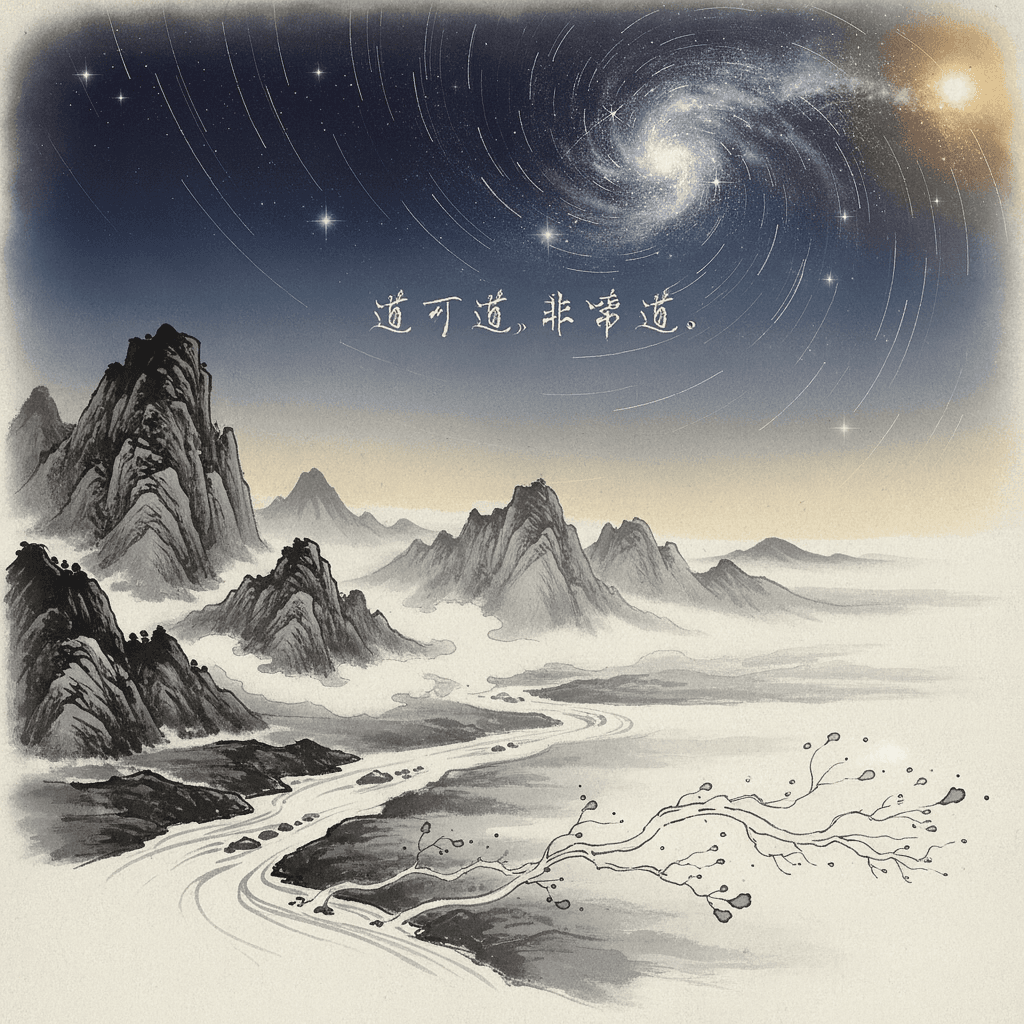
The way that can be spoken is not the eternal Way. The name that can be named is not the eternal Name. Nameless, it is the origin of Heaven and Earth; Named, it is the mother of all things. Thus, free from desire, one observes its mystery; With desire, one observes its manifestations. These two emerge together but differ in name— Both are called profound. Profound and ever more profound, It is the gateway to all wonders. - Laozi
—What lingers after this line?
The Unsayable Nature of the Dao
Laozi’s opening claim is deliberately disorienting: the Way that can be spoken is not the enduring Way (Daodejing, ch. 1). Language arrests the motion of reality, pinning flowing life to stable signs. Like a finger pointing at the moon, words can indicate but never become the light they denote. Philosophers across ages have echoed this caution; Wittgenstein’s Tractatus ends, “Whereof one cannot speak, thereof one must be silent” (1921). Yet Laozi does not ban speech; he relativizes it. Names are tools to navigate experience, not thrones to enthrone as ultimate truth. This apophatic stance inoculates us against idolatry of concepts: we may use language deftly while remembering that the living source remains beyond it.
Nameless Origin, Named Mother
Having set the limits of language, Laozi sketches a cosmogony: the Nameless is the origin of Heaven and Earth; the Named is the mother of all things. The Nameless hints at undifferentiated source—pure potential—while the Named signals differentiation, relation, and generative order. In other words, the world of forms is not false; it is motherhood, a continual birthing of patterns. Zhuangzi captures this intimacy without splitting self and cosmos: “Heaven and earth and I were born together” (Zhuangzi, ch. 2). Thus, naming is neither mere illusion nor ultimate reality; it is the maternal process by which the ten thousand things become legible, even as their root remains wordless.
Desireless Seeing and Desiring Seeing
From origin, Laozi turns to perception: free from desire, one observes mystery; with desire, one observes manifestations. Desire focuses attention, letting us grasp particulars—useful for craft and survival—yet it also narrows the field. By contrast, desireless seeing relaxes the grip of preference, revealing background harmonies that desire often eclipses. Zhuangzi calls this fasting of the mind, a practice of emptying so that “the spirit gathers” (Zhuangzi, ch. 4). Consider a forest walk: the botanist’s trained desire sees species, while a quieted gaze senses wind, light, and interdependence. Both perceptions are valid; Laozi simply clarifies that different orientations disclose different layers of reality.
Two Aspects, One Profound Depth
Laozi then reconciles what might seem opposed: these two—mystery and manifestation—arise together yet differ in name; both are called profound. The term xuan suggests a dark richness, like ink so deep it shimmers. Their togetherness recalls Daoist polarity: yin and yang are not enemies but mutual completions. Elsewhere, the text says, “Dao produces One; One produces Two…” (Daodejing, ch. 42), evoking a cascade where unity blossoms into difference without ceasing to be unity. The double profundity—“ever more profound”—is a reminder that the world’s surfaces and depths interpenetrate. Attuning to this simultaneity opens the promised threshold: the gateway to wonders.
Entering the Gateway: Practice and Flow
How does one step through? Daoism points to wuwei—effortless action—where skill and situation fit like hand to glove. Zhuangzi’s Cook Ding describes learning to carve by spirit, not brute force: “Perception and understanding have come to a stop; my spirit moves where it wants” (Zhuangzi, ch. 3). This is not passivity; it is precise responsiveness, guided by the grain of things. In such flow, desire is not eliminated but quieted, allowing the mystery to guide the knife through the seams of manifestation. The result feels wondrous because action aligns with the world’s own articulations, revealing unity in the midst of multiplicity.
Echoes Across Traditions and Modern Insight
Laozi’s insight reverberates widely. Pseudo-Dionysius counsels a via negativa, naming God by un-naming, lest words limit the limitless (Mystical Theology, c. 5th–6th c.). Nagarjuna’s Middle Way dissolves conceptual extremes, showing dependent arising as emptiness—appearance without fixed essence (Mulamadhyamakakarika, c. 2nd c.). Even modern thinkers caution humility: Korzybski’s reminder that “the map is not the territory” (Science and Sanity, 1933) mirrors Laozi’s opening lines. Taken together, these voices do not reject articulation; they teach us to hold names lightly. In doing so, we preserve access to both the mystery and its manifestations—and so keep open the gateway to all wonders.
One-minute reflection
Where does this idea show up in your life right now?
Related Quotes
6 selectedThe Dao is empty; in use it is never exhausted. Deep and unfathomable, it seems to be the ancestor of the myriad things. It blunts what is sharp, unravels what is tangled, softens its light, and mingles with the dust. Clear and still, it seems to be there. I do not know whose child it is; it appears to have preceded the Lord of Heaven. - Laozi
Lao Tzu
Laozi opens with an image of emptiness that is not lack but capacity. In Daodejing 4, the Dao is likened to a well drawn upon yet never depleted.
Read full interpretation →The ultimate mysteries are opened only to those who have immense patience. — Osho
Osho
Osho’s statement begins with a simple but demanding premise: the deepest truths do not yield to force. In this view, mystery is not a puzzle to be solved quickly but a reality that unfolds on its own terms.
Read full interpretation →The magic is in the mystery. — Henry Miller
Henry Miller
This quote highlights that the sense of wonder and enchantment exists in the unknown. It is the mysteries of life that evoke curiosity and excitement, making existence magical.
Read full interpretation →The future is dark, which is the best thing the future can be. — Toni Morrison
Toni Morrison
To begin, calling the future “dark” reframes uncertainty as freedom rather than doom. Darkness here is not a moral verdict but a description of what is not yet illuminated—what has not hardened into inevitability.
Read full interpretation →Heaven and Earth are not benevolent: they regard the myriad things as straw dogs; the sage is not benevolent: he regards the common people as straw dogs.
Lao Tzu
At the outset, the line jars modern readers because “not benevolent” seems to deny ordinary morality. In the Daodejing (ch.
Read full interpretation →By not exalting the worthy, the people are not contentious; By not valuing rare treasures, the people do not steal; By not displaying what is desirable, the hearts of the people remain calm. Therefore, the Sage governs by emptying their minds and filling their bellies, Weakening their ambitions and strengthening their bones. He always keeps the people free from knowledge and desire, And ensures that the clever dare not act. Practice non-action, And there is nothing that cannot be governed. - Laozi
Lao Tzu
This passage, commonly aligned with Tao Te Ching, chapter 3, sketches a governing philosophy that cools desire rather than inflaming it. By not exalting the worthy or parading rare treasures, the ruler removes the fuel o...
Read full interpretation →More From Author
More from Lao Tzu →If you want to be out front, then act as if you were behind. — Lao Tzu
Lao Tzu’s saying begins with a paradox: to move ahead of others, one must behave as though one is behind them. Rather than urging weakness or hesitation, the quote points to a subtler form of strength—leadership that doe...
Read full interpretation →Do you have the patience to wait until your mud settles and the water is clear? — Lao Tzu
Lao Tzu’s question frames patience not as passive delay but as an active kind of wisdom. The image of muddy water settling on its own suggests that confusion often clears not through force, but through restraint.
Read full interpretation →Anything that is living must have a rest. If it does not rest, it will lose its strength. — Lao Tzu
Lao Tzu’s insight begins with a simple observation: all living things move in cycles, not in endless exertion. By saying that anything alive must rest, he frames rest not as laziness but as a biological and spiritual nec...
Read full interpretation →Yield and overcome, bend and be straight. — Lao Tzu
At first glance, Lao Tzu’s line seems contradictory: how can yielding lead to overcoming, or bending result in straightness? Yet this paradox lies at the heart of Taoist thought.
Read full interpretation →